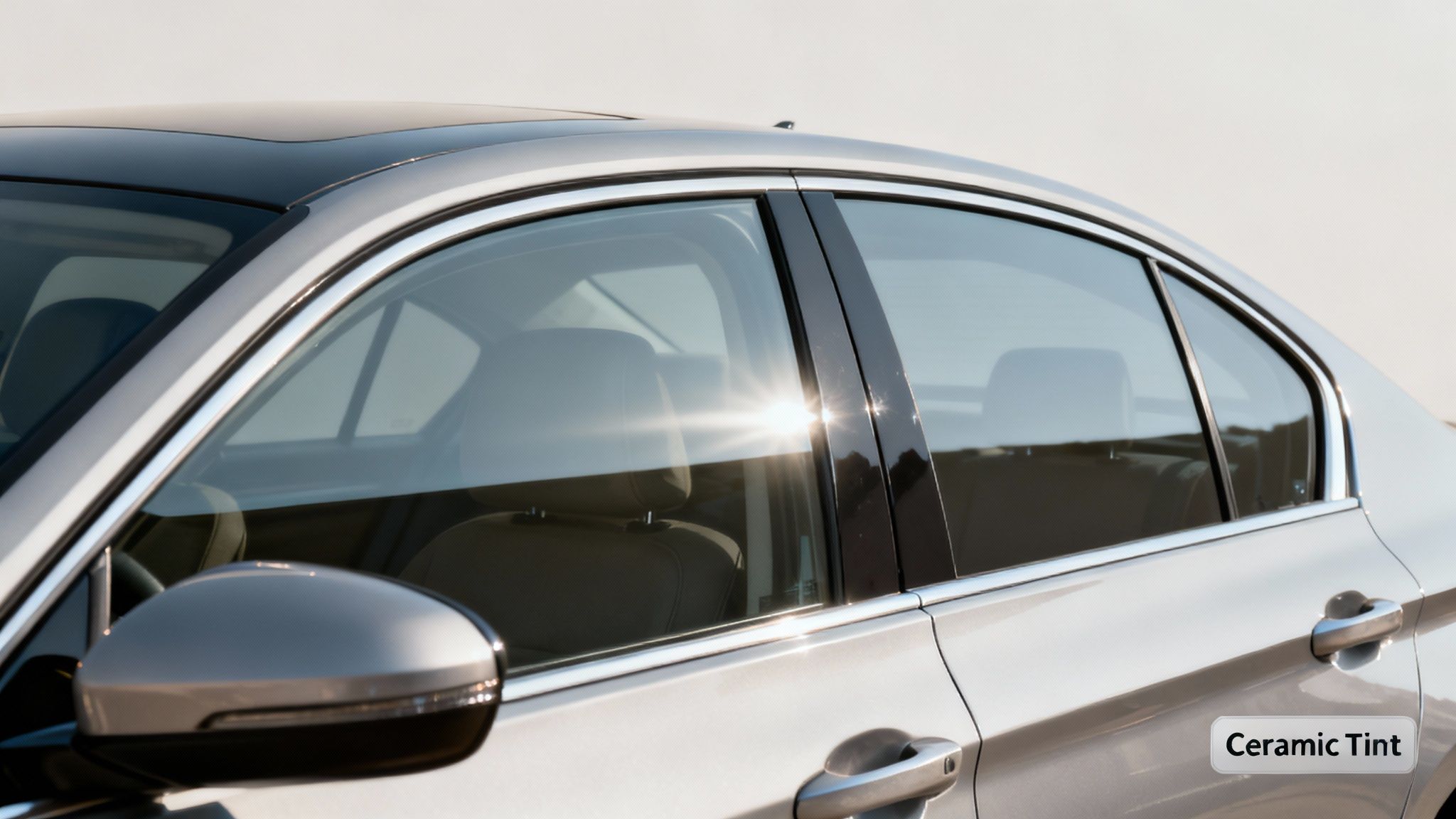
When you're looking for the best window tint for heat reduction, there's one clear winner: ceramic window tint. This isn't just about making your car windows dark; it's about advanced film technology that delivers serious heat rejection and UV protection without the "limo tint" look. For anyone trying to survive a Georgia summer, it's the top choice for keeping your car's interior comfortable.
Your Quick Guide to the Best Heat Reducing Tints
Trying to figure out automotive window tinting can feel a little overwhelming, but it gets a lot simpler once you know a few key terms. When your main goal is to cut down the heat in your car, truck, or SUV, you need to look at the technology, not just how dark the film is. For our customers here in Marietta and Kennesaw, getting a handle on these concepts is the first step toward a much cooler drive.
The right film can completely change your vehicle's cabin from an oven into a comfortable retreat. Think of it as an investment. A quality heat-reducing tint not only makes you more comfortable but can also significantly help your car's AC system work more efficiently.
Core Metrics for Heat Rejection
To make a smart choice for your car, you really only need to focus on three critical performance numbers:
- Total Solar Energy Rejected (TSER): This is the big one for heat reduction. TSER tells you the total amount of solar energy—that's UV, visible light, and infrared—that the window film blocks. A higher TSER percentage means a cooler car. Simple as that.
- Infrared Rejection (IR): Infrared rays are what you actually feel as heat on your skin. High-performance films, especially ceramics, are incredible at blocking IR light, which leads to a massive drop in cabin temperature.
- Visible Light Transmission (VLT): This is all about how much visible light gets through the tinted window. It determines the shade or darkness of the tint and is what the Georgia state law regulates.
Ceramic window tints are the undisputed champions here, capable of rejecting up to 90% of infrared radiation. That translates to slashing the heat transfer through your car windows by 50-70%.
These films are packed with non-conductive nanoparticles that block 99% of damaging UV rays without messing with your GPS, cell phone, or radio signals—a must-have for any modern vehicle.
To help you keep these terms straight, we put together a quick reference guide.
Key Heat Reduction Tint Metrics at a Glance
This table breaks down the essential terms you’ll encounter when choosing an automotive tint for maximum heat rejection in Georgia.
| Metric | What It Measures | Why It Matters for Your Car in Georgia |
|---|---|---|
| TSER | Total percentage of solar energy blocked | The best overall indicator of how well a tint will keep your car cool. |
| IR Rejection | Percentage of heat-causing infrared rays blocked | Directly impacts how much heat you feel, making rides more comfortable. |
| VLT | Percentage of visible light that passes through | Determines the tint's darkness and ensures compliance with Georgia laws. |
Understanding TSER, IR, and VLT puts you in the driver's seat, allowing you to choose a film based on real performance data, not just looks.
How Automotive Window Tints Block Solar Heat
To pick the best window tint for beating the heat, you first have to know what you’re up against. The sun’s energy comes at your car in three different ways, and they all work together to create that sweltering interior you dread on a hot Georgia day.
The sunlight cooking your vehicle is a mix of:
- Ultraviolet (UV) Light: You can’t see it, but this is what fades your car’s upholstery, cracks the dashboard, and damages your skin over time.
- Infrared (IR) Light: This is the part of the solar spectrum you actually feel as heat. If you want to cool down your truck or SUV, blocking IR rays is the most direct way to do it.
- Visible Light: This is the light we see. Its intensity creates brightness and that frustrating glare when you’re trying to drive.
A lot of people think that a darker tint automatically means a cooler car. But modern window tinting technology shows that real performance comes from the film’s material science, not just its shade. The best films are engineered to selectively target and block the parts of the solar spectrum that actually produce heat.
The Science of Heat Rejection
Different types of automotive window films use completely different methods to handle solar energy. Once you understand how they work, it becomes clear why some tints run circles around others, especially when it comes to pure heat reduction.
A basic dyed window tint, for instance, mainly works by absorption. The dark dye in the film literally soaks up a chunk of the solar energy, stopping it from passing right into your car. While this helps a little with heat and a lot with glare, the film itself gets hot and radiates that heat into the cabin. Its effectiveness is limited.
High-performance films, on the other hand, play a different game entirely.
Key Takeaway: The best window tints don't just absorb heat—they actively reject it. Top-tier films are engineered to reflect or scatter specific wavelengths of solar energy, stopping them from ever getting inside your car. This is the critical difference between a simple cosmetic tint and a real heat-blocking solution.
How Different Films Manage Heat
The technology baked into the film is what determines how well it performs. For car owners here in Marietta and Kennesaw, choosing a film based on its heat rejection method is the key to a much cooler and more comfortable drive.
Here’s a quick breakdown of how the main tint technologies work:
- Dyed Films: Like we mentioned, these films use absorptive dyes. They're easy on the wallet and good for privacy, but they offer the lowest level of heat rejection because the film itself gets hot and radiates that heat inside.
- Metallic Films: These films have tiny metal particles that act like a mirror, reflecting solar energy away from your vehicle before it has a chance to be absorbed. They’re pretty good at rejecting heat, but they have one huge flaw: the metal can interfere with your cell phone, GPS, and radio signals.
- Carbon Films: Instead of metal, these films use carbon particles, which are fantastic at absorbing and dispersing heat. They’re much more durable than dyed films and provide better IR heat rejection without the signal interference you get from metallic tints.
- Ceramic Films: This is the undisputed champion of heat rejection. Ceramic films are made with non-metallic, non-conductive ceramic nanoparticles. They are spectrally selective, which is a fancy way of saying they are engineered to block a massive amount of infrared light—up to 96%—while still letting visible light through. This technology gives you maximum heat reduction without needing a super-dark look or causing any signal interference, making it the best all-around choice for any vehicle.
Comparing the Top Tints for Heat Rejection
When you’re looking for the best window tint to beat the Georgia heat, the conversation almost always lands on two technologies: carbon and ceramic films. Both are a huge step up from the old-school dyed tints, but they work very differently and offer unique advantages for drivers. Instead of just listing pros and cons, let's break down how they actually perform when the sun is blazing.
This decision tree helps visualize the best path to maximum heat rejection, showing why ceramic tint is the go-to for blocking all types of solar energy.
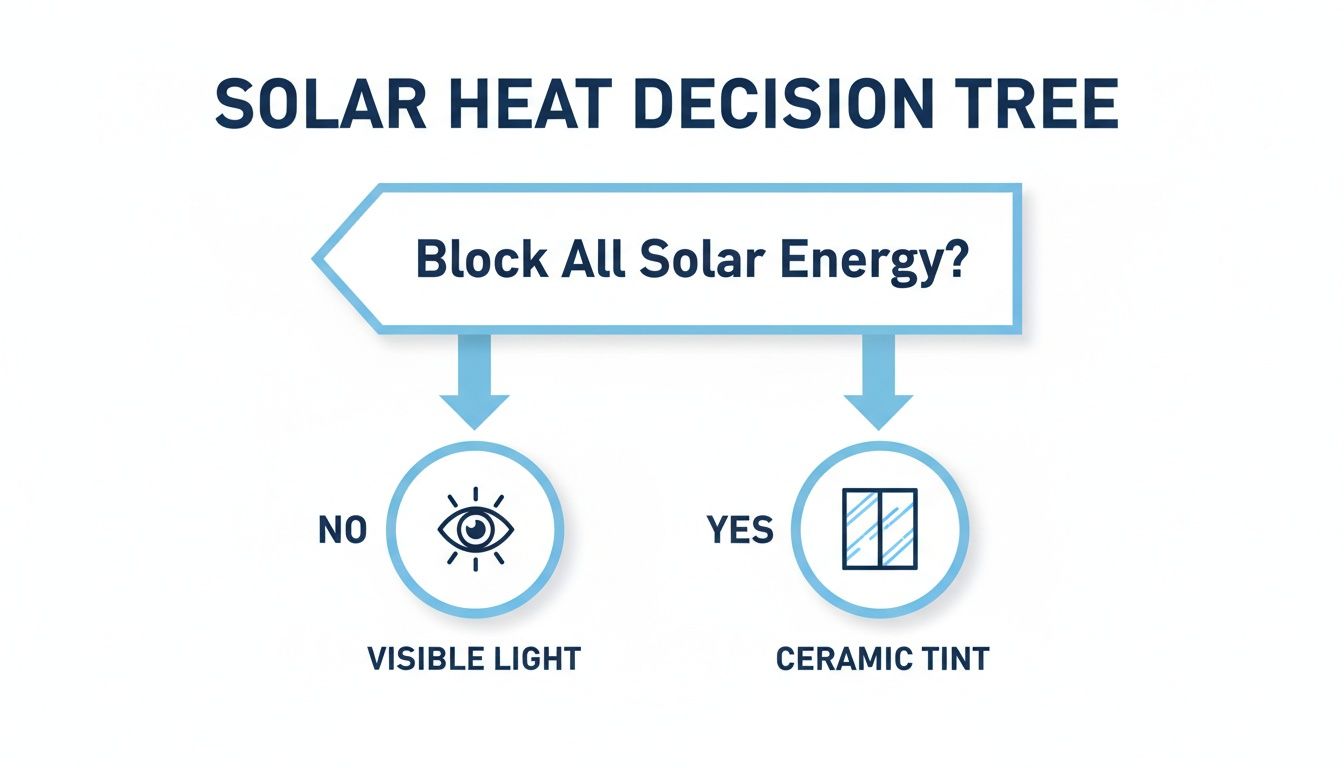
As the graphic illustrates, if your main goal is blocking the most solar energy—not just visible light—ceramic is the technology built for the job.
Carbon Film: The Dependable Performer
Carbon window tint was a major leap forward from older film technology. It's made with microscopic carbon particles infused directly into the film, which are fantastic at absorbing and scattering solar energy. This absorption method is far more effective at stopping heat than a simple dyed film ever could be.
The result is a tint that gives you solid heat reduction and won't turn that dreaded shade of purple over time—a classic sign of a cheap, failing dyed film. Carbon tint also has a rich, matte-black finish that looks incredible on any vehicle. Critically, it’s a 100% metal-free film, so you never have to worry about it interfering with your GPS, cell phone, or satellite radio signals.
For drivers in Marietta or Kennesaw who want a durable, effective, and signal-friendly option without breaking the bank, carbon is a fantastic choice. It delivers reliable performance that makes every drive more comfortable.
Ceramic Film: The Ultimate Heat-Blocking Technology
While carbon tint is a great product, ceramic window tint is the undisputed champion of heat rejection. This is simply the best technology available for automotive window tinting, designed from the ground up to attack infrared (IR) heat—the part of the solar spectrum that you actually feel as heat on your skin.
Ceramic film is built using non-conductive, non-metallic ceramic nanoparticles. This advanced construction makes the film "spectrally selective," a fancy way of saying it can target and block a massive amount of IR radiation without having to be dark. A high-quality ceramic tint can reject up to 96% of infrared heat, which makes an immediate and dramatic difference in your car's interior temperature.
Key Differentiator: The magic of ceramic tint is its power to block infrared heat without relying on darkness. A legally light ceramic film can easily outperform a limo-dark carbon or dyed film. You get superior comfort, crystal-clear visibility, and full compliance with Georgia tint laws.
This level of performance is why premium automotive tinting is so effective. Top-tier window films can block up to 97% of infrared light, turning your vehicle into a cool oasis and cutting solar heat entry by up to 60%.
Ceramic vs. Carbon Tint: A Performance Showdown
To make the choice even clearer, let’s put these two films head-to-head on the factors that matter most to drivers of cars, trucks, and SUVs.
This table gives you a direct comparison to help you decide which automotive tint is the best fit for your heat reduction goals and overall needs.
| Feature | Ceramic Window Tint | Carbon Window Tint |
|---|---|---|
| Infrared Heat Rejection | Exceptional (Up to 96%). The best you can get for feeling cooler. | Good. A significant upgrade over dyed and metallic films. |
| UV Protection | Excellent (99%+). Protects your skin and vehicle interior. | Excellent (99%+). Offers the same top-tier UV blocking. |
| Clarity & Visibility | Superior. Offers crystal-clear views with no haze, even at an angle. | Very Good. Provides clear visibility without distortion. |
| Signal Interference | Zero. Contains no metal particles to disrupt electronics. | Zero. Also a non-metallic film, ensuring clear signals. |
| Durability & Lifespan | Extremely Durable. Resists fading, scratching, and discoloration. | Very Durable. More stable and long-lasting than dyed films. |
| Cost | Premium Investment. Higher upfront cost for superior performance. | Mid-Range Price. More affordable than ceramic but pricier than dyed. |
At the end of the day, both options give you fantastic UV protection and won't mess with your electronics. If your primary mission is getting the absolute best window tint for heat reduction, ceramic film is the hands-down winner. Its ability to reject infrared heat is unmatched in the industry. For a deeper dive into the science, check out our guide on the ceramic tint benefits.
But if you're looking for a serious performance boost at a more moderate price point, carbon tint is a reliable workhorse that will keep your vehicle cool and comfortable for years to come.
Staying Compliant with Georgia Window Tint Laws
Choosing the right window tint is about more than just beating the Georgia heat. You also have to make sure your choice is legal. The last thing anyone wants is the hassle and expense of a ticket for a tint that’s too dark.
Fortunately, Georgia's laws are pretty straightforward, and with today's advanced film technology, you don't have to choose between a cool car and a legal one. Here at The Tint Guy, we make sure every single car tint job leaving our Marietta and Kennesaw shops is 100% compliant, giving you total peace of mind.
The main thing Georgia law cares about is Visible Light Transmission (VLT). This is just a fancy way of saying how much light the film allows to pass through your windows.
Georgia VLT Limits for Sedans
If you drive a standard passenger car—think sedans, coupes, or hatchbacks—the law is consistent across most of your vehicle:
- Front Side Windows: Must let in more than 32% of light.
- Back Side Windows: Must let in more than 32% of light.
- Rear Windshield: Must also let in more than 32% of light.
That 32% VLT is the magic number for car owners. It strikes a good balance between privacy and ensuring law enforcement can see inside the vehicle, which is the main reason these laws exist.
Georgia VLT Limits for Trucks and SUVs
For those of us driving trucks, SUVs, or vans, the rules are a bit more flexible for the back half of the vehicle:
- Front Side Windows: The rule is the same as for cars—they have to let in more than 32% of light.
- Back Side and Rear Windows: Behind the driver, you can go as dark as you want. Any VLT is fair game.
This difference is a big deal, as it allows for much better privacy and security if you're carrying tools, gear, or valuables in the back. But the front windows, which are critical for a driver's clear view, are still held to that same 32% VLT standard. For a deeper dive, check out our complete guide to Georgia's auto window tinting laws.
The bottom line is this: the legal limit for front side windows on ALL passenger vehicles in Georgia is 32% VLT. It's the one number you absolutely have to get right for a street-legal tint.
Now for the good news. You don't need an illegally dark tint to get incredible heat rejection. This is where modern film technology makes all the difference. A high-end ceramic tint at a perfectly legal 32% VLT will block way more heat than a cheap, dark dyed film.
It's because ceramic films are engineered to specifically target and block infrared rays—the invisible light that actually creates heat. Their heat-blocking power isn't tied to how dark they are. This lets our customers in Marietta and Kennesaw get a cooler, more comfortable ride while staying well within the lines of Georgia law. When you go with a professional installation and a quality ceramic film, you truly get the best of both worlds.
Why Professional Installation Maximizes Heat Rejection
Picking a high-performance ceramic film is the most important step for beating the heat, but it’s only half the battle. That film's incredible heat-blocking potential can be completely wasted without a flawless installation. Getting it done by a pro isn't a luxury; it's the only way to guarantee your car window tint performs exactly as it was engineered to.
The difference between a professional job and a DIY attempt is night and day. Even the smallest installation flaw—a trapped speck of dust, a tiny air bubble, or a slightly crooked edge—creates a weak point. These imperfections don't just look terrible; they compromise the film's integrity, leading to premature peeling, bubbling, and a serious drop in heat rejection performance.
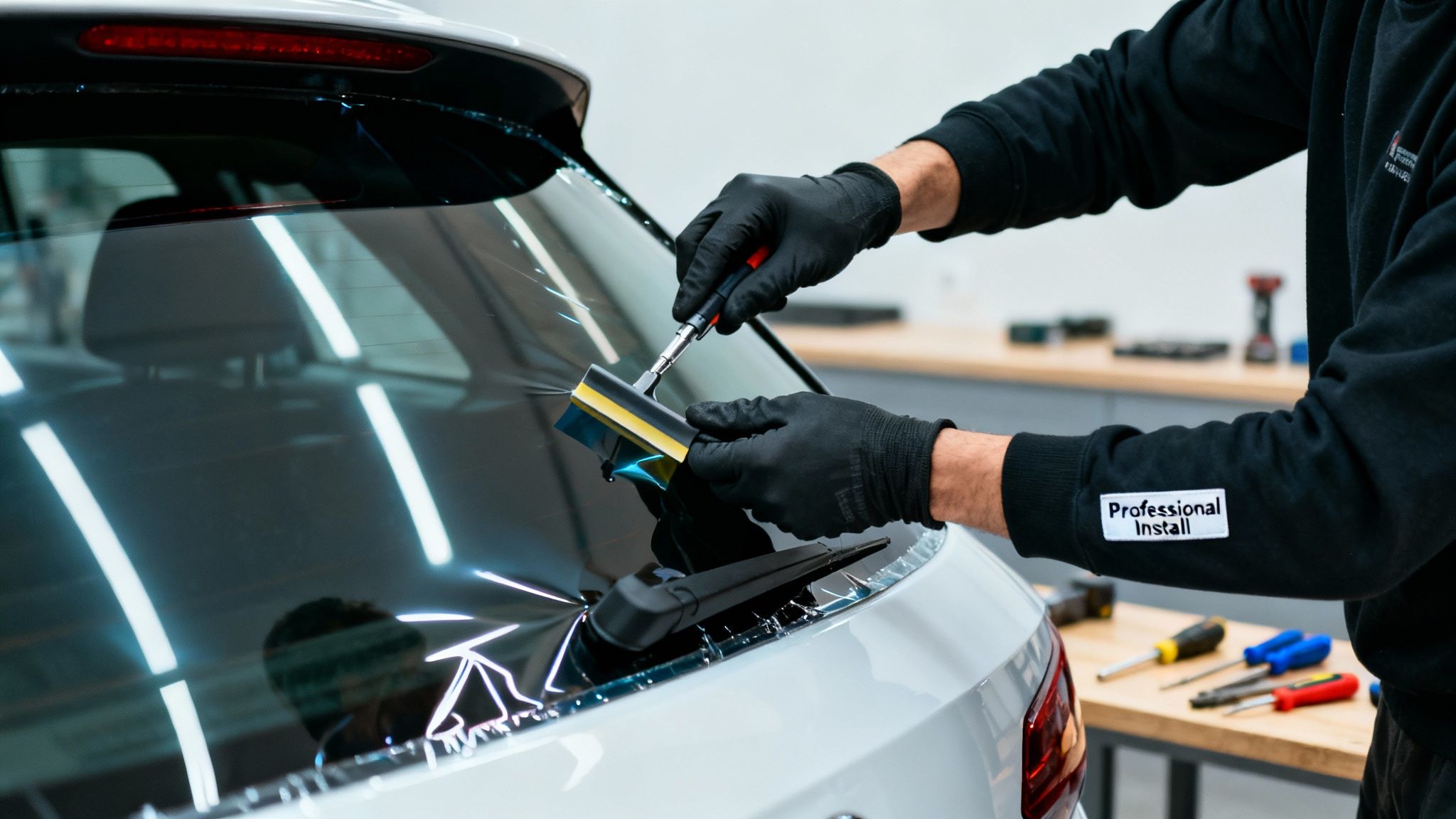
The Anatomy of a Perfect Tint Application
At The Tint Guy, our process is built on decades of hands-on experience and an obsession with precision. We know that to get the most out of your investment, you need an environment and a methodology that leave zero room for error. This meticulous approach is how we ensure every car, truck, and SUV leaves our shops ready to deliver peak performance.
Our professional installation process breaks down into several critical stages:
- Immaculate Surface Preparation: We start by deep-cleaning every inch of the glass, inside and out. Using specialized tools and solutions, we remove microscopic contaminants that could otherwise get trapped under the film.
- Computer-Cut Film Plotting: We use advanced software to precisely cut the tint film to the exact specifications of your vehicle’s make and model. This computer-aided process eliminates the risk of human error and ensures perfect, gap-free coverage.
- Controlled Installation Environment: Our dedicated installation bays in Marietta and Kennesaw are designed to be clean, well-lit, and climate-controlled. This setup minimizes airborne dust and particles, which are the number one cause of those ugly contamination bubbles.
- Expert Application and Curing: Our technicians use proven techniques to apply the film smoothly, forcing out every bit of moisture and air. We then walk you through the proper curing process—a crucial final step for a lasting bond.
The High Cost of DIY Pitfalls
Trying to install a high-performance tint yourself usually ends in frustration and wasted money. The specialized tools, clean environment, and steady hand required just aren't available in a typical home garage.
Expert Insight: The single biggest mistake we see in DIY tinting is improper surface cleaning. A single hair or dust particle trapped under the film will eventually grow into a large bubble as the adhesive fails around it, ruining both the look and the heat-blocking function of your tint.
Common DIY failures include:
- Bubbling and Lifting: Caused by trapped air and moisture.
- Creasing and Wrinkling: A result of improper handling and squeegee technique.
- Contamination: Specks of dust and hair creating visible blemishes under the film.
- Peeling Edges: Happens when the film isn't cut precisely or sealed correctly.
Sun control films are a powerhouse for automotive efficiency, capable of blocking up to 60% of solar heat gain while filtering over 99% of UV rays. By investing in professional installation, you make sure you get every ounce of that proven performance. You can learn more about our methods by exploring our complete automobile window tinting process.
Ultimately, a professional install protects your investment with a solid warranty and guarantees your tint will look great and perform at its best for years to come.
Ready to Beat the Heat? Here's Our Recommendation
When you start digging into the world of car window tint, it's easy to get bogged down in the details. But after years of seeing what works best in the brutal North Georgia heat, one technology consistently comes out on top for our customers: ceramic window tint.
This isn't about just making your windows dark. Ceramic films are engineered to aggressively target and reject infrared heat—the invisible energy you actually feel baking your car's interior. This means you get incredible heat reduction without needing a super-dark, limo-style tint, keeping you comfortable while staying well within Georgia's legal limits. It's a smart investment that pays off every time you get behind the wheel.
Your Local Automotive Tinting Experts
We’ve been tinting cars here in North Georgia since 1986. That's a lot of summers and a lot of happy, cooler customers. Decades of hands-on experience have taught us exactly which films stand up to the Georgia sun and how to match the right product to each driver's needs. We don't just sell you a roll of tint; we talk with you, listen to what you're looking for, and recommend the perfect solution for your vehicle.
Our entire team is here to walk you through the options and show you the real-world difference between film types. We find that when a customer truly understands what they're getting, they're always happier with the result. Our goal is to make sure you drive away confident you've made the absolute best choice for your car's comfort, protection, and style.
At The Tint Guy, we only do one thing: automotive tinting. This specialized focus means we've perfected our craft, delivering flawless results that last, all backed by a rock-solid warranty.
Get Started at Our Marietta or Kennesaw Shops
Upgrading your ride for a cooler, more enjoyable drive is easier than you think. Our shops in Marietta, GA, and Kennesaw, GA, are set up to give you a seamless and professional installation from start to finish. We pair the industry's best films with meticulous craftsmanship to ensure your new tint looks and performs perfectly.
Don’t suffer through another sweltering season. Let our experts upgrade your driving experience with the best heat-blocking technology available. You'll protect your interior from fading, cut down on blinding glare, and finally enjoy a cooler cabin every time you open your car door.
Ready to feel the difference? Let's get started.
Call for a Free Tint Consultation or Schedule Your Tint Appointment online. We look forward to helping you out
Answering Your Top Questions About Heat Reduction Tints
Even after digging into the tech, most drivers still have a few questions before pulling the trigger on new car tint. We get it. To help out, we've put together answers to the most common things we're asked by car, truck, and SUV owners at our Marietta and Kennesaw shops.
How Much Does High-Performance Ceramic Window Tint Cost?
The final price tag for ceramic tint really depends on your vehicle and the specific film you go with. It's definitely a premium option compared to standard films, but that price reflects its incredible heat rejection, 99% UV protection, and the fact that it's built to last for years.
Think of it less as a cost and more as an investment in your daily comfort and your car's interior. For a number that's specific to your vehicle, the best bet is to contact The Tin Guy in Marietta or Kennesaw for a quick, no-pressure quote. We'll walk you through the options and find something that hits the mark for your budget and what you want out of your tint.
Will a Darker Tint Block More Heat?
Not always—and this is probably the biggest myth in the tinting world. A film's power to reject heat comes from its technology, not its darkness.
A high-quality, lighter ceramic film engineered to block infrared radiation will blow a very dark, cheap dyed film out of the water when it comes to heat rejection. Our job is to help you pick a tint that’s perfectly legal in Georgia but still gives you the best possible heat reduction, all without making it hard to see at night.
Expert Answer: Performance all comes down to the film's TSER (Total Solar Energy Rejected) and IR (Infrared Rejection) ratings. Modern ceramic films are champs in these areas, even at lighter VLTs, making them the perfect solution for Georgia's climate and tint laws.
We can actually show you how a legal 32% VLT ceramic tint easily outperforms a darker, lower-quality film. You get maximum comfort with zero legal headaches.
How Long Does a Professional Tint Installation Take?
Our installation process is thorough but efficient, aimed at getting you a perfect result. For most cars, trucks, and SUVs, you can expect the entire window tinting job to take somewhere between 2 to 4 hours.
That window of time gives our technicians the space to properly prep the glass, apply the computer-cut film with precision, and do a final quality check to make sure everything is flawless. We work hard to get the job done right and get you back on the road, knowing your tint is perfect and built to last.
Does Ceramic Tint Interfere with My Phone or GPS?
Nope, not at all. This is one of the huge advantages of choosing a modern ceramic window tint for your car.
Older metallic films were notorious for blocking or scrambling electronic signals because they contained tiny metal particles. Ceramic films, on the other hand, are made with non-conductive nanoparticles. This advanced, metal-free design means you get maximum heat rejection without messing with any of your essential devices.
With ceramic tint, you'll have:
- Clear GPS Navigation: Your maps and location services will work flawlessly.
- Strong Cell Service: Calls and data streaming won't be affected one bit.
- Uninterrupted Radio Signals: Both satellite and regular radio come in crystal clear.
This makes ceramic tint the no-brainer choice for any modern vehicle. You get top-tier comfort and performance with zero compromises.
Ready to feel the difference the best heat-blocking technology can make in your drive? The experts at The Tin Guy are here to help you find the perfect film for your car, truck, or SUV.