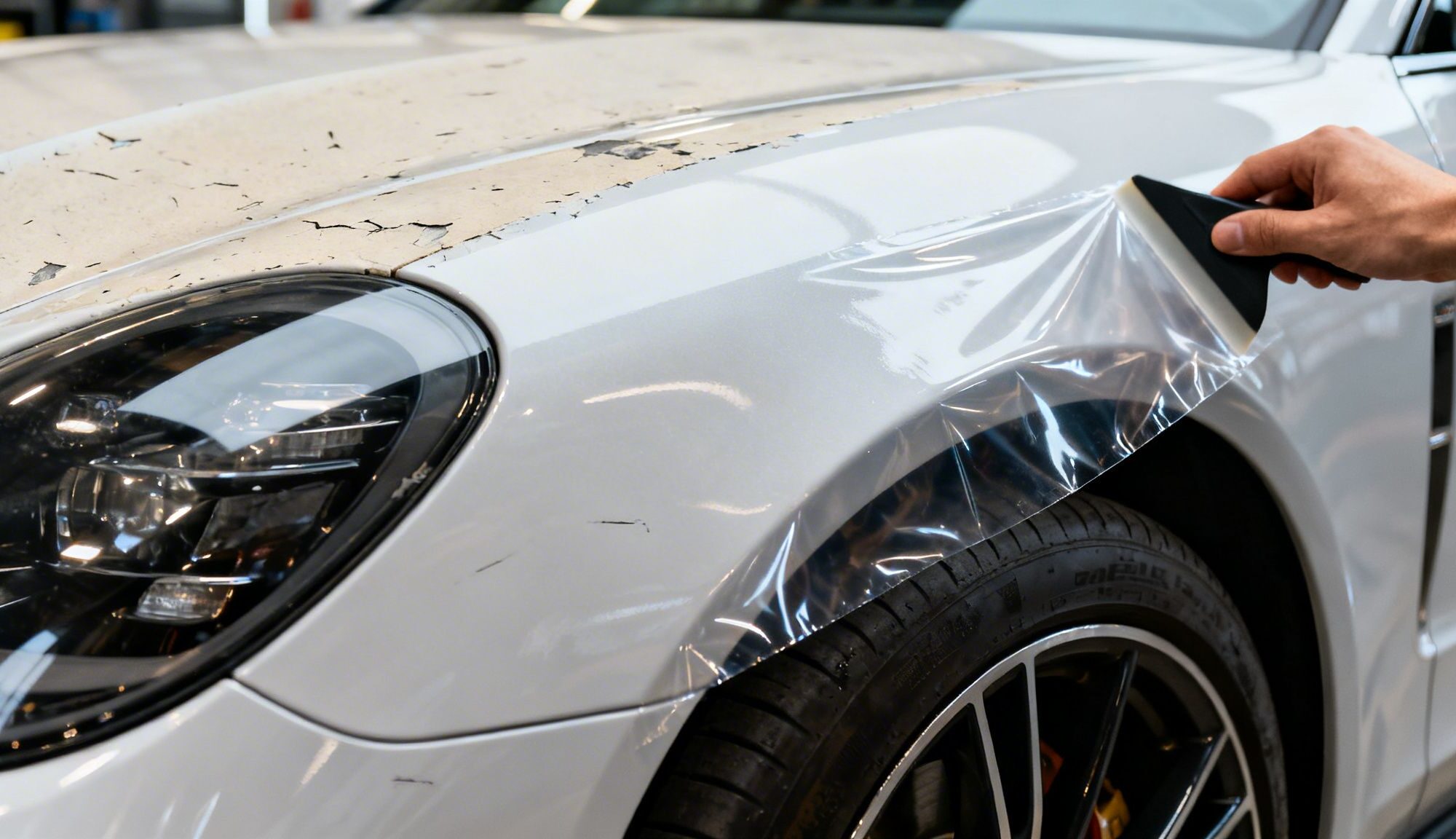
Think of Paint Protection Film (PPF) as invisible body armor for your car. It’s a transparent, incredibly durable urethane film that we apply directly over your vehicle's paint, where it acts as a sacrificial shield. Its main job is to take the hit from road debris, rock chips, and minor scuffs that would otherwise wreck your factory finish.
How This "Invisible Armor" Really Works
Paint Protection Film is way more than just a sheet of plastic. It’s a sophisticated, multi-layered system engineered from the ground up to defend your car’s paint from the daily grind. Each layer has a specific job, and together they create a resilient barrier that keeps your car looking brand new.
Whether you're cruising through Woodstock or navigating traffic in Alpharetta, this film offers serious defense. It provides a crucial buffer between your car’s delicate clear coat and all the hazards of the road. From stones kicked up on the highway to bug splatter and bird droppings, PPF takes the abuse so your paint doesn’t have to.
The real magic is in its advanced construction. Modern PPF isn't a single material but a stack of them, each with a purpose. It starts with a self-healing topcoat, which is a mind-blowing layer of elastomeric polymers. Light scratches and swirl marks literally disappear when exposed to a little heat from the sun or a heat gun.
Underneath that is the polyurethane core—the film's workhorse. This layer is exceptionally tough but flexible, allowing it to absorb and spread out the energy from an impact. That’s what stops rock chips from ever reaching your paint.
The core idea behind PPF is impact absorption. Imagine a small rock hitting your unprotected hood at 60 mph—all that force is focused on one tiny point, which is what causes a chip. With PPF, that same force gets spread across the film's flexible surface, dissipating the energy and leaving your paint perfectly unharmed.
To really see how these components work together, it helps to break down each layer and its function.
The Layers of Paint Protection Film and Their Functions
This table breaks down the core components of modern PPF, explaining the role each layer plays in protecting your automotive investment.
| Layer | Primary Function |
|---|---|
| Topcoat (Elastomeric Polymer) | Provides self-healing properties, stain resistance, and a high-gloss finish. |
| Polyurethane Film (Urethane) | Absorbs and dissipates impact energy from rocks, gravel, and other road debris. |
| Adhesive Layer (Acrylic-Based) | Creates a strong yet removable bond to the vehicle's paint without causing damage. |
| Protective Liner | Safeguards the adhesive layer from contaminants before and during the installation process. |
This multi-layer technology is precisely what makes PPF an essential investment for any car owner who wants to maintain their vehicle’s looks and protect its resale value. It’s not just a film; it’s a complete defensive system for your car’s finish.
The Science Behind a Self-Healing Invisible Shield
Ever wonder how that "invisible shield" on a car actually works? It’s not just a simple sheet of plastic; it’s a sophisticated piece of material science with multiple layers, each with a specific job. To really appreciate what PPF does, you need to understand how it’s built.
Let's start from the bottom up. The first layer that touches your car is a specialized acrylic-based adhesive. This isn't just any glue. It's formulated to grip your car's clear coat with incredible strength, ensuring it won't peel or bubble through intense heat, freezing cold, or countless car washes.
The brilliant part is that this bond is also designed for clean removal. Years down the road, a professional can lift the film off without leaving a sticky mess or, more importantly, without harming the factory paint it was put there to protect. It’s the best of both worlds: tenacious protection that can be removed without a trace.
The Impact-Absorbing Core
Sitting right above the adhesive is the film's unsung hero: the polyurethane core. This is the thickest part of the film, usually between 6 to 8 mils thick (a mil is one-thousandth of an inch), and it's where the real impact resistance comes from. Think of it as a flexible, full-body shock absorber for your car's paint.
When a rock gets kicked up and hurtles toward your bumper, this polyurethane layer flexes on impact. It catches the kinetic energy and spreads it out across a wider area, preventing that force from punching through to your paint. Instead of a deep, ugly chip, you get… nothing. That’s why PPF is the undisputed champ at stopping physical damage.
This is a great visual breakdown of the three main ways PPF guards your paint against everyday hazards.

As you can see, the film does a lot more than just stop rocks. It’s a complete defense system for your vehicle's finish.
The Magic of the Self-Healing Topcoat
The outermost layer is where things get really impressive. We call it the self-healing topcoat, and it’s made from a special type of material called elastomeric polymers. The easiest way to picture how this works is to think about memory foam. When you push your hand into it, you leave an imprint, but the foam gradually returns to its original flat shape.
The elastomeric polymers in the PPF topcoat are chemically structured to do something similar. They have a "memory" of their smooth, original state. When a light scratch or swirl mark is introduced, it disrupts the polymer network.
By applying just a bit of heat—from the sun on a warm day or even just some warm water—you give those polymers the energy they need to flow back into place. The scratch doesn't get filled in; the surface actually rebuilds itself on a molecular level, and the mark vanishes.
This self-healing ability is what keeps a PPF-protected car looking like it just rolled off the showroom floor, even after minor run-ins with car wash brushes or stray jacket zippers. If you want to get deeper into the details, check out our guide on self-healing paint protection film.
When you put all these layers together, you get a system that’s far greater than the sum of its parts.
- Strong Adhesion: Bonds securely to your car's finish but removes cleanly.
- Impact Absorption: The tough polyurethane core stops rocks and debris in their tracks.
- Self-Healing: The advanced topcoat erases light scratches and swirls with heat.
This multi-layered defense is exactly how paint protection film keeps vehicles across Woodstock and Alpharetta looking brand new for years. It's not magic, it's just really, really good science.
The Art of Professional PPF Installation

Even the most advanced paint protection film is only as good as the hands that install it. Getting that truly invisible, factory-perfect finish isn’t just about the film itself—it’s a delicate dance between cutting-edge tech and old-school craftsmanship. That’s why professional application is an absolute must. This is far from a weekend DIY project; it's a precise, multi-step process that demands a clean, controlled environment and a ton of patience.
The real work starts long before a single piece of film touches your car. The first and most critical step for any professional installer is intensive vehicle preparation. We're talking a deep decontamination wash to strip away all surface dirt, followed by a meticulous clay bar treatment. This lifts out any embedded contaminants from your paint’s microscopic pores, leaving behind a perfectly clean and smooth canvas for the film.
Think about it—any speck of dust, wax residue, or tiny particle left on the surface gets trapped under the film forever. It becomes a permanent blemish. A true professional understands that 90% of a flawless finish comes from this obsessive level of prep work.
Precision Cutting for a Perfect Fit
The days of an installer taking a razor blade and cutting film directly on your car’s paint are long gone. At least, they should be. Modern, top-tier shops like The Tin Guy use advanced software and a plotter to precision-cut film patterns tailored to your car's exact make, model, and year. A computer-aided design means every piece of PPF fits perfectly around badges, sensors, and complex body lines without a blade ever getting near your paintwork.
This method is a game-changer for a few key reasons:
- Exact Fit: The patterns are digitally mapped to your vehicle’s specific panels, ensuring total and seamless coverage.
- Safety: There is zero risk of an installer accidentally scoring or cutting your car’s factory paint.
- Seamless Edges: Computer-cut patterns allow us to wrap the film around panel edges, tucking them out of sight for a truly invisible look.
The demand for this level of quality is exploding. The global paint protection film market was valued at around USD 575.62 million in 2025 and is on track for a strong compound annual growth rate (CAGR) of 6.3% through 2035. This growth, especially in the use of advanced Thermoplastic Polyurethane (TPU) films, shows just how many car owners in the Atlanta area are investing in professional-grade protection. You can dive deeper into these market trends and see the full paint protection film research.
The Squeegee and Slip Solution
Once the film patterns are perfectly cut, the installer gets to work. First, they spray both the vehicle panel and the adhesive side of the PPF with a special "slip solution." This soapy water mix is the secret sauce that allows them to slide the film into its exact position, lining it up flawlessly with the panel’s curves and edges. It's a delicate process that requires a sharp eye and a very steady hand.
With the film in place, the real artistry begins. Using a series of specialized squeegees, the installer meticulously pushes the slip solution out from under the film. This technique is all about applying firm, consistent pressure to chase out every last air bubble and drop of water, always working from the center of the panel outwards.
Finally, the edges get special attention. An installer will often use a tack solution and a bit of heat to securely wrap the film’s edges around the body panels. This is the crucial finishing touch that prevents the edges from lifting over time and creates that seamless, undetectable finish that defines a truly professional job. To see what this level of quality looks like, check out our paint protection film services in the Atlanta area.
More Than Just Scratch Protection

Most people know paint protection film for its incredible ability to stop rock chips in their tracks. While that's its claim to fame, the real value of a quality PPF installation goes so much deeper than just physical impacts. It's a full-on defense system, guarding your vehicle's finish against a whole host of threats to keep it looking showroom-fresh for years.
Think of it like a powerful, invisible sunscreen for your car. The top layer of the film is packed with advanced UV inhibitors designed to block the sun's harsh rays. For anyone driving in the sunny climate of North Metro Atlanta, this is a huge deal. That constant UV exposure is what causes paint to oxidize and fade, leaving it looking dull and tired. PPF stops that damage cold, preserving your car’s original color and shine.
This level of protection is exactly why more and more discerning car owners are seeking out PPF. In fact, the U.S. paint protection film market is on track to hit an estimated value of USD 146.78 million by 2032. This isn't just a trend; it's a clear signal that people want real solutions to protect their cars from the elements and preserve their long-term value. You can read more about the growing demand for PPF in the automotive industry in this market analysis.
A Shield Against Chemical and Environmental Damage
Your car’s paint has to deal with a lot more than just rocks and road debris every day. There’s a constant barrage of acidic and environmental contaminants that can literally etch into your clear coat, causing permanent damage that's expensive to fix. PPF creates a non-porous, chemically-resistant barrier that stands between your paint and these hazards.
- Bird Droppings: These are incredibly acidic and can eat through a clear coat in a surprisingly short amount of time. With PPF, they never even touch your paint.
- Bug Splatter: The acidic guts of insects can bond to your paint and leave stains, especially after baking in the sun for a few hours.
- Tree Sap: That sticky mess is a pain to remove and can leave lasting blemishes on an unprotected surface.
- Hard Water Spots: Mineral deposits left behind by sprinklers or even just a bad car wash can create stubborn spots. The hydrophobic topcoat on modern PPF makes water bead up and roll right off, which seriously cuts down on spotting.
By creating this impenetrable layer, paint protection film lets you simply wipe these common nuisances away, leaving your factory finish completely unscathed.
Enhanced Gloss and Easy Maintenance
Beyond just protection, a high-quality PPF installation actually makes your car look even better. The film itself has an optically clear topcoat that adds a stunning depth and gloss to the paint. It smooths out the almost microscopic "orange peel" texture in most factory clear coats, creating a richer, wetter-looking finish that really pops.
That slick, high-gloss surface also makes keeping your car clean a whole lot easier.
The topcoat on modern PPF is inherently hydrophobic, meaning it actively repels water, dirt, and grime. This not only keeps your vehicle cleaner for longer but also makes washing a breeze. Contaminants have a harder time sticking to the slick surface, so you can spend less time scrubbing and more time enjoying your pristine ride.
Protecting Your Automotive Investment
When you add it all up, every single benefit of paint protection film leads to one key outcome: protecting your vehicle’s resale value. A car’s exterior condition is one of the biggest factors that determines what it’s worth. Scratches, rock chips, swirl marks, and faded paint can take thousands off what a potential buyer is willing to pay.
By keeping the original factory paint in flawless condition, PPF essentially acts as an insurance policy for your investment. When it's time to sell or trade in, you’re presenting a car with a perfect finish, which maximizes its value and appeal. For car owners in our local communities like Woodstock and Alpharetta, this makes PPF more than just a protective product—it's a smart financial move.
PPF vs Ceramic Coatings Which Shield Is for You?
If you're a car owner in Roswell or Marietta, choosing the right paint protection can feel like a big decision. Two names constantly pop up in the conversation: Paint Protection Film (PPF) and ceramic coatings. Figuring out the key differences is the first real step to making a choice you’ll be happy with for years to come.
The easiest way to understand the distinction is with a simple analogy. Think of PPF as your car’s physical armor and a ceramic coating as its hardened, super-slick force field. PPF is a thick, durable film made to absorb the kinetic energy from rock chips and stop deep scratches. A ceramic coating, on the other hand, creates a chemically bonded, non-porous layer that's amazing at repelling dirt and water while adding an unbelievable gloss.
Head-to-Head Comparison: PPF vs. Ceramic Coating
Both products offer fantastic protection, but they really shine in different situations. To help you decide what’s truly best for your vehicle and driving habits, we've broken down their core functions in a head-to-head comparison.
Paint Protection Film (PPF) vs. Ceramic Coating
A head-to-head comparison to help you choose the right paint protection for your vehicle.
| Feature | Paint Protection Film (PPF) | Ceramic Coating |
|---|---|---|
| Impact Resistance | Superior. Absorbs energy from rocks, gravel, and road debris to prevent paint chips. | Limited. Offers minor resistance to very light scratches but will not stop a rock chip. |
| Self-Healing | Yes. Top-tier films use heat to make light scratches and swirls disappear. | No. Scratches in a ceramic coating are permanent and must be polished off. |
| Chemical Resistance | Good. Resists stains from bird droppings, bug splatter, and tree sap. | Excellent. Creates a hard barrier against chemicals, UV rays, and environmental fallout. |
| Hydrophobics | Good. Modern films repel water, but this is not their primary function. | Superior. Creates extreme water beading, making the vehicle much easier to clean. |
| Visual Finish | Adds gloss and depth while being virtually invisible. | Adds a deep, candy-like gloss that significantly enhances the paint's appearance. |
It's no surprise that so many car owners are turning to these solutions. The global paint protection film market is set to grow from USD 537.4 million in 2023 to USD 971.5 million by 2033, climbing at a steady 6.1% annual rate. This trend shows just how many people are investing in advanced materials like Thermoplastic Polyurethane (TPU) for real-world protection. You can read more about these findings in the full PPF market report.
The Ultimate Combination: The Best of Both Worlds
Here’s a secret the pros have known for years: you don’t always have to pick just one. For the ultimate in automotive protection, the best strategy is often using both PPF and ceramic coatings together. This powerful duo delivers a comprehensive defense that neither one can achieve on its own.
The most popular approach is to install PPF on high-impact areas of the vehicle—like the front bumper, hood, fenders, and side mirrors—and then apply a professional-grade ceramic coating over the entire car, including the film.
This layered approach gives you everything you could want:
- Unbeatable Impact Protection: The PPF takes the hits from rocks and debris on the most vulnerable parts of your car.
- Extreme Gloss & Slickness: The ceramic coating goes over the top, adding a brilliant shine and a super hydrophobic surface.
- Effortless Maintenance: With a ceramic coating on everything, dirt and grime have nowhere to stick, making wash day a breeze.
By combining these two technologies, you get the tough, physical armor of PPF exactly where you need it, paired with the slick, easy-to-clean, and ultra-glossy finish of a ceramic coating everywhere else. It’s the definitive way to protect your investment from just about every threat the road can throw at it. If you're still weighing your options, you'll find even more detail in our in-depth comparison of PPF vs. ceramic coatings.
Why Trust The Tin Guy for Your PPF Installation
Your car is a massive investment, and protecting it right means handing the keys to a true automotive specialist. When it comes to something as intricate as Paint Protection Film, settling for a generalist just won't cut it. At The Tin Guy, we live and breathe automotive services—we don't do residential or commercial jobs.
This sharp focus means our entire team has honed their skills on the specific curves and challenges of cars, trucks, and SUVs. We’re not jacks-of-all-trades; we are automotive protection pros serving the North Metro Atlanta area. Our clients from Woodstock to Marietta come to us because they know every vehicle in our shop gets our complete, undivided focus and a fanatical level of detail.
A Commitment to Craftsmanship and Quality
A perfect PPF job is about so much more than just the film. The real magic is in the obsessive prep work and a flat-out refusal to cut corners. Our technicians know that a truly invisible finish can only be achieved on a perfectly decontaminated surface, which is why our prep process is second to none.
We match that meticulous work ethic with the absolute best materials on the market. Our promise to you includes:
- World-Class Film Brands: We only work with PPF from industry leaders celebrated for their incredible clarity, advanced self-healing properties, and proven long-term durability.
- Computer-Cut Precision: We use state-of-the-art software and a plotter to generate patterns that are digitally cut to your vehicle's exact make and model. This means no dangerous blades near your paint and a perfect fit, every single time.
- Seamless Installation: Our installers are masters at tucking and wrapping every possible edge. The result is a finish so seamless it looks like it came straight from the factory.
Your Local Automotive Protection Experts
As a local business with deep roots in the community, we take pride in building real, lasting relationships with our customers. It doesn't matter if you need a full front-end kit for your daily driver in Roswell or full-body coverage for a show car in Alpharetta—you'll get the same sky-high standard of service and results.
We get the unique challenges your paint faces on our local roads, and we’re here to provide the absolute best defense possible. Protect your investment with a team that is genuinely passionate about automotive excellence. Call The Tin Guy today for a free quote or to get your appointment on the books.
Frequently Asked Questions About Paint Protection Film
Making a big investment in your car's protection brings up a lot of questions. It's completely normal. To help you feel confident in your decision, we've pulled together the most common questions we hear from car owners about Paint Protection Film and given you some clear, straightforward answers.
How Long Does Paint Protection Film Last?
You can expect a high-quality, professionally installed PPF to last anywhere from 7 to 10 years. The real-world lifespan comes down to a few things: the quality of the film itself, the skill of the installer, and how you take care of the car afterward.
Simple things like regular washing with pH-neutral soaps and steering clear of harsh chemicals will go a long way in extending its life. Here at The Tin Guy, we only work with premium films that are backed by solid manufacturer warranties covering problems like yellowing, cracking, or peeling. That means you get real peace of mind.
Can You Install PPF on Headlights?
Absolutely, and it's honestly one of the smartest things you can do with PPF. Today's polycarbonate headlights are incredibly vulnerable to UV rays, which causes that ugly, yellow, cloudy look over time. They also get pitted and chipped from everyday road debris.
PPF acts like a tough, invisible shield against that physical damage, and its built-in UV blockers stop the yellowing before it starts. This keeps your headlights looking crystal clear, which isn't just about looks—it’s critical for nighttime visibility and safety. We can apply this same protection to headlights and just about any other painted surface on your car.
Does PPF Need Special Maintenance?
One of the best parts about modern Paint Protection Film is how low-maintenance it is. You can wash your car like you normally would, though we always recommend waiting about a week after installation for the film to fully set and cure.
As a best practice, stick to gentle, pH-neutral car soaps and try not to aim a high-pressure washer directly at the film's edges. Many of the films we use have hydrophobic properties, meaning they naturally shed water and dirt, which makes keeping your car clean even easier.
Can Paint Protection Film Be Removed?
Yes, and that's a huge advantage of using a top-tier film. Years down the road, a professional installer can safely remove the film without leaving a trace or harming your car’s original paint. The adhesive is specially made to form a rock-solid bond but also release cleanly when the right techniques and a little heat are applied.
This is perfect if you have a leased vehicle that needs to be returned in factory condition, or when it comes time to sell your car. Once the film is removed, it reveals the perfectly preserved paint underneath, which can significantly boost its resale value.
Ready to give your vehicle the ultimate defense against rock chips, scratches, and environmental damage? Trust the automotive protection experts at The Tin Guy.