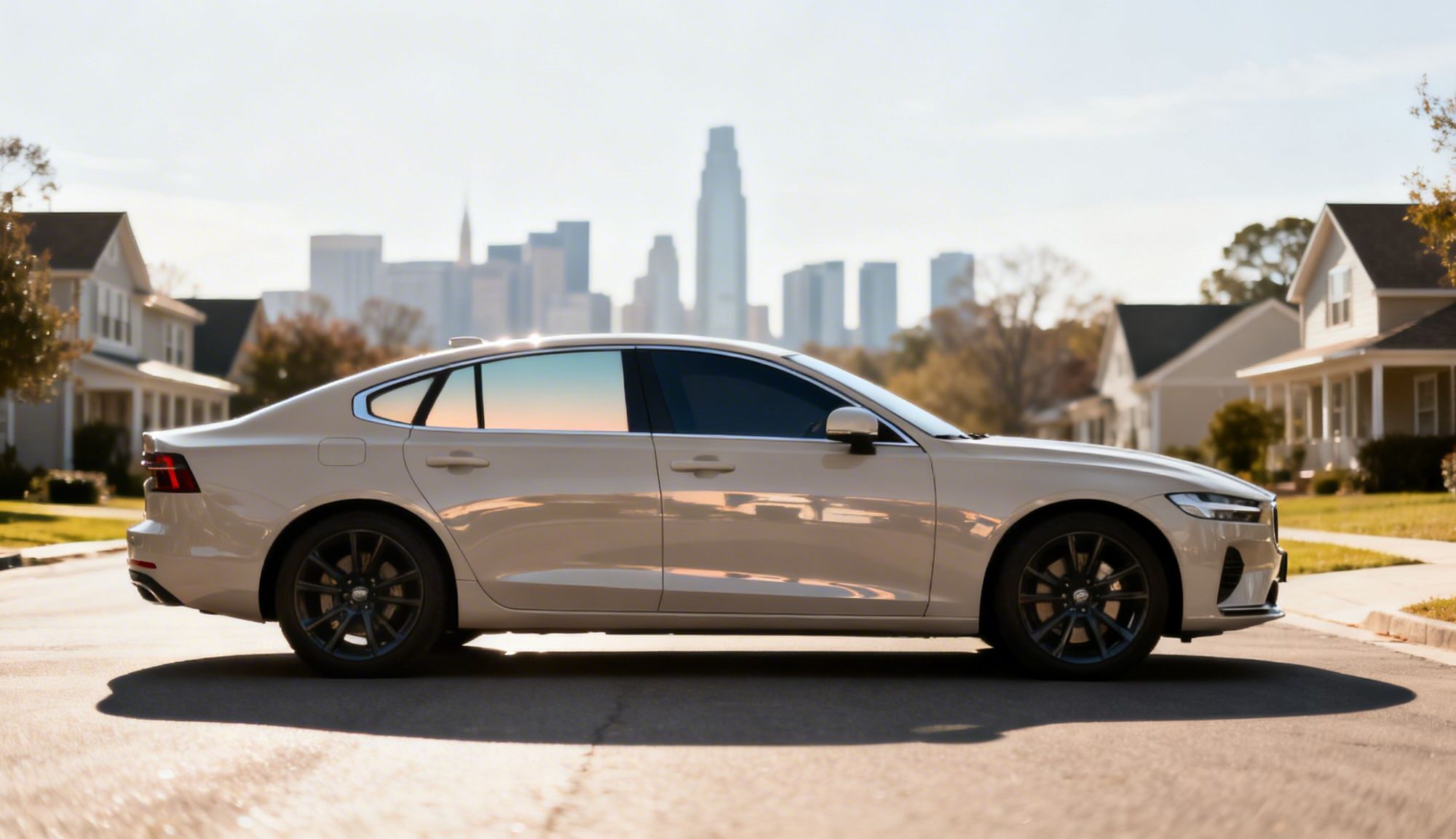
Picking a window tint level is a bit like choosing the right pair of sunglasses for your car. You'll see percentages like 5%, 20%, or 50%, and that number simply refers to the Visible Light Transmission (VLT). In short, it’s how much light the film lets through.
A lower number always means a darker tint. So, a 5% VLT film is significantly darker than a 50% VLT film.
What Are Car Window Tint Levels?
When you’re looking at window tint levels for cars, you're really deciding on the perfect mix of style, privacy, and performance for your ride. Since The Tint Guy works exclusively on automotive window tinting for cars, trucks, and SUVs, we walk drivers in Woodstock, GA, and Alpharetta, GA, through these exact choices every single day.
That percentage isn't just a random number; it directly impacts how your car looks and how it feels to be inside. A darker tint gives you more privacy and a sharp, aggressive look. A lighter tint, on the other hand, offers a more subtle, factory-style appearance while still blocking a surprising amount of heat and UV rays.
Understanding VLT Percentages
Visible Light Transmission, or VLT, is the industry standard we use to measure tint darkness. It's a really simple concept: the VLT percentage tells you exactly how much visible light can pass through your car's window film.
A good way to understand the options is to break them down into common ranges.
To make it even simpler, here's a quick breakdown of what those percentages actually look and feel like on a car.
Quick Guide to Common VLT Percentages
| VLT Percentage | Appearance and Feel | Primary Use Case |
|---|---|---|
| 5% – 20% | Very dark, often called "limo tint." Offers maximum privacy and a bold, sleek look. It can be difficult to see inside the vehicle from the outside. | Ideal for show cars, limousines, or anyone prioritizing ultimate privacy and a dramatic aesthetic on vehicles where legally permitted. |
| 20% – 35% | This is the sweet spot for most drivers. It provides a great balance of noticeable privacy and clear visibility, even at night. | The most popular choice for daily drivers, commuters, and family vehicles. 35% is a common legal limit. |
| 50% – 70% | A very light film that doesn't significantly darken your windows. It maintains the car's original look. | Chosen primarily for heat and UV rejection without altering aesthetics or reducing night visibility. |
Remember, a darker tint doesn't always mean better performance. Many modern ceramic films in the 50% to 70% range can outperform much darker, lower-quality dyed films when it comes to blocking heat.
This image gives you a great visual of how these tint levels compare side-by-side.

As you can see, the difference between a light 50% and a dark 5% tint is huge, dramatically changing the car's appearance and privacy.
Finding Your Perfect Balance
At the end of the day, picking an automotive tint level comes down to personal preference and your daily needs. The most important thing to remember is that darkness doesn't automatically equal performance.
For a deeper look into how these percentages deliver real-world benefits, you can learn more about the different levels of window tinting for cars in our detailed guide. In the sections ahead, we’ll get into how state laws, film technology, and your own driving habits all play a role in making the right choice for your vehicle.
Decoding Georgia's Auto Tinting Laws
Navigating Georgia's rules for automotive window tint can feel a little tricky. But getting it right is about more than just avoiding a ticket—it’s about ensuring your vehicle is safe, legal, and looks exactly how you want it to. The regulations are very specific and actually change depending on your vehicle, so understanding the law is the first step to making a smart tinting decision.
Here at The Tint Guy, we only do one thing: professional automotive window tinting. For years, we've been the go-to for drivers in Woodstock, GA, Alpharetta, GA, and all over North Metro Atlanta. Our team lives and breathes these regulations, ensuring every car, truck, and SUV we service is perfectly compliant with Georgia state law.
The 32% Rule for Passenger Cars
For most passenger cars—think sedans, coupes, and hatchbacks—the law in Georgia is straightforward. State law requires that the front side windows, rear side windows, and the rear windshield must all allow more than 32% of light to pass through. This is what we call a 32% Visible Light Transmission (VLT).
The law also bakes in a tolerance of +/- 3%. That means a tint that meters at 29% VLT on the dot is still technically legal. This rule applies to all the windows around the driver and passengers, keeping things consistent.
Key Takeaway: For a standard car in Georgia, 32% VLT (+/- 3%) is the legal limit for all side windows and the rear glass. Going any darker, like with a 20% or 5% film, is illegal on these windows and could get you a citation.
Different Rules for Trucks and SUVs
This is where a lot of drivers get mixed up. The rules for what the state calls "multi-purpose vehicles"—which covers most trucks, SUVs, and vans—are different from those for regular cars. It's a critical distinction that really opens up your options.
Here’s how it breaks down for these vehicles:
- Front Side Windows: These must follow the same 32% VLT (+/- 3%) rule that applies to all passenger cars. No exceptions here.
- Rear Side Windows and Rear Windshield: This is the big difference. For any window behind the driver, there is no VLT limit. You can legally go as dark as you want, whether that's a 20% film or even a 5% "limo tint" for ultimate privacy and heat rejection.
This legal distinction is great for truck and SUV owners in places like Canton and Kennesaw, as it allows for much better privacy for rear passengers and any valuables you might keep in the back.
Understanding the Front Windshield Rules
Georgia also has very clear regulations for the front windshield to make sure nothing compromises the driver's view. You absolutely cannot tint the entire front windshield with a film that reduces light.
However, the law does permit a non-reflective tint strip along the top six inches of the windshield. This strip can't extend below the AS-1 line, which is a small mark you can find on the upper corners of most factory windshields. If your vehicle doesn't have that marking, the strip just can't be more than six inches wide.
This is a fantastic and legal way to cut down on sun glare, making it a popular choice for commuters in Roswell and Marietta. As you can see, there are quite a few nuances. For a complete breakdown, you can read our guide on the legal tint percentage in Georgia. Working with a professional installer who gets these details right is your best bet for a perfect, legal tint job.
How Tint Levels Affect Your Driving Comfort

Choosing an automotive window tint is about so much more than just how your car looks. Think of it as a high-performance upgrade for your daily drive. The right tint completely transforms your vehicle's cabin, making it a more comfortable, protected, and enjoyable space—especially during those brutal Georgia summers.
The VLT percentage you land on will directly influence how much heat, glare, and damaging UV radiation gets into your car. We talk through this connection with every customer at our Woodstock, GA, and Alpharetta, GA, shops because it’s the key to getting a result you'll love.
Heat Rejection and a Cooler Cabin
The first thing you’ll feel after a professional automotive tint installation is a massive reduction in heat. It’s immediate. High-quality car window films act as a thermal shield, blocking the sun’s infrared rays that are responsible for turning your car into an oven on a hot day.
This isn't just about feeling better when you first hop in, either. A cooler cabin means your A/C doesn't have to work nearly as hard to keep things comfortable. Over time, that reduced strain can even help with your fuel efficiency, saving a little money on gas during those long commutes.
Did You Know? A lighter 50% ceramic tint can often block more heat than a much darker 20% dyed film. This is where modern automotive film technology really shines. You don't have to sacrifice visibility for incredible heat reduction, making it a perfect solution for drivers who want comfort without that "blacked-out" look.
With top-tier ceramic car window films cutting interior heat by up to 60%, it's easy to see why so many people in North Metro Atlanta are making the investment.
UV Protection for You and Your Car
Think of window film like sunscreen for your car. It shields you, your passengers, and your interior from the sun's destructive ultraviolet (UV) rays. No matter how dark or light you go, modern automotive films are engineered to block up to 99% of these harmful rays.
This has two huge benefits:
- Health Protection: It drastically cuts your exposure to UV radiation on your daily drive. That's a big deal, as UV is a known contributor to premature skin aging and even skin cancer.
- Interior Preservation: UV rays are what cause your car’s dashboard, leather seats, and plastic trim to fade, crack, and look old. A quality auto tint is a powerful defense, keeping your interior looking new and helping maintain your car's value.
Glare Reduction and Safer Driving
That blinding glare from bright sun or another car’s headlights isn't just annoying—it’s a real safety hazard. Glare kills your visibility and causes serious eye strain, making it much harder to stay focused on the road.
Picking the right tint level for your car dramatically cuts down on that blinding light. Whether you're driving into the sun on your morning commute through Cumming or dealing with nighttime traffic in Alpharetta, GA, a good tint makes the drive safer and way less stressful. Even a lighter film makes a noticeable difference, sharpening your view and keeping your eyes relaxed. It’s an investment in your comfort and your safety behind the wheel.
Choosing the Right Film: Ceramic, Carbon, and Dyed

Once you’ve settled on how dark you want to go, the next big decision is the type of film itself. This is a huge deal, because the material you choose has a massive impact on everything from how cool your car stays to whether the color holds up over time. It’s not just about looks.
Here at The Tint Guy, we specialize in automotive window tinting. We work with drivers all over Kennesaw and Marietta to find the perfect match for their vehicle and budget. Let’s walk through the three main types of film we install every day: dyed, carbon, and ceramic.
Dyed Window Film
Think of dyed film as the classic, entry-point into the world of car tinting. It’s a great, budget-friendly option if your main goals are adding privacy and getting that sleek, tinted look. The film has a layer of dye that absorbs sunlight, which helps cut down on glare.
The trade-off? Dyed film offers the most basic level of heat rejection. Over time, after years of baking in the Georgia sun, the dye can also break down and fade, sometimes taking on a purple hue. It's a solid start, but there are more durable technologies out there.
Carbon Window Film
Taking a big step up in performance, we have carbon window tint. This is our go-to recommendation for a fantastic balance of price and performance, making it a crowd-favorite for daily drivers across North Atlanta.
Instead of a simple dye, this automotive film is infused with microscopic carbon particles. These particles are workhorses when it comes to blocking infrared (IR) light—the invisible wavelength that generates all that heat. You get a huge bump in heat rejection without needing a super-dark "limo" look.
A few key benefits of carbon film include:
- Serious Heat Rejection: Your car will be noticeably cooler on hot days.
- A True Black Look: It delivers a rich, matte-black finish that is guaranteed to never fade or turn purple.
- Zero Signal Interference: Because it's metal-free, it won’t mess with your cell phone, GPS, or radio reception.
Ceramic Window Film
When you want the absolute best performance money can buy, you want ceramic tint. This is the pinnacle of modern window film technology, and for good reason. Ceramic films use powerful, non-metallic ceramic nanoparticles to do their job.
These tiny particles are engineered to be an absolute wall against infrared heat and UV rays. A quality ceramic film can block up to 90% of infrared heat, creating a much more comfortable cabin. This incredible efficiency is why advanced films like ceramic are a major focus in the automotive industry.
The Ceramic Advantage: The real magic of ceramic tint is that it delivers incredible heat rejection without relying on a dark color. A lighter, Georgia-legal ceramic film can easily outperform the darkest dyed or carbon film, all while keeping your view crystal clear at night.
For drivers in Kennesaw and Marietta who refuse to compromise, ceramic is the answer. It gives you the highest heat rejection available, 99.9% UV protection, perfect clarity, and zero signal interference. If you're weighing your options, our detailed guide on carbon vs. ceramic automotive tints is a great next step.
To make the choice even clearer, here’s a quick side-by-side comparison of how these three film types stack up.
Comparing Automotive Tint Films
This table compares the key features, performance, and cost of the three main types of automotive window tint films to help you make an informed decision.
| Feature | Dyed Film | Carbon Film | Ceramic Film |
|---|---|---|---|
| Primary Goal | Privacy & Aesthetics | Performance & Value | Maximum Performance |
| Heat Rejection | Basic | Good | Exceptional |
| UV Protection | Good | Excellent | Best (99.9%) |
| Color Stability | Can fade over time | Will never fade | Will never fade |
| Signal Interference | None | None | None |
| Cost | $ | $$ | $$$ |
Ultimately, each automotive film has its place. Dyed film is a great starting point for looks, carbon offers a fantastic middle-ground for daily drivers, and ceramic delivers unbeatable protection for those who want the absolute best for their vehicle.
Our Professional Installation and Aftercare Process
Picking out the right window tint for your car is just the beginning. The real magic—what makes a tint job look incredible and last for years—comes down to the quality of the installation and the simple care you give it afterward. Here at The Tint Guy, we live and breathe automotive tinting, and we've fine-tuned our process to deliver a perfect finish on every car, truck, and SUV that comes through our doors in Acworth and Canton.
A flawless tint job is a two-part equation: top-tier film plus expert craftsmanship. This is exactly why we've put so much into our tools and training. It’s what allows us to produce results that those DIY kits from the auto parts store just can't touch and avoid the dust, bubbles, and peeling edges that are the tell-tale signs of a rushed job.
Our Meticulous Automotive Installation Method
Precision is the name of the game for us. We start by bringing your vehicle into a clean, controlled bay specifically designed to keep airborne dust and other tiny particles from getting between the film and the glass. It might sound like a small detail, but it’s absolutely critical for a smooth, blemish-free result.
From there, we turn to our computer-cutting system. We load your vehicle's exact make and model, and it plots out a perfect digital template for every window. This tech ensures a flawless fit, with no gaps or light leaks you often see with hand-cut film. Our certified technicians then apply the film, using specialized tools and techniques to create a strong, seamless bond with the glass.
Understanding the Curing Process and Aftercare
Once the film is on, your new tint needs a little time to "cure." You might notice a faint haze or some tiny water pockets under the film at first—don't worry, this is completely normal. It's just the application moisture evaporating, a process that can take a few days up to a couple of weeks, depending on the film and how much sun it gets.
Do not roll down your windows for at least 3 to 5 days after installation. This gives the adhesive time to fully bond with the glass, preventing the film from peeling or shifting.
Keeping your tint looking great is easy. When you clean the inside of your windows, just use a soft microfiber cloth and a cleaner that’s ammonia-free. Simple aftercare, along with performing other essential vehicle maintenance, will keep your car in top shape for years.
The demand for quality automotive tinting is fueled by drivers who want the comfort and protection that quality films provide. We back every job with a lifetime warranty, so you can be confident your investment is built to last.
Frequently Asked Questions About Car Window Tint
We get a lot of the same great questions from customers at our Woodstock, GA, and Alpharetta, GA, shops. It makes sense—automotive window tint is an investment, and you want to get it right. To clear things up, we've put together answers for the questions we hear most often from drivers around North Atlanta.
Can I Legally Put 5% Tint on My Car in Georgia?
That's one of the most common questions we get, and the short answer is no. For a standard passenger car, 5% VLT is illegal on any window here in Georgia. That "limo tint" look is far too dark for what the law considers safe for daily driving.
The legal limit for sedans, coupes, and other passenger cars is 32% VLT (with a small +/- 3% tolerance) on the front side, rear side, and back windows. While trucks, vans, and SUVs can go darker on the windows behind the driver, 5% film is really only for show cars that aren't being driven on public roads.
Is 35% Tint Dark Enough for Privacy?
For most people, a 35% tint is the perfect sweet spot. It offers a fantastic balance of privacy and clear visibility. From the outside during the day, it gives your car that sleek, shaded look that makes it tough for prying eyes to see inside.
But from the driver's seat, you'll still have great visibility, even when driving at night. It's easily one of our most popular choices for customers who want a clean, classic look without making nighttime driving a challenge.
How Much Does Professional Car Window Tinting Cost?
The final price for a professional automotive tint job really depends on three things: the size of your vehicle (a two-door coupe has less glass than a full-size SUV), how many windows you’re tinting, and—most importantly—the type of film you choose.
Film Type Matters: Ceramic tint is a premium investment that offers superior heat rejection and UV protection, while dyed film is a more budget-friendly option focused on aesthetics. Carbon film offers a great middle-ground of performance and value.
Because every car and customer is different, the best way to get an accurate price is to give us a call. We can provide a no-obligation quote right over the phone based on your specific car, truck, or SUV.
Can You Tint the Windows on a Leased Car?
Yes, and we actually recommend it! Tinting a leased vehicle is incredibly common and one of the smartest ways to protect its interior from fading and sun damage. This can save you from expensive wear-and-tear fees when you turn the car in.
High-quality window film isn't permanent. When your lease is up, it can be professionally removed, leaving the glass in pristine, factory condition, just as you received it.
Ready to upgrade your vehicle with the perfect tint? The team at The Tint Guy provides expert installation of high-performance automotive films in Woodstock, GA, Alpharetta, GA, and across North Metro Atlanta. Schedule your appointment online today