Here in Georgia, the magic number for automotive window tint is 32% Visible Light Transmission (VLT). This simple figure is the key to getting that sleek, custom look for your car, truck, or SUV without landing a ticket. For most passenger cars, the law says the film on your side and rear windows must let at least 32% of light shine through.
Your Guide To Georgia's Automotive Tint Laws
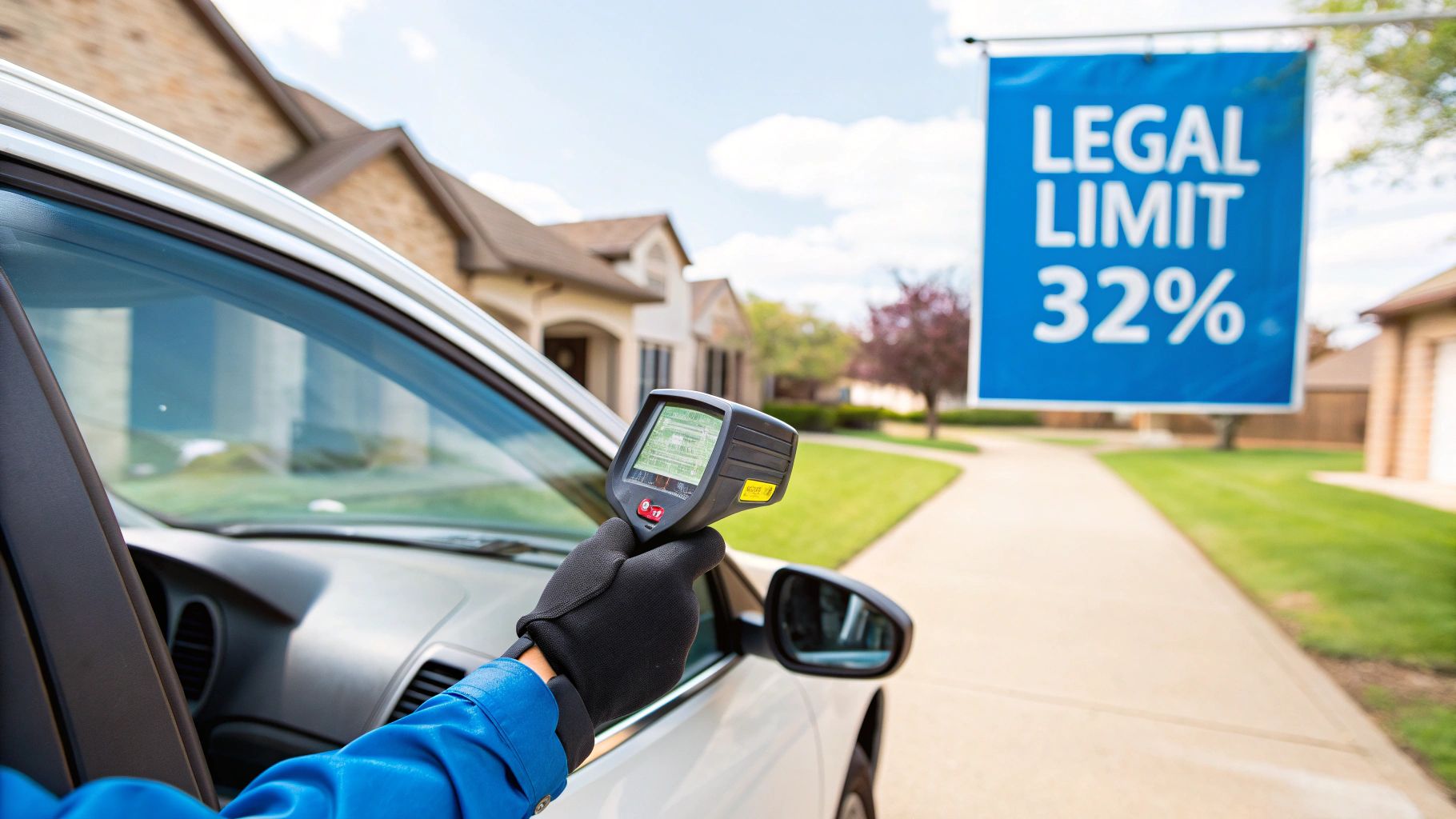
Trying to figure out automotive window tinting rules can feel a bit overwhelming, but it all comes down to one core concept: Visible Light Transmission (VLT).
Think of VLT as a measure of how light or dark a tint film is. It’s the percentage of visible light that can actually pass through your car window once the tint is applied. A higher VLT number means a lighter tint, while a lower number means it's much darker. For instance, a 70% VLT film is almost clear, but a 5% VLT film—what most people call "limo tint"—is nearly blacked out.
Georgia law draws a clear line in the sand to make sure drivers can see clearly, keeping everyone on the road safe.
Breaking Down The Rules By Vehicle Type
The state makes a simple but crucial distinction between different kinds of vehicles, which changes what you're legally allowed to do with your automotive tint.
To make it easy, here’s a quick breakdown of Georgia's automotive tinting laws:
Georgia Automotive Window Tint Laws At A Glance
| Window Location | Sedans & Coupes | SUVs, Trucks & Vans |
|---|---|---|
| Front Side Windows | 32% VLT | 32% VLT |
| Rear Side Windows | 32% VLT | Any Darkness |
| Back Windshield | 32% VLT | Any Darkness |
As you can see, the rules change depending on what you drive.
For Sedans, Coupes, and Passenger Cars: The rule is simple and consistent. Your front side windows, rear side windows, and back windshield all have to be 32% VLT or higher.
For SUVs, Trucks, and Vans: This is where things get a little different. The front two side windows must follow that same 32% VLT limit. But for the rear side windows and the back windshield, you can go as dark as you want.
This gives owners of larger vehicles more flexibility for privacy and heat rejection in the back, all without affecting the driver’s critical line of sight.
At The Tin Guy, our installers in Marietta and Kennesaw use precise digital tint meters to check every film. We guarantee the automotive window tint we put on your vehicle is fully compliant with Georgia's laws, so you can drive away with total peace of mind.
A National Perspective On Tint Laws
It's really important to remember that these laws are specific to Georgia. Car window tint limits vary wildly from state to state, creating a patchwork of different rules.
For example, California is super strict, requiring 70% VLT on front side windows. Head over to Texas, and you can go as dark as 25% VLT. Florida lands somewhere in the middle at 28% VLT. Knowing these differences is a big deal if you travel or move.
Here at The Tin Guy, we are experts in Georgia's regulations. Our focus is making sure every car, truck, and SUV that leaves our shops is 100% compliant. Our deep local knowledge means you get all the benefits of high-quality ceramic window tint—like incredible UV protection and heat reduction—without ever worrying about legal trouble. For a deeper dive, you can learn more about Georgia window tinting law in our complete guide.
Why Window Tint Laws Exist In The First Place
Car window tint laws can sometimes feel like they're just there to put a damper on your car's style, but there's a good reason they're on the books. These rules aren't arbitrary; they’re built around a serious commitment to public safety for everyone on the road, from drivers like you to law enforcement officers.
The number one goal is ensuring the driver can see clearly. Your ability to spot other cars, pedestrians, and unexpected road hazards is crucial. A very dark car tint might feel great on a blazing sunny day, but it can become a serious liability at night, in a downpour, or during thick morning fog.
State regulations are designed to find that sweet spot—letting you enjoy the benefits of automotive tint without compromising the visibility you need to react quickly and drive safely.
Ensuring Safety During Traffic Stops
Another huge piece of the puzzle is the safety of police officers. During any traffic stop, an officer needs to see inside the vehicle to understand the situation and spot any potential threats. Illegally dark car tint creates a dangerous blind spot for them.
This inability to see the driver or passengers instantly raises the tension in what is already a stressful situation. By setting legal VLT limits, states create a standard of transparency that helps protect officers just doing their jobs and can de-escalate a potentially dangerous encounter.
The core principle is simple: what you can’t see can hurt you. Tint laws protect drivers from obstructed views and officers from hidden dangers, making the roads safer for everyone involved.
Regulating More Than Just Darkness
While VLT percentages get most of the attention, automotive tint laws also cover other film properties to head off different kinds of safety issues.
Reflectivity: Most states, Georgia included, have strict limits on how reflective your car tint can be. Highly reflective, mirror-like films can bounce sunlight directly into the eyes of other drivers, creating a blinding glare that's a recipe for an accident. The law makes sure your car's windows don't become a moving hazard.
Color Restrictions: You can't just slap any color tint on your car windows, either. States often ban certain colors like red, amber, and sometimes blue because they can be easily mistaken for the lights on emergency vehicles. This rule prevents confusion on the road and ensures police cars, fire trucks, and ambulances are instantly recognizable.
Ultimately, choosing a legally compliant automotive tint is about more than just dodging a ticket. It’s about being a responsible driver. The good news is you don't have to sacrifice performance for compliance. For a deeper look into the advantages, check out our guide on the benefits of automotive window tint. Here at The Tin Guy, we specialize in installing high-performance ceramic tints that give you incredible heat rejection and UV protection while staying well within Georgia's legal limits.
Comparing Georgia Tint Laws To Neighboring States
While Georgia's 32% VLT rule is pretty clear-cut for those of us driving around locally, it's easy to forget that these regulations stop right at the state line. If you travel a lot for work or just for fun, the automotive window tint that's perfectly legal in Marietta could get you a ticket just a few miles into a neighboring state.
It’s a classic case of "one-size-fits-all" simply not working. Each state has its own way of balancing things like driver visibility, officer safety, and even climate, which results in a unique set of rules. A quick road trip can suddenly put your car in a completely different legal territory.
A Look At The Southeast
Driving across the Southeast is a perfect example of this. You'll find a whole spectrum of VLT requirements. Some states are right in line with Georgia, but others are a lot stricter, which is something you need to be aware of before hitting the road with aftermarket automotive tint.
Here’s a quick snapshot of the legal VLT for front side windows in the states bordering Georgia:
- Florida: Requires a lighter 28% VLT, meaning your Georgia-legal tint would be too dark.
- Alabama: Shares the same 32% VLT requirement as Georgia, so no worries there.
- Tennessee: Is a bit more relaxed, allowing for a slightly darker tint at 35% VLT.
- South Carolina: Is stricter, requiring front side windows to let in at least 27% VLT.
- North Carolina: Matches Georgia and Alabama with a 32% VLT limit.
This patchwork of laws means a drive from Kennesaw down to Orlando could land you in hot water as soon as you cross the Florida border. The difference between 32% and 28% might not sound like much, but it's more than enough for law enforcement to notice and write a citation.
The infographic below really breaks down why states create these laws in the first place, focusing on critical concerns like visibility and officer safety.
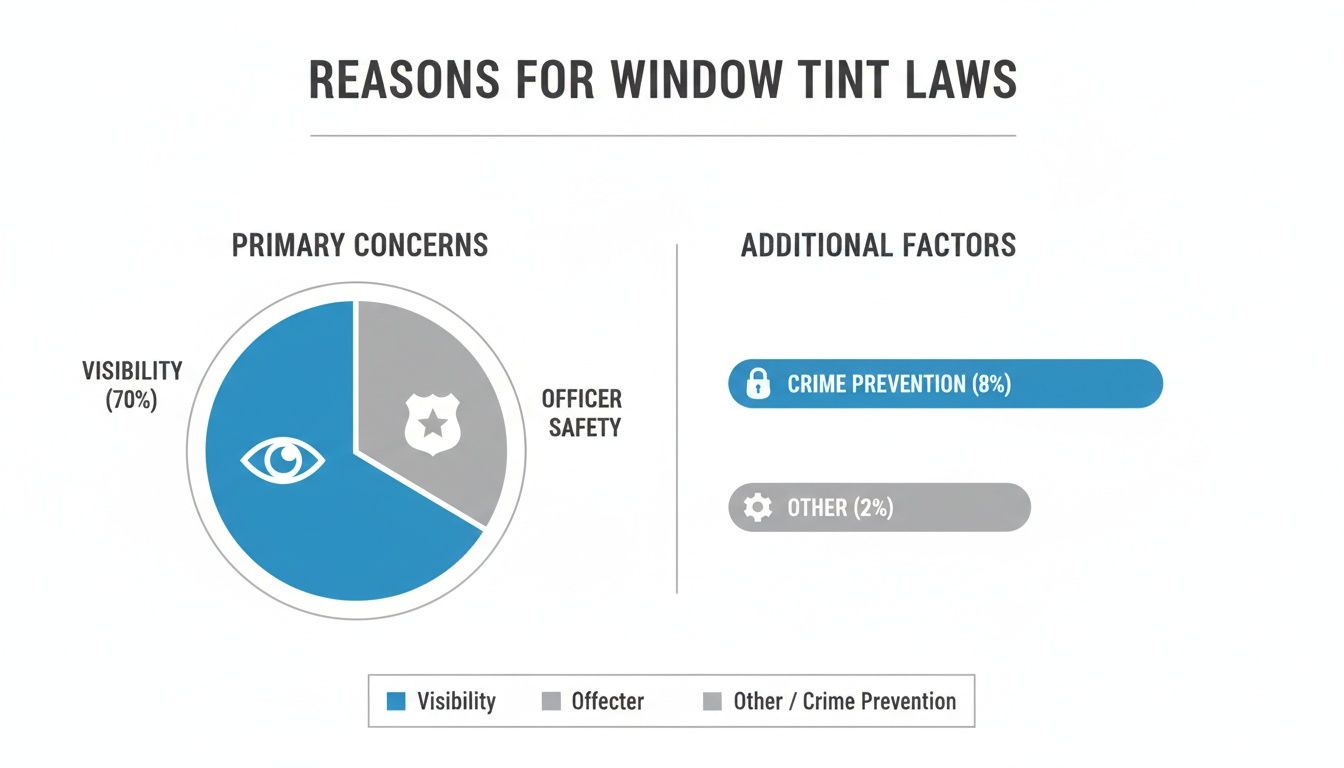
As you can see, the top priorities behind these varied regulations are ensuring drivers can see clearly and protecting law enforcement officers during traffic stops.
The National Tinting Landscape
This variability isn't just a regional thing; it's the reality across the entire country. The demand for high-performance automotive tint that still complies with local laws has created a huge market. Globally, the industry was valued at $3.9 billion in 2023 and is expected to hit $6.7 billion by 2033. Here in North America, we accounted for a $1.2 billion share, all driven by these state-specific VLT rules and our desire for comfort and UV protection. You can explore more about these market trends to see the bigger picture.
For drivers, the takeaway is simple: your tint's legality is tied directly to your location. A car that's legally tinted in Texas at 25% VLT would be highly illegal in California, where the front window limit is a much lighter 70% VLT.
This is exactly why having local, hands-on expertise is so critical. Here at The Tin Guy, we don't just stick film on car windows; we provide genuine peace of mind. Our team in Marietta and Kennesaw has a deep, up-to-date understanding of Georgia's specific laws. We make sure every single automotive tint installation not only looks great and performs perfectly but is also 100% compliant, keeping you safe and ticket-free on Georgia roads.
The Real Cost Of Having Illegal Window Tint

Choosing a car window tint that's darker than the legal limit for tint in Georgia might feel like a small risk, but the consequences can stack up in a hurry. It’s rarely just a single ticket. More often, it’s a frustrating and expensive cycle that turns one traffic stop into a major headache.
Getting caught with non-compliant tint is an easy violation for law enforcement to spot. During a routine stop, an officer can pull out a handheld tint meter and measure the VLT of your car windows right on the spot. If that reading comes in below 32%, you're almost guaranteed to drive away with a citation.
Financial Penalties And Fix-It Tickets
In Georgia, an illegal tint violation is considered a misdemeanor, and the initial fine is just where the financial pain begins. Along with that penalty, you’ll also get what’s known as a “fix-it ticket.” This is a court order demanding that you remove the illegal film and prove your vehicle is now compliant with state law.
This single ticket suddenly balloons into a much costlier problem:
- You pay the fine for the ticket itself. This is an immediate out-of-pocket expense that can vary by jurisdiction.
- You must pay a professional to remove the illegal tint. Removing old film is a specialized job that takes time and skill to avoid damaging your car's glass.
- You have to pay for a new, legal tint installation. If you still want the benefits of window tint, you’re back to square one, paying for a whole new job with a compliant film.
All of a sudden, that attempt to get a slightly darker look has tripled your cost. And don't forget that any traffic violation, including one for illegal tint, often comes with additional court costs for traffic tickets.
The Broader Impact Of Non-Compliance
Ignoring window tint laws carries real consequences. In major metro areas, police issue thousands of citations for this violation every year, with fines ranging from $100 to $500 per offense. Those fines only get steeper with repeat violations.
The real cost isn't just one fine. It's the combined expense of the ticket, professional removal, and re-installation of a legal film—all while dealing with the inconvenience of court appearances and inspections.
At The Tin Guy, our entire focus is on preventing this hassle from the start. Our expert technicians in Marietta and Kennesaw exclusively install automotive window tinting films that are 100% compliant with Georgia law. We use advanced ceramic and carbon films that deliver incredible heat reduction and UV protection without ever crossing the legal line.
When you work with us, you get the high-performance results you want with the guaranteed peace of mind you need.
How To Choose A Legal And High-Performance Tint
There's a common misconception that to get serious heat rejection and privacy, you have to flirt with the legal limit for tint. We hear it all the time. But honestly, that's an old way of thinking that can land you a hefty ticket.
The truth is, modern car window tint technology is so advanced that you can get incredible performance while staying completely legal here in Georgia. You don't need to go illegally dark to make your car comfortable.
High-quality films are engineered for performance, not just for looks. They use sophisticated layering to target and block specific wavelengths of light—like infrared rays that create heat and UV rays that cause fading—without needing to be super dark. This means a fully compliant 32% VLT tint can easily outperform a darker, lower-quality film.
Here at The Tin Guy, helping drivers in Marietta and Kennesaw find that perfect balance is what we do best.
Understanding Modern Tint Film Technology
The secret to getting amazing results within the legal limits comes down to the type of car tint film you choose. Not all tint is created equal. The old-school dyed films from back in the day didn't do much more than darken the glass, but today's options are in a different league entirely.
We focus on two main types of high-performance automotive tint that deliver outstanding benefits at legal VLT levels:
Carbon Tint: This film is infused with carbon particles that are fantastic at blocking infrared light. It gives you strong heat rejection and, unlike cheap dyed films, it won't fade to purple over time. Carbon tint also provides a classic, true-black look that really sharpens your vehicle’s style.
Ceramic Tint: This is the top-tier of tint technology. Ceramic films use non-metallic, non-conductive ceramic nanoparticles. These tiny particles are absolute powerhouses at blocking heat and UV rays without interfering with any of your car's electronics—GPS, satellite radio, or your cell phone signal will be perfectly clear.
A high-quality ceramic tint with a 32% VLT can block more heat than a cheap 15% VLT dyed film. This proves performance comes from the film’s construction, not just its darkness.
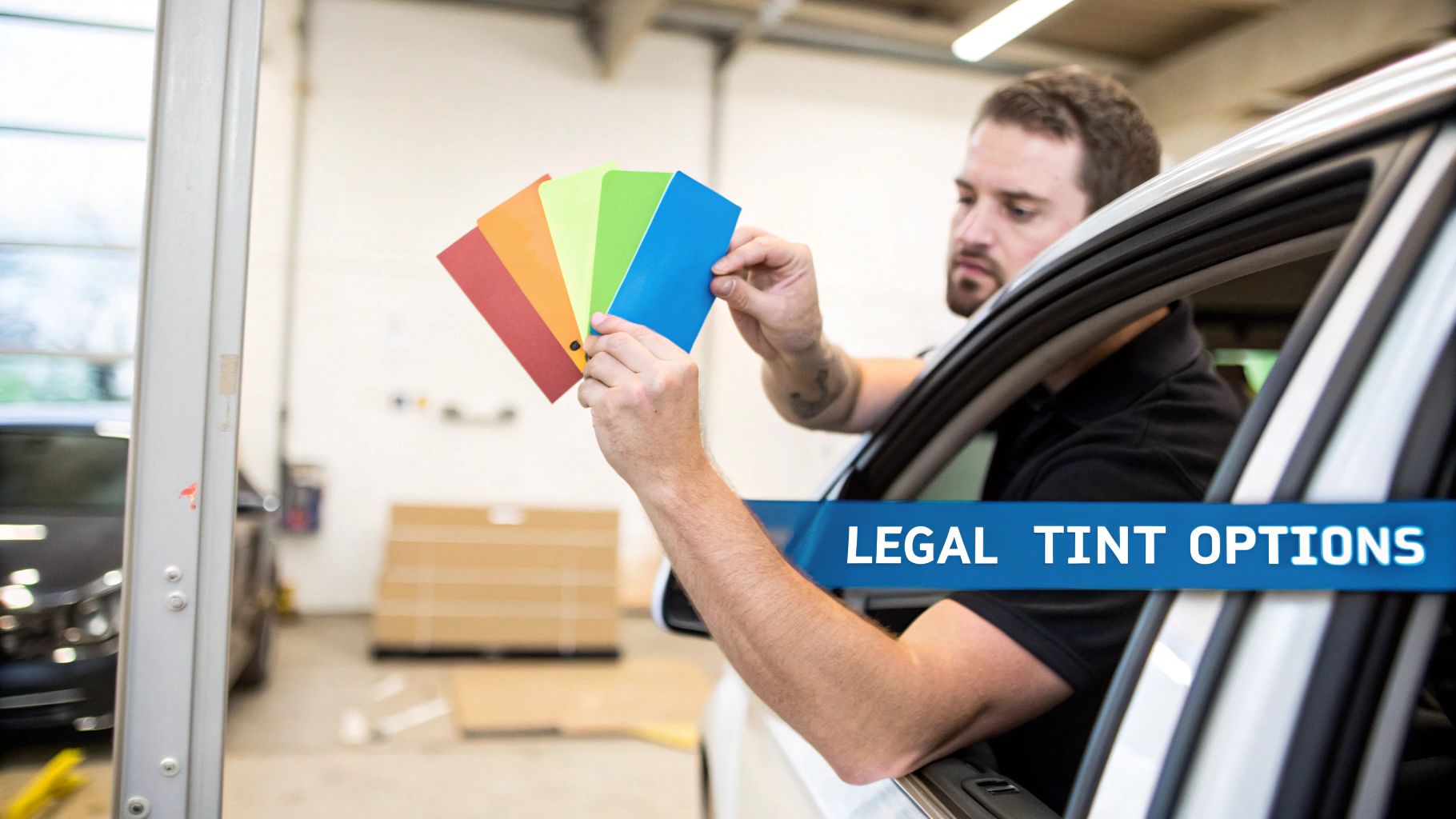
Choosing between different film types can be tough, but you don't have to sacrifice performance to stay legal. Here's a quick look at the car tint film options we offer at The Tin Guy that meet Georgia's standards.
Comparing Legal Tint Film Options
| Film Type | Key Benefits | Best For | Georgia Legal Compliance |
|---|---|---|---|
| Carbon Film | Excellent heat rejection, no signal interference, won't fade, deep black color. | Drivers looking for great performance and style at a more accessible price point. | Easily available in 32% VLT to meet state law. |
| Ceramic Film | Maximum heat & IR rejection, superior UV protection, crystal clear visibility, no signal interference. | The driver who wants the absolute best in comfort, protection, and technology. | Top-tier performance available in a fully compliant 32% VLT. |
| Dyed Film | Most affordable, provides privacy and glare reduction. | Budget-conscious drivers whose primary goal is aesthetic. | Compliant shades are available, but performance is minimal compared to Carbon or Ceramic. |
Ultimately, both our Carbon and Ceramic films offer fantastic benefits well within Georgia's legal framework. The choice just depends on your specific needs and budget.
Key Factors To Consider For Legal Tint
When you're picking out a car window tint, it's about more than just the shade. You need to think about what you actually want the film to do for you. To make sure you get it right, focus on these key factors.
1. Heat Rejection (Infrared Rejection)
This is the big one for most people, especially during those scorching Georgia summers. Look for a film's Infrared Rejection (IRR) rating. A higher IRR percentage means the film is doing a better job blocking the sun's heat-producing rays, keeping your car's interior much cooler and more comfortable.
2. UV Protection
Protecting yourself and your car's interior from damaging ultraviolet rays is a must. Any quality film worth its salt should block 99% or more of UV rays. This is what stops your dashboard, seats, and door panels from cracking and fading over time, while also protecting your skin.
3. Glare Reduction
A good car tint makes driving so much more pleasant by cutting down on blinding sun glare during the day and the annoying halos from headlights at night. This improves your visibility and reduces eye strain, making your drive safer. For a deeper dive into how different shades impact your view, check out our guide on selecting the best window tint percentage.
4. Professional Installation
Even the absolute best film will underperform if it's not installed perfectly. A professional installation from The Tin Guy guarantees a flawless, factory-like finish with no bubbles, peeling, or dirt trapped underneath. We cut the film precisely for your vehicle's windows, ensuring it looks great and lasts for years. Remember, getting caught with illegal tint can lead to penalties that might even impact your auto insurance rates, making a professional, legal installation a truly smart move.
Partner With The Tint Guy For Guaranteed Legal Tint
Picking out the right window film is only the first step. The real key to a perfect, legal, and long-lasting car tint job is choosing the right installer.
Navigating Georgia’s specific tint laws can be a real headache. A simple mistake from an inexperienced shop—or a DIY kit that goes sideways—can quickly turn into a frustrating cycle of fines and fix-it tickets. This is where leaning on a true expert makes all the difference.
At The Tin Guy, we don’t just stick film on glass. We deliver total peace of mind, making sure every single car, truck, and SUV that leaves our shop is 100% compliant with Georgia’s legal tint limits. Our deep understanding of state regulations, paired with an obsession for precision, means you never have to second-guess the legality of your tint.
Your Local Experts In Marietta And Kennesaw
Since way back in 1986, The Tint Guy has been the go-to name across North Atlanta for quality and expertise in automotive window tinting. Our technicians aren’t just installers; they're career professionals who live and breathe this stuff. They understand the science behind high-performance films and have mastered the art of a flawless application.
We use top-of-the-line equipment, including digital tint meters, to verify that every job meets Georgia’s 32% VLT standard right on the money.
Why trust your vehicle to The Tin Guy?
- Guaranteed Legal Compliance: We’re masters of Georgia tint law. Your vehicle will pass inspection, every single time.
- Decades of Experience: With a history stretching back to 1986, our skill and reliability are proven.
- Premium Film Selection: We only work with the best ceramic and carbon films that give you incredible heat reduction and UV protection without crossing legal lines.
- Flawless Installation: Our meticulous process means no bubbles, no peeling, and no imperfections. Just a clean, factory-finish look.
Avoid The Risks And Choose A Professional
Honestly, the gamble on cheap, illegally dark car tint just isn't worth it. You’re looking at initial fines, the cost of getting the illegal film removed, and then paying all over again for a proper re-installation. One bad decision can end up costing you a lot.
When you choose The Tin Guy, you're investing in a professional automotive tinting service that gets it right the first time. You’ll drive away in a cooler, more comfortable vehicle that looks amazing and is fully protected—the legal way.
Don't roll the dice with your car's appearance or your driving record. A professional, compliant tint installation is a smart investment in your car's value, your comfort, and your peace of mind on the road.
Ready to give your vehicle the legal, high-performance tint it deserves? Our teams in Marietta and Kennesaw are here to help. We'll walk you through the best film options, answer every question you have, and deliver a perfect installation you can count on for years.
Call us today for a free consultation or schedule your tint appointment to experience the professional difference.
Common Questions We Hear About Georgia Tint Laws
When you're trying to get your car tinted, a lot of questions pop up about what's legal and what's not. To cut through the confusion, we've gathered the most common questions we get asked at our automotive tinting shops in Marietta and Kennesaw and answered them for you right here.
Can I Get a Medical Exemption for Darker Tint in Georgia?
Yes, you absolutely can. Georgia law recognizes that certain medical conditions require extra protection from the sun, and there's a process for getting a medical exemption.
This involves getting a certified statement or prescription from your doctor that clearly explains why a darker car tint is a medical necessity for you. Once you have that documentation squared away with the state, our team at The Tin Guy can install the right film for your needs. We're happy to walk you through the paperwork and make sure your new tint meets your specific medical requirements using the best film for the job.
Does the Factory Privacy Glass on My SUV Count as Tint?
This is a great question and one we hear all the time. That darker glass on the back windows of SUVs, trucks, and vans isn't an aftermarket film—it's actually dyed glass, done at the factory.
While Georgia law says you can go as dark as you want on those rear windows, it's critical to remember that your two front side windows must still meet the 32% VLT limit. Our process always starts by using a professional-grade tint meter on your factory glass. This lets us know exactly what film to apply to the front windows to keep your entire vehicle compliant.
A lot of people think that dark factory glass offers great UV protection, but that's a common misconception. Most dyed glass blocks very little UV radiation. Adding a professional ceramic tint is a huge upgrade for protecting your passengers and your car's interior from sun damage.
What’s the Rule for Tinting My Car’s Windshield?
For safety, Georgia law doesn't allow you to tint your entire front windshield with a dark film. You need a clear line of sight, after all.
However, the law does permit a non-reflective tint strip across the top six inches of the windshield. We call this a "visor strip," and it's a game-changer for cutting down sun glare during those bright morning and evening drives. Our automotive tint technicians can install a perfect, legally-sized windshield strip that makes your commute more comfortable without getting you into any trouble.
How Do I Know My New Tint Is Actually Legal?
Simple—when you come to The Tin Guy, you leave with a guarantee. Our expert technicians live and breathe Georgia’s tint laws. We use high-tech digital light meters to verify that every single automotive tint installation is perfectly legal.
We give you clear documentation on the film we installed and its VLT rating. You can pull out of our Marietta or Kennesaw shops with total confidence, knowing your car not only looks fantastic but is 100% street legal.
Ready to get a high-performance car tint that looks great and follows the rules? Trust the pros at The Tin Guy for a flawless installation and complete peace of mind. Schedule your appointment online today!