
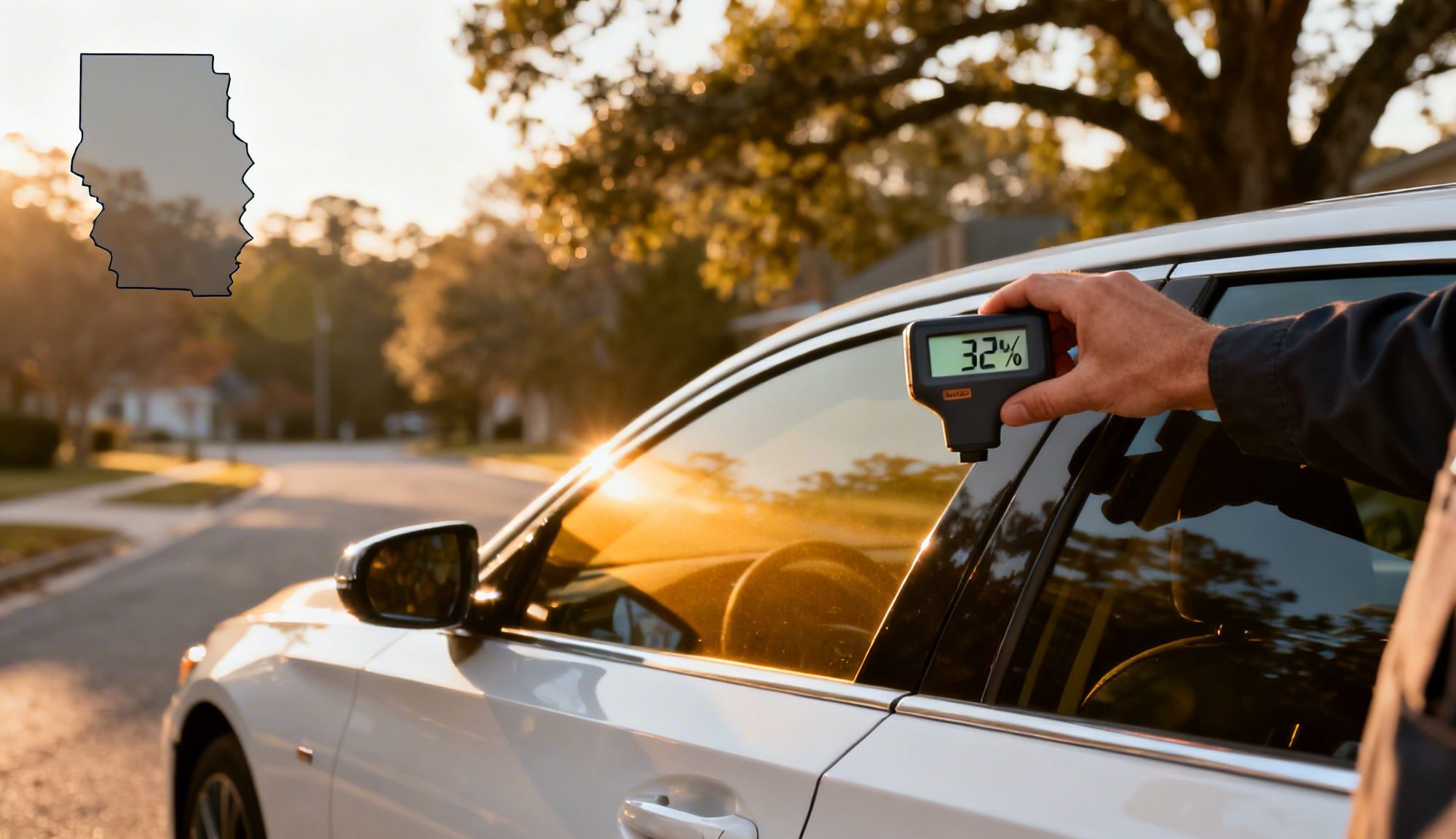
Getting your car windows tinted is one of the best upgrades you can make, but it's essential to know the rules of the road. In Georgia, the legal tint percentage is pretty clear-cut: your automotive tint must let at least 32% of light pass through. This magic number is what we in the industry call Visible Light Transmission, or VLT.
Understanding Georgia’s Automotive Tint Laws
When we talk about car window tint, the most important term you'll hear is Visible Light Transmission (VLT). The easiest way to think about VLT is to picture a pair of sunglasses. A low percentage means the lenses are very dark and block a lot of light, while a high percentage means they’re lighter and let more light through. The same principle applies to your car’s windows.
Georgia's laws are all about finding a sweet spot. They let you enjoy the perks of automotive tinting—like less heat and more privacy—while making sure your vision isn't dangerously impaired. It's also about safety for law enforcement officers, who need to be able to see into a vehicle during a traffic stop. For our customers here in Woodstock and Acworth, this means you can get a sleek, protective car tint without ever crossing the legal line.
Georgia Tint Rules for Passenger Vehicles
For most cars, SUVs, and trucks, Georgia keeps the rules consistent to ensure everyone stays safe.
- Front Side Windows: Must allow more than 32% of light in.
- Rear Side Windows: Must also allow more than 32% of light in.
- Rear Windshield: The same 32% VLT rule applies here, too.
Every state has its own take on tint laws, but Georgia’s 32% VLT minimum for side and rear windows is a balanced approach. It’s dark enough to make a real difference for commuters in Acworth, GA cutting down on glare and stopping your car's interior from fading. Plus, modern ceramic car tints can hit this mark perfectly while blocking up to 99% of damaging UV rays—protection that older, basic films just can't match.
Key Takeaway: In Georgia, a 32% VLT is the darkest you can legally go on your car's side and rear windows. Choosing a professional installer like The Tint Guy guarantees your automotive tint looks great and complies with all state regulations.
For a quick reference, we've put together a simple table outlining the specifics for your car.
Georgia Automotive Window Tint Laws at a Glance
This chart breaks down the legal limits for passenger cars, so you can see exactly what's allowed.
| Window Location | Legal VLT Percentage | Reflectivity Limit |
|---|---|---|
| Front Side Windows | 32% Minimum VLT | No more than 20% |
| Rear Side Windows | 32% Minimum VLT | No more than 20% |
| Rear Windshield | 32% Minimum VLT | No more than 20% |
| Windshield Sun Strip | AS-1 Line or Top 6 Inches | Non-Reflective |
As you can see, the law also limits how shiny or reflective your car tint can be, capping it at 20%. And for the windshield, you can add a non-reflective sun strip along the top 6 inches. Sticking to these guidelines ensures you'll never have to worry about a ticket.
How VLT Is Measured on Your Automotive Tint
So, you know the 32% legal tint limit in Georgia. But do you know how that number is actually measured on the side of the road? This is where a lot of car owners get tripped up and end up with a costly ticket.
First, you have to realize that your car’s factory glass isn't perfectly clear. Straight from the manufacturer, it has a slight, almost invisible tint that already blocks a small amount of light. This is a crucial detail because the final Visible Light Transmission (VLT) isn’t just the number on the tint film’s box; it’s the combined total of the film plus your vehicle's existing glass.
A common mistake is thinking that applying a 32% film will get you a legal 32% tint. It won’t. If your factory glass already blocks 15% of light (an 85% VLT) and you add a 32% film, the final reading will be much darker, putting you on the wrong side of the law.
The Role of a VLT Meter
So how do law enforcement and professional auto tint installers get that final number? They use a specialized tool called a VLT meter, or tint meter. This handheld device is the official standard for measuring window tint legality. There's no guesswork involved.
The process is simple but precise:
- The window is rolled down just enough to fit the meter.
- The meter slides over the glass, with one sensor on the inside and one on the outside.
- It shoots a calibrated beam of light through the glass and measures how much makes it to the other side.
- The device displays the final VLT as a percentage.
This measurement is absolute. It doesn't matter what the film manufacturer claims; the only number that counts during an inspection is the one on that meter.
This graphic breaks down the key ideas behind Georgia's tint law, from understanding VLT to ensuring your car tint is safe and compliant.
As you can see, hitting that legal sweet spot requires balancing the film's VLT with the state's 32% limit to maintain clear, safe vision for the driver.
Why Professional Automotive Tint Expertise Matters
This is exactly why you need to trust your automotive tinting job to a professional. Here at The Tint Guy, we don't guess. We have decades of experience and understand precisely how different films perform on the factory glass of countless cars, trucks, and SUVs.
We use a VLT meter during our consultation and installation process to calculate the final VLT before the film ever touches your glass. This guarantees your vehicle will be fully compliant with Georgia's 32% legal tint percentage.
This proactive approach saves our customers in Acworth, GA, and Woodstock, GA, from the headache of getting a ticket and the expense of having to remove illegal tint. We make sure the ceramic window tint or other film you select gives you the heat rejection and style you want without any legal stress. To see how different car tint film options impact the final look and VLT, check out our guide on the best percentage for car window tint. Don't leave your car’s legality to chance—let our experts get it right the first time.
Penalties for Illegal Car Tint in Georgia

Going darker than Georgia’s 32% VLT law might seem tempting for that sleek, private look, but the consequences can be a real headache. It's not just a minor risk; understanding what actually happens when you get caught with illegal tint is something every car owner in Georgia should know. We're not here to scare you, just to give you the straight facts so you can make a smart call for your car.
The most common penalty for a non-compliant car tint is a traffic citation. If a police officer pulls you over and their VLT meter shows your windows are below the 32% limit, you're getting a ticket. The cost can add up, but the financial sting often goes way beyond just the initial fine.
The Financial Cost of a Tint Ticket
The penalties for an illegal car window tint violation in Georgia are meant to be a serious deterrent, not just a slap on the wrist. They're in place to make sure everyone sticks to the safety rules.
- Initial Fine: A first-offense ticket for illegal window tint is a misdemeanor. Once you add in court costs, you can expect a fine well over $100.
- Points on Your License: Depending on the situation, a tint violation can also tack points onto your driver's license, which is never good news for your insurance rates.
- Repeat Offenses: If you get cited more than once for the same issue, those fines and penalties are only going to get steeper.
But those direct costs are only where the trouble begins. The real hassle comes from what you have to do after you get the ticket.
The Problem with 'Fix-It' Tickets
Most of the time, a window tint citation is what's known as a "fix-it" ticket. This means that on top of paying the fine, you are legally required to remove the illegal tint from your vehicle. This is where a new layer of cost and frustration that most people don't see coming kicks in.
You'll have to show the court proof that the problem has been corrected. That means paying a professional auto tint shop—like us here at The Tint Guy—to perform a full tint removal. It's a job that takes time and specific tools to strip the old film and adhesive off without damaging your glass, especially those fragile defroster lines on the back window.
The real penalty for illegal tint is paying twice: once for the ticket and court fees, and a second time to have the illegal film professionally removed. You essentially pay for a service that you can no longer legally use.
This is a frustrating and completely avoidable expense. The absolute best way to sidestep these problems is to make sure your car tint is legal from the get-go. For a closer look at the specifics, check out our detailed article on the consequences of illegal window tint in Georgia.
An Investment in Peace of Mind
At The Tint Guy, serving our clients in Woodstock, GA, and Acworth, GA, we put legal compliance on the same level as a quality installation. Our expert installers guarantee that every automotive window tinting job we do meets Georgia’s 32% VLT requirement, period. We use top-of-the-line films like ceramic window tint that give you incredible heat rejection and UV protection while staying perfectly legal.
Choosing a professional auto tint installation isn't just about avoiding bubbles; it's an investment in your peace of mind. When you work with our team, you can be confident your car looks fantastic and is 100% compliant, saving you from the stress and expense of any future legal troubles down the road.
Comparing Georgia's Tint Laws with Neighboring States
If you live anywhere in North Metro Atlanta, from Woodstock to Acworth, you know how easy it is to find yourself crossing a state line. A weekend trip to the Florida coast, a family visit in Alabama, or a drive through the mountains of Tennessee is all part of the lifestyle. Your car goes where you go, but there's a catch many drivers overlook.
That legal window tint you have in Georgia could land you in hot water in a neighboring state.
Georgia’s 32% VLT law is pretty clear for us, but our neighbors play by a completely different set of rules. This patchwork of regulations can turn a simple road trip into a confusing and expensive headache. A car that’s perfectly legal cruising through Acworth, GA might suddenly be in violation the second you cross into Alabama or Florida.
Making a smart, long-term decision for your automotive window tinting means seeing the whole map. We believe in giving our clients the full picture so you can choose a car tint that fits your life, not just one that’s legal in your own garage.
How Georgia's Tint Law Stacks Up
While Georgia keeps things consistent with a 32% VLT requirement on most passenger car windows, the states around us have their own ideas. Some are stricter, some are more lenient, and it almost always gets complicated when you look at the rear windows.
Let's take a quick road trip through the laws of the states bordering Georgia:
- Florida: They’re a bit stricter on the front side windows, demanding at least 28% VLT. But for the back half of the car, they're much more relaxed, allowing a darker 15% VLT.
- Alabama: This one is a mixed bag. Like Georgia, they require 32% VLT on the front side windows, but they permit any level of darkness on the rear side and back windows.
- Tennessee: Good news for frequent travelers to the Volunteer State. Their law perfectly mirrors Georgia's 32% VLT on all side and rear windows, so there are no surprises there.
- South Carolina: They require a minimum of 27% VLT on all windows, making them noticeably stricter than Georgia across the board.
- North Carolina: Similar to Tennessee, they stick close to Georgia’s standard with a 32% VLT limit for all windows behind the windshield.
What this all means is that while your 32% tint from our Woodstock shop is perfect for a drive up to Chattanooga, it’s technically too dark for the front windows in South Carolina or Florida.
Crucial Insight: Your Georgia-legal 32% VLT tint is darker than what’s allowed on the front side windows in South Carolina (27%) and Florida (28%). While officers in other states might give out-of-state plates a pass, relying on courtesy is a gamble.
Automotive Tint Law Comparison Georgia vs. Neighboring States
To make things even clearer, we've put together a simple chart. It gives you a side-by-side look at the Visible Light Transmission (VLT) requirements for standard passenger cars in Georgia and its neighbors.
| State | Front Side Window VLT % | Rear Side Window VLT % | Rear Windshield VLT % |
|---|---|---|---|
| Georgia | 32% | 32% | 32% |
| Florida | 28% | 15% | 15% |
| Alabama | 32% | Any Darkness | Any Darkness |
| Tennessee | 32% | 32% | 32% |
| South Carolina | 27% | 27% | 27% |
| North Carolina | 32% | 32% | 32% |
This table shows just how much the rules can change in a short drive. The biggest things to watch for are those stricter front-window VLT percentages in Florida and South Carolina.
Making the Right Choice for Your Vehicle
At The Tint Guy, we’re here to help you navigate these complex rules. For our clients who are always heading down to Florida or over to South Carolina, we often suggest a slightly lighter film, like a 35% VLT ceramic tint. It’s the smartest choice to ensure you’re compliant everywhere, and you still get phenomenal UV protection and heat rejection.
When you come in for a consultation at our shops in Woodstock, GA, or Acworth, GA, we'll talk about your driving habits. Our goal is to help you find the perfect balance between style, privacy, and the practical need to stay on the right side of the law, no matter where the road takes you.
Getting a Medical Exemption for Darker Window Tint
While Georgia’s 32% VLT law is the standard for most cars, the state does provide a formal exception for drivers with specific medical conditions. We often get questions about this, and it's important to know this isn't just an informal loophole. It's a regulated process for people who have a genuine, documented health reason to need extra protection from the sun.
This exemption is specifically for those diagnosed with conditions that cause severe photosensitivity. If sun exposure is medically dangerous for you, you might be eligible to apply for a permit that allows for a car tint darker than the legal limit.
Who Qualifies for a Medical Exemption?
This isn't about simply preferring darker car windows or feeling a little more comfortable. The exemption is reserved for specific, diagnosed medical issues where extra light protection is a true necessity.
Some common qualifying conditions include:
- Lupus: An autoimmune disease where sunlight can trigger severe skin reactions and other symptoms.
- Xeroderma Pigmentosum: A rare genetic disorder that makes the skin extremely vulnerable to UV damage.
- Certain Skin Cancers: In these cases, minimizing all UV exposure is critical for a patient’s health and recovery.
- Albinism: A condition impacting melanin production, often leading to extreme sensitivity to light.
If you believe your medical condition falls into a qualifying category, the next step is to start the official application process with the state.
How to Apply for a Tint Exemption in Georgia
Getting a medical exemption requires clear, official documentation. You can't just bring us a doctor's note and ask for darker film; you have to get a permit directly from the state of Georgia first.
Here’s how the process works, step-by-step:
- Get the Right Form: You’ll need the Application for Exemption to the Window Tint Law, which comes from the Georgia Department of Public Safety (DPS).
- Get Your Doctor’s Certification: A licensed physician or dermatologist has to fill out their section of the form. They must certify that your medical condition genuinely requires darker window tint for health and safety reasons.
- Submit the Application: Once completed, the form is sent to the Georgia DPS for their review.
- Receive Your Permit: If your application is approved, the state will issue you a permit. This document must be kept in your vehicle at all times to prove your tint is legal.
It’s crucial to understand that a doctor's note by itself is not enough. Only an official, state-issued permit will legally validate your darker automotive tint.
This regulated approach is becoming more common as the global automotive tint film market, which hit $11.56 billion in 2023, continues to expand alongside evolving state laws. As films get more advanced, so do the regulations around them. To get a broader perspective on these changes, you can learn more about window tint industry statistics.
At The Tint Guy, we are absolutely committed to providing expert automotive window tinting for our clients in Acworth, GA, and Woodstock, GA. We strictly follow Georgia's legal tint percentage for all our standard jobs. However, we fully respect and understand the needs of clients who have secured a medical exemption. If you have a valid state permit, we are ready and able to professionally install the film that gives you the protection you legally and medically require.
Why Professional Automotive Tint Installation Is Essential

After digging into the complexities of Georgia’s tint laws, it becomes pretty obvious that getting the perfect auto tint isn't a simple DIY job. The line between a legal 32% VLT and a costly ticket is incredibly thin. Guessing can lead to fines and the headache of having to strip off your brand-new film.
This is exactly where the skill of a professional automotive tinter comes in. Choosing a pro isn't just about convenience; it's an investment in getting the job done right, legally, and with a quality finish that lasts. A seasoned technician knows that applying film is only half the battle. They understand the science of VLT and, crucially, how to account for your car’s factory glass tint to guarantee the final result is 100% compliant.
Precision and Legal Compliance Guaranteed
An experienced installer at The Tint Guy doesn't guess when it comes to your legal tint percentage. We start by using a professional VLT meter to get a precise reading of your car's existing glass. From there, we help you choose a film—like a high-performance ceramic window tint—that combines with the glass to hit that legal 32% mark perfectly.
This level of expertise is what drives a massive industry that supports over 25,000 jobs and brings in $1.8 billion in services nationwide. Here in Georgia, where the law is strictly enforced, our professional method ensures drivers in Acworth and Woodstock get top-tier films that are fully legal. The standards and technology are always evolving, as you can see in this automotive tinting film market report.
Peace of Mind: When you leave our shop, you drive away with the confidence that your car tint is flawless and legal. You get all the benefits—like UV protection and a much cooler interior—with zero risk of a ticket.
The Unmistakable Mark of Quality
Beyond just being legal, the difference between a professional installation and a DIY attempt is night and day. A perfect, seamless finish requires a controlled environment, specialized tools, and the kind of muscle memory that only comes from years of hands-on experience.
Our process is meticulous:
- Computer-Cut Patterns: We use advanced software to cut the film to the exact dimensions of your vehicle's make and model. This ensures a perfect, gap-free fit right to the edge of the glass.
- Flawless Application: Our technicians work in a clean, dust-free bay to prevent any specks or bubbles from getting trapped under the film. The result is a smooth finish that looks like it came straight from the factory.
- Lifetime Warranty: We stand firmly behind our work. Our professional automotive window tinting is backed by a lifetime warranty that covers any bubbling, peeling, or fading for as long as you own your car.
An installation from our shops in Acworth, GA, and Woodstock, GA, is more than a service—it’s a guarantee. It protects your investment and ensures your vehicle looks its absolute best for years to come. Curious to see what sets our work apart? Take a look at our professional window tinting services near you. Choosing The Tint Guy means choosing excellence, legality, and the confidence that your tint is done right the first time.
Frequently Asked Questions About Georgia Tint Laws
We get it. The specifics of Georgia’s legal tint percentage can feel a bit confusing, and the last thing you want is a ticket. Here at our shops in Woodstock and Acworth, we answer these questions all the time, so let's clear up some of the most common ones.
Can I Get 5% Limo Tint on My Car in Georgia?
That’s a hard no, at least for a standard passenger car. While 5% VLT film (what everyone calls "limo tint") looks slick, it’s illegal on any window of a regular car, truck, or SUV in Georgia. The only exception is if you have a specific medical exemption.
State law is crystal clear: the darkest you can legally go is 32% VLT on the front side, rear side, and back windows. Putting limo tint on your personal ride is a fast track to getting pulled over, getting points on your license, and being forced to pay for removal. It’s best to stick with a legal shade installed by a pro.
Are Mirrored or Reflective Tints Legal in Georgia?
Georgia law is also strict when it comes to how shiny your automotive window tinting can be. For both your front and rear side windows, the tint film cannot be more than 20% reflective.
Super reflective or "mirror" tints are off-limits for a good reason—they can act like a mirror, blasting dangerous sun glare into other drivers' eyes. Our ceramic window tint options are designed to give you amazing heat rejection and UV protection without ever crossing that legal reflectivity line, keeping your car safe, cool, and compliant.
What Are the Rules for a Windshield Sun Strip?
You can absolutely get a sun strip at the top of your windshield to cut down on glare. In Georgia, you’re allowed to apply a non-reflective tint strip, but it can’t go down past the manufacturer’s AS-1 line. You can usually find this little mark on the glass itself.
If your car doesn't have a visible AS-1 line, the rule of thumb is that the strip can’t extend more than 6 inches down from the top of the windshield. This gives you great sun-blocking benefits without messing with your clear view of the road.
I Got a Tint Ticket, Can You Remove My Old Film?
Yes, we can absolutely help with that. If you've been handed a "fix-it" ticket for an illegal legal tint percentage, our shops in Woodstock, GA, and Acworth, GA, specialize in professional tint removal.
Our technicians use the right tools and methods to safely strip off the old film and all the sticky adhesive left behind. We’re especially careful not to damage the glass or the sensitive defroster lines on your back windshield. Once it's clean, we can do a fresh automotive tint installation with a high-quality, legal film that meets Georgia's 32% VLT requirement and gets you back on the road without the worry.
Don’t let confusing tint laws keep you from enjoying a cooler, more comfortable ride. The experts at The Tint Guy have the knowledge and tools to ensure your car gets the perfect legal tint every time.