Let's get right to it. Illegal window tint on cars in Georgia is all about one thing: how dark it is. This is measured in Visible Light Transmission, or VLT. Think of it like a pair of sunglasses—the lower the VLT number, the darker the tint.
Georgia law is very specific about these percentages for vehicles. The rules aren't just there to be difficult; they're designed to make sure a police officer can see inside a car during a traffic stop, which is crucial for their safety. If your automotive tint is darker than what the law allows, it’s considered illegal.
What Makes Automotive Window Tint Illegal In Georgia
Trying to figure out car window tinting rules can feel like a maze, but in Georgia, it really boils down to a few key numbers. The state has set clear limits to strike a balance between a driver's desire for privacy and heat rejection, and the safety requirements for law enforcement. For anyone driving around Woodstock, GA, or Canton, GA, knowing these rules is the first step to getting a great tint job that won't get you in trouble.
At The Tint Guy, we only work on cars, trucks, and SUVs. We've always believed that an informed customer is a happy one, so we make it a point to walk you through the regulations before we ever start an automotive tint installation. The main factor that determines if your tint is legal is its VLT percentage.
Understanding VLT Percentages
Visible Light Transmission (VLT) is simply the percentage of light that can pass through your car window after a tint film has been applied.
- A lower VLT percentage means a darker tint. For example, a 5% VLT film is what people often call "limo tint" because it's extremely dark.
- A higher VLT percentage means a lighter tint. A 50% VLT film, for instance, is much more transparent and lets in a lot more light.

Georgia law sets a minimum VLT percentage, but the rules change depending on your vehicle type and the specific window. This is a critical detail that trips up a lot of people. The legal limit for a sedan is different from an SUV or truck, which is why you can't just pick a tint you like and apply it to your entire car.
Key Takeaway: The final VLT reading combines the slight tint already in your car's factory glass with the film we apply. A true professional always accounts for the factory glass to make sure the combined VLT is compliant.
Georgia Automotive Window Tint VLT Limits At A Glance
To make things simple, we've put together a quick-glance table for Georgia's legal VLT limits. Following these numbers is the best way to avoid a ticket and the headache of having to remove an illegal window tint.
| Window Location | Legal VLT % For Sedans | Legal VLT % For SUVs, Trucks, & Vans |
|---|---|---|
| Front Side Windows | Must allow more than 32% of light in | Must allow more than 32% of light in |
| Rear Side Windows | Must allow more than 32% of light in | Any darkness can be used |
| Rear Windshield | Must allow more than 32% of light in | Any darkness can be used |
| Front Windshield | Non-reflective tint is allowed on the top 6 inches | Non-reflective tint is allowed on the top 6 inches |
As you can see, the big difference is in the rear half of the vehicle. Our team in Woodstock and Canton is meticulous about this stuff. We guarantee every single automotive tint we install meets these standards perfectly, so you can drive away with confidence.
Understanding The Details Of Georgia Tint Law
When most people think about tint laws, they focus on one thing: darkness. But while the VLT percentage (Visible Light Transmission) is a huge part of the equation, it's not the whole story. To stay 100% compliant, you also need to pay attention to Georgia's rules on tint color and reflectivity, all laid out in the official state law, O.C.G.A. § 40-8-73.1.
Getting these details right is what separates a professional auto tint service from a job that gets you a ticket. As specialists who focus exclusively on automotive tinting for cars, trucks, and SUVs, we at The Tint Guy live and breathe these rules. It’s our job to make sure every vehicle that leaves our shops in Woodstock, GA, and Canton, GA, is perfectly legal.

Beyond Darkness: Color And Reflectivity Rules
It surprises a lot of drivers, but Georgia law is very specific about which colors are off-limits for car window tint. You absolutely cannot use red or amber films on any window. Those colors are strictly reserved for emergency lights and turn signals, and having them on your car's windows can create dangerous confusion for other drivers.
On top of that, your tint can't be too shiny. The law puts a hard stop on any window film that has more than 20% light reflectance. Think of a "mirrored" or chrome-like finish—that’s a no-go. This rule is in place for a couple of very important safety reasons:
- Driver Safety: Highly reflective tint acts like a mirror, shooting intense glare directly into the eyes of other drivers. It’s distracting at best and temporarily blinding at worst.
- Officer Safety: Just like with tint that’s too dark, reflective film makes it impossible for law enforcement to see inside a vehicle during a traffic stop, creating a major safety risk.
These rules aren’t unique to Georgia. Most states set a VLT of around 35% for front side windows to ensure visibility for law enforcement. In fact, over 40 states have an outright ban on metallic or mirrored tints for the same safety concerns. For drivers in the Canton, GA, and Woodstock, GA, areas, it means sticking to Georgia’s specific rules is the only way to avoid headaches. You can get a better sense of how these rules compare by exploring nationwide tinting regulations.
Sedans vs. SUVs: The Privacy Glass Distinction
Here’s another detail that often trips people up: Georgia law treats different types of vehicles differently. While the front side windows follow the same 32% VLT rule for all passenger vehicles, the rules for the back half of the car can change.
For sedans, every window behind the driver—the rear sides and the back windshield—must follow the same 32% VLT limit. But for multi-purpose vehicles like SUVs, trucks, and vans, the windows behind the driver can be tinted to any darkness you want.
So, why the difference? It comes down to something called "privacy glass." Many SUVs and trucks roll off the factory line with rear windows that are already darkened. This isn't a film; the glass itself is dyed during manufacturing, typically resulting in a VLT between 15% and 25%. The law makes an allowance for this, letting owners of these vehicles go just as dark, or even darker, with aftermarket film on the rear windows.
This is exactly why choosing an installer who knows the law is so critical. A true professional auto tint shop in Canton, GA, or Woodstock, GA, will understand these nuances immediately. They'll recommend the right car tint film options for your specific make and model, giving you the look you want while ensuring you stay legal on every road.
The Real Risks Of An Illegal Car Window Tint Job
It might seem like a minor gamble, but getting caught with illegal automotive tint in Georgia can spiral into a major headache. We see it all the time—drivers are drawn to that dark, slick look of a tint well below the legal 32% VLT. They’ll often go to a discount installer who quotes a great price but conveniently forgets to mention the legal ramifications.
The truth is, those initial "savings" completely vanish the second you see police lights flashing in your rearview mirror.
Think about a story we hear constantly from car owners around our communities. A driver gets a "deal" on a dark, 20% tint for their sedan, loving the look and the privacy. A few weeks go by, and then they're pulled over. What began as a routine stop quickly becomes a costly "fix-it" ticket for an illegal window tint. And that's where the real trouble starts.
More Than Just A Fine
That initial ticket is rarely the end of it. The real cost comes from the chain reaction of expenses and hassles that follow. It's a frustrating, expensive domino effect that can easily double or even triple what you originally paid to get your car tinted.
A citation for illegal tint is just the beginning. Here’s what you’re really up against:
- Failed Vehicle Inspections: If your county requires emissions testing, an illegal tint is an automatic fail. You won’t be able to renew your vehicle registration until that film is gone and your car passes.
- Forced Removal Costs: The court will order you to remove the non-compliant film. Professional tint removal is a careful, time-consuming process that takes real skill to avoid damaging your car's glass or rear defroster lines—and it comes with its own price tag.
- Re-Installation Expenses: After paying for the illegal tint and then paying a professional to strip it off, you're right back where you started. You still have to pay a reputable installer, like The Tint Guy, for a brand-new, legal automotive window tinting job.
All of a sudden, that "deal" on a dark tint has morphed into a significant financial hit. The combined cost of the fine, professional removal, and a proper re-installation often ends up being more than double your initial investment.
The Bottom Line: Trying to get around the law with an illegal window tint almost always costs you more in the long run. Choosing a compliant, professional automotive tint installation from the start is simply the smarter financial move.
The Hidden Safety And Liability Risks
Beyond the money, driving with an illegal window tint introduces other serious risks you might not have considered. Film that's too dark seriously impairs your visibility, especially at night or in bad weather like rain or fog. It makes seeing pedestrians, cyclists, and other cars much more difficult, which directly increases your risk of causing an accident.
Worse yet, if you're ever in a collision, that illegal tint can become a massive liability. Insurance companies and opposing attorneys can argue that your compromised visibility was a contributing factor in the crash, potentially making you partially or even fully at fault. A police report that notes the illegal tint is powerful evidence that can be used against you in an insurance claim or a personal injury lawsuit.
For drivers in Woodstock, GA, and Canton, GA, the choice is clear. Working with a professional installer who guarantees legal compliance isn't just about following rules—it's about protecting your wallet, your safety, and your peace of mind. At The Tint Guy, we make sure every car window tint we install is 100% legal, looks fantastic, and delivers the performance you want without any of the risks.
How Police Measure Your Car's Window Tint
Have you ever been driving and seen a car with super dark windows, wondering how officers can tell if it's illegal just by sight? The truth is, they don't guess. When it comes to enforcing Georgia’s automotive tint laws, it’s all about precise science, not a hunch.
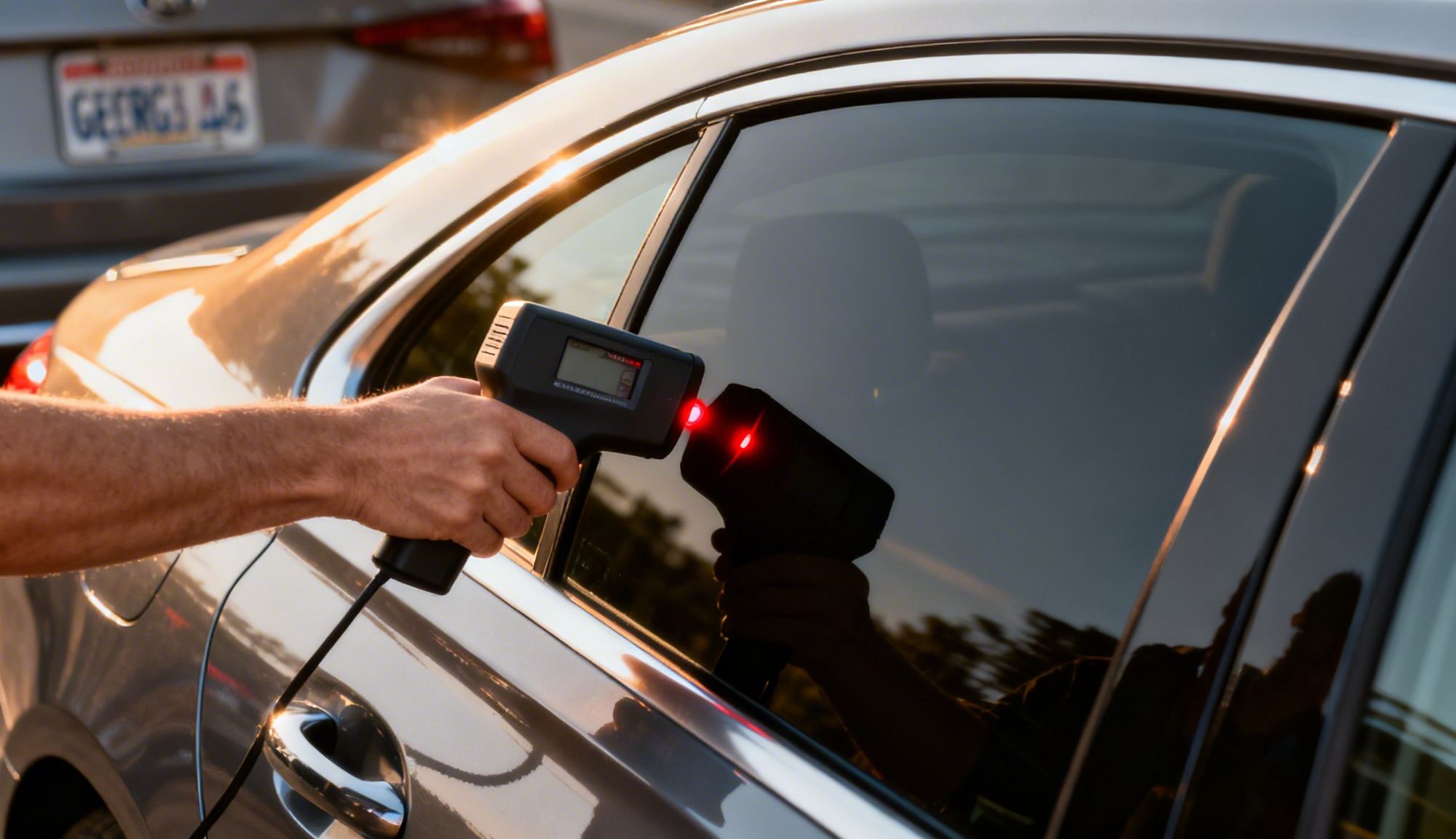
Police use a small, handheld device called a tint meter, which takes all the subjectivity out of the equation. Knowing how this little gadget works shows you that enforcement isn't random—it's based on an exact, verifiable number.
The Science Of A Tint Meter
A tint meter is a surprisingly simple tool that measures Visible Light Transmission (VLT). It’s made of two parts: one that sends out a calibrated beam of light and another that receives it.
- The officer will ask you to roll your window down just a bit.
- They'll slide the meter over the top of the glass, placing one sensor on the inside and the other on the outside.
- The device then shines a light from one side through the glass.
- The receiving sensor on the other side measures exactly how much of that light successfully passed through your window and the film.
The meter displays the result as a percentage—that’s your car's VLT. If you’re in a sedan and that number is below Georgia's 32% limit for front windows, you have an illegal window tint. A ticket can be written right there on the spot. This kind of check is a routine part of any comprehensive vehicle safety inspection meant to keep cars compliant with road standards.
Failing this simple test can set off a chain reaction of costs, as you can see below. It's not just the ticket; it's the hassle and expense of removing the film and starting over.

As the chart shows, getting caught with illegal tint is a financial headache that goes way beyond the initial fine.
The Hidden VLT In Factory Glass
Here’s a critical detail that trips up a lot of car owners and even some inexperienced installers: your car's "clear" glass isn't actually 100% clear. Straight from the factory, nearly all automotive glass has a slight, built-in tint. It typically lets through somewhere between 88% to 94% of light.
That small difference might not sound like much, but it makes a huge impact on your final VLT reading after a film is applied.
Crucial Calculation: The tint meter reads the total VLT of the factory glass and the aftermarket film combined. The final number is found by multiplying the two percentages, not adding them. This is where many people make a costly mistake.
Let’s walk through a common scenario. A car owner in Woodstock, GA, wants the darkest legal tint for their sedan. They buy a 35% VLT film, figuring that's safely above the 32% state limit.
- Factory Glass VLT: 90% (0.90)
- Applied Film VLT: 35% (0.35)
- Final Measured VLT: 0.90 x 0.35 = 31.5%
Boom. That seemingly legal film is now illegal, putting the driver at risk for a ticket. This is exactly why a professional automotive tint installation is non-negotiable if you want to stay compliant.
At The Tint Guy, we measure your factory glass before we even touch a roll of film. This allows us to recommend the perfect film that ensures your final, combined VLT is 100% legal and looks great. If you're curious about how different shades look and perform, our guide on 20% tint vs 5% tint breaks it down even further.
Choosing a Legal Tint That Still Performs
A lot of car owners fall into a common trap. They think that to get powerful performance—like serious heat reduction window tint and UV protection—they have to go with an illegal window tint. This is one of the biggest myths in the automotive world. The idea that a legal film can't keep up with its darker, non-compliant counterparts is just plain outdated.
Thanks to huge leaps in automotive tint technology, you no longer have to sacrifice performance to stay on the right side of Georgia law. Premium films, especially in the ceramic window tint category, are engineered to deliver incredible results without needing to be dangerously dark.
The Power Of Modern Ceramic Tint
Imagine your car parked under the blazing Georgia sun on a summer afternoon. With a cheap, illegal dyed film, the interior still feels like an oven. That dark film might look private, but it mostly just absorbs heat and eventually radiates it right into your cabin. It offers minimal UV protection auto tint and is notorious for bubbling and turning purple over time.
Now, picture that same car, but with a high-performance, legal ceramic tint. You open the door, and the interior is noticeably cooler and more comfortable. This isn't magic; it's just advanced engineering at work.
- Superior Heat Rejection: Ceramic tints are infused with microscopic ceramic particles that are amazing at blocking infrared radiation—the part of the light spectrum that carries heat. They don't just absorb it; they actively reject it before it can even get through your glass.
- Maximum UV Protection: A quality ceramic film blocks over 99% of harmful UV rays. This is crucial for protecting your skin from sun damage and preventing your car's dashboard, upholstery, and trim from fading, cracking, and deteriorating.
- Impressive Glare Reduction: Legal ceramic tints significantly cut down on blinding sun glare during the day and the distracting halo effect from headlights at night. The result is a drive that's both safer and more comfortable.
The key takeaway here is that real performance comes from the material technology, not just the darkness of the film. A legal 32% ceramic window tint will vastly outperform an illegal 20% dyed film in every single category that matters, from heat blocking to longevity.
Pro Tip: When you're choosing a tint, don't just ask about the VLT. Ask about the Total Solar Energy Rejected (TSER) value. A high TSER number on a legal VLT film is the true mark of a premium product that will keep you cool.
Legal Compliance and Peak Performance in One
For car owners in Canton, GA, and Woodstock, GA, the rules are clear: stay at or above 32% VLT to avoid a ticket. Smart professionals, like us here at The Tint Guy, specialize in legal ceramic window tint options that deliver the goods—cutting glare by up to 80%, protecting interiors from fading, and coming with lifetime warranties.
Instead of risking a fine with an illegal tint, you can go premium with a compliant film that offers same-day installation and superior comfort, all without the legal headache. The choice is clear for drivers in Woodstock, Canton, and the surrounding areas. You really don’t have to compromise.
At The Tint Guy, we focus exclusively on automotive window tinting and proudly offer premium ceramic films that give you the best of both worlds. You get the elite performance you’re looking for—heat rejection, UV protection, and enhanced privacy—all while being 100% compliant with Georgia law. This means you can enjoy a cooler, safer, and more stylish ride without ever worrying about seeing flashing blue lights in your rearview mirror.
To find the perfect shade for your vehicle, check out our guide on selecting the best window tint percentage for your needs.
Common Questions We Hear at the Shop
To wrap things up, let's go over the specific questions we hear most often from car owners at our shops in Woodstock, GA, and Canton, GA. Think of this as your quick-reference guide for clearing up any final confusion about getting your car tinted in Georgia. We want to give you the facts so you can feel confident you're making a smart, legal choice for your car, truck, or SUV.
Our goal is to help drivers in our surrounding communities avoid the common—and costly—pitfalls of an illegal window tint.
Are Medical Exemptions For Darker Tint Available In Georgia?
Yes, they are. Georgia law recognizes that some people have medical conditions like lupus or other photosensitivity disorders that require extra protection from the sun. If this applies to you, you can get an exemption for a darker tint, but you have to follow the process correctly.
You’ll need to get a signed letter from your doctor or optometrist that clearly explains the medical necessity for darker window tint. This permit allows for a VLT no lower than 23% on any window (the standard windshield strip rule still applies). It’s crucial that you keep this signed documentation in your vehicle at all times.
Here at The Tint Guy, we only handle automotive window tinting. If you have a valid medical permit, we can absolutely walk you through selecting a high-quality ceramic window tint that meets these specific requirements while giving you the superior heat and UV protection you need.
Is A Tint Strip On My Car's Windshield Legal?
Absolutely. A non-reflective tint strip across the top of the windshield is 100% legal in Georgia and happens to be one of our most popular professional auto tint services. It’s a fantastic way to cut down on harsh sun glare, especially during those sunrise and sunset commutes.
There is one firm rule, though: the tint strip can't extend more than six inches down from the very top of the windshield. A professional installer has to be precise to make sure the strip provides relief without breaking the law.
Our expert installers in Woodstock, GA, and Canton, GA, are trained to measure and apply these windshield strips perfectly. We make sure you get maximum glare reduction while staying fully compliant. It’s a small touch that makes a huge difference in your daily drive.
Important Note: Just like your other windows, the windshield strip cannot be reflective. A mirrored or chrome-like finish is illegal on any part of your vehicle's glass.
What If I Move To Georgia With Tint From Another State?
This is a critical question for new residents, and the answer is straightforward: once you establish residency and register your car in Georgia, your vehicle must comply with Georgia’s window tint laws. The rules from your previous state no longer matter.
Many states have different VLT limits. For instance, Florida might allow a 25% VLT on a sedan's front windows. If you move here with that tint, it’s now considered illegal, since Georgia mandates a minimum of 32% VLT for sedans.
If your current tint is too dark, you'll need to have it professionally removed to avoid a ticket or to pass a state inspection. We help new residents in the area with this all the time. We offer professional automotive tint removal to get your car, truck, or SUV legal and ready for a fresh, compliant installation at our shops in Woodstock, GA, or Canton, GA.
Does Factory Tint Affect My Aftermarket Film Choice?
Yes, and this is probably the single most important detail that DIYers or less experienced installers miss. "Factory tint," often called privacy glass, isn't a film at all. It's a pigment that's mixed into the glass itself during manufacturing.
- Sedans: The "clear" glass on most sedans isn't perfectly clear. It typically has a natural VLT of around 88-94%.
- SUVs, Trucks, and Vans: These vehicles often come with dark privacy glass on the rear windows, which usually has a factory VLT of about 15-25%.
When we apply an aftermarket tint film, the final VLT—what a police officer's meter reads—is the factory glass VLT multiplied by the film VLT. This is where so many people make a costly mistake. For example, putting a 35% film on a front window that starts at 90% VLT gives you a final VLT of 31.5% (0.35 x 0.90), which is just under the legal limit and illegal for a sedan in Georgia.
As dedicated automotive tint installation professionals, the very first thing we do is measure your car's factory glass. This allows us to recommend the correct film that guarantees your final tint level is safely and legally compliant. That attention to detail is what protects you from tickets and headaches down the road, and it's what sets a professional auto tint shop apart.
Ready to upgrade your vehicle with a legal, high-performance tint? At The Tint Guy, we specialize in expert automotive window tinting services in Woodstock, GA, and Canton, GA. We guarantee every installation is 100% compliant with Georgia law.