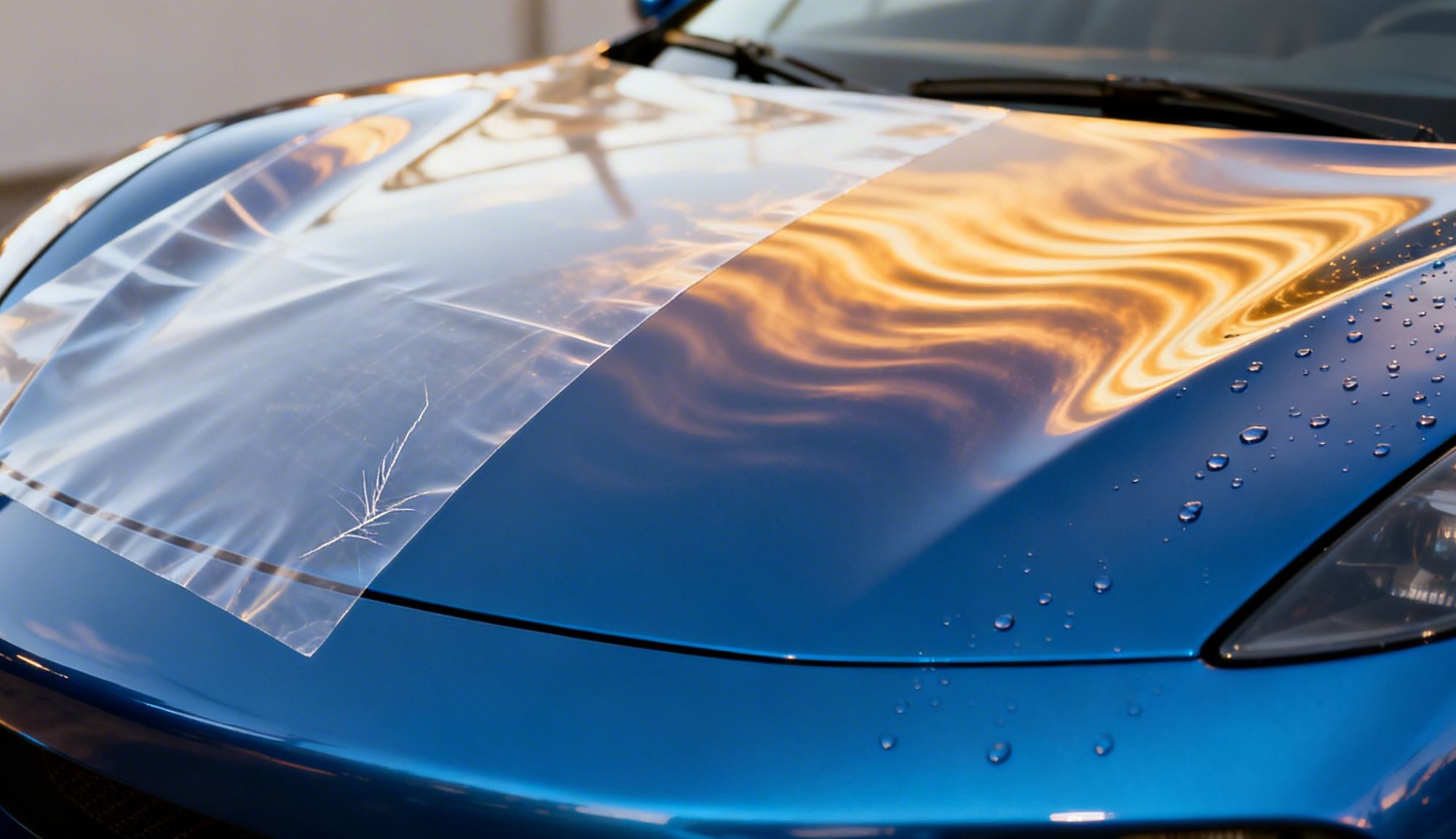
Imagine a nearly invisible shield for your car's paint that doesn't just block scratches but actively makes them vanish. That's the real-world magic of self healing paint protection film (PPF). This high-tech skin, made from a tough thermoplastic polyurethane, is your vehicle's best defense against rock chips, road salt, and the grind of daily driving.
The Ultimate Defense for Your Vehicle's Paint

Think of self healing PPF as a regenerative barrier for your automobile. It’s a transparent, incredibly durable layer that we apply directly over your vehicle's factory paint. Its entire job is to absorb the impacts that would otherwise chip, scratch, or stain that beautiful finish, keeping the paint underneath looking brand new.
But this isn't just a simple sheet of plastic. The real value is hidden in its unique molecular structure. When the film gets a light scratch or a swirl mark—maybe from an automatic car wash, a stray branch, or just daily use—its surface can literally mend itself. This isn't a gimmick; it’s advanced polymer science at work.
Understanding the Self Healing Process
The "magic" behind the self-healing ability comes from a special elastomeric top coat. The easiest way to picture this top layer is as a dense, flexible net of molecules. When a minor scratch happens, it just temporarily pushes these molecules out of place.
With a simple bit of heat—either from the sun's warmth on a typical Georgia day or a heat gun in the hands of a pro—the material’s “memory” kicks in. The polymer chains snap back into their original, flat state, and the blemish effectively disappears.
This process is what allows the film to keep a smooth, glossy look for years, actively fighting off the fine scratches that make a car's finish look dull and tired over time.
Why It Matters for Drivers in Kennesaw and Marietta
For anyone navigating the busy automotive corridors around Kennesaw and Marietta, self healing PPF provides a practical solution to constant threats. From gravel getting kicked up on I-75 to minor scuffs in crowded shopping center parking lots, your car's paint is always at risk. This film gives you peace of mind by creating a sacrificial layer that takes the hit for your paint.
The benefits go far beyond just fixing scratches:
- Impact Resistance: It acts as a durable shield against rock chips, bug splatter, and other road debris that cause permanent paint damage.
- Stain Prevention: The film resists discoloration from bird droppings, tree sap, and harsh chemicals that can etch into unprotected paint.
- UV Protection: It’s formulated with UV inhibitors that block harmful ultraviolet rays, stopping your car's paint from fading and oxidizing.
- Enhanced Appearance: A high-quality PPF adds a noticeable layer of gloss, making your paint color look deeper and far more vibrant.
Ultimately, investing in self healing paint protection film is the single most effective way to preserve your vehicle’s factory finish. Keeping your paint flawless not only maintains its beauty but also significantly boosts its long-term resale value. To get into the nitty-gritty of this protective solution, feel free to explore more about our paint protection film services. It’s the smartest way to keep your car looking like it just left the showroom, year after year.
How The Self-Healing Magic Actually Works

The "magic" that makes scratches on your car disappear isn't an illusion; it's a fantastic piece of material science. This technology is baked right into the top layer of self-healing paint protection film, giving you real confidence that your car is shielded by a durable, repeatable process.
The secret is in the film’s topcoat, which is a special layer of what we call elastomeric polymers. Think of it like a high-tech memory foam. The molecules in this layer are engineered to hold a specific, perfectly smooth shape.
When a light scratch happens—maybe from an automatic car wash brush or a stray key fob—it doesn't actually cut the film. Instead, the impact just pushes those flexible polymers around, creating a dent or mark you can see. The film itself is still whole underneath.
The Science Of Reforming The Surface
This is where things get interesting. That "memory foam" layer has a built-in "shape memory." It always wants to return to its original flat, smooth state. All it needs is a little bit of energy to do it, and that energy comes from heat.
Heat gets the polymer chains moving, giving them the kick they need to snap back into their original formation. As they realign, they pull the surface tight again, and just like that, the indentation is gone. The scratch vanishes completely.
This isn't a one-and-done trick. The film can do this over and over again for its entire lifespan, continuously fixing the minor damage that makes a car look old and worn. This ability to constantly restore itself is one of the core advantages of investing in paint protection film.
Passive vs. Active Healing Explained
Depending on the film and how noticeable the blemish is, this healing process can happen in two different ways. Both rely on the same principle: a little heat goes a long way.
1. Passive Healing (Ambient Heat)
For those ultra-fine swirl marks or faint scuffs, you often don't have to do a thing. The environment does the work for you.
- How It Works: Simply parking your car in the sun on a warm day in Kennesaw or Marietta is often enough. As the film’s surface heats up to around 85°F or more, the polymers start to mend themselves.
- Best For: Light "spiderweb" scratches from washing, minor surface hazing, and other faint blemishes.
- Result: You might come back to your car after a few hours and find the marks have completely disappeared on their own.
2. Active Healing (Applied Heat)
For deeper, more obvious scratches that don't go away on their own, a more direct approach is needed. We call this active healing.
- How It Works: A professional installer, like our team here at The Tint Guy, will use a heat gun to apply controlled warmth to the scuffed area. This targeted heat gives the polymers a much faster kickstart.
- Best For: More defined surface scratches, scuffs from loading groceries, and marks that passive healing can't resolve.
- Result: You can watch the scratch disappear in real-time as the heat is applied, restoring the film to a perfect, glossy finish right before your eyes.
This blend of passive and active healing makes self-healing paint protection film an incredibly smart and resilient shield for any vehicle. It's a layer of defense that doesn't just block damage—it actively repairs it, keeping your car looking flawless day after day.
The Real-World Benefits of Investing in PPF
More than just a cool self-healing trick, installing paint protection film is one of the smartest moves you can make for your vehicle’s long-term health and value. For anyone driving the busy roads of North Atlanta, from Marietta to Kennesaw, it offers real-world defense against the things that ruin a car's finish.
Think about your daily drive on I-75 or the gravel and debris that get kicked up on our local roads. PPF is your car's first line of defense against that constant barrage. This isn't just about keeping your car looking good—it's about protecting your automotive investment every single day.
Unmatched Protection Against Daily Hazards
The most immediate benefit you'll notice with PPF is its sheer physical toughness. The film is engineered to take a hit, absorbing the impact from things that would normally leave a permanent mark on your factory paint.
This protection covers a whole range of common headaches for car owners:
- Rock Chip Defense: It’s a lifesaver for your front end. The film effectively stops small rocks, gravel, and other debris from chipping the paint on your bumper, hood, and mirrors.
- Minor Scuff and Scratch Prevention: PPF acts as a buffer against those frustrating accidental scuffs from shopping carts, tight parking lot bumps, or even just brushing against a stray tree branch.
- Chemical and Environmental Shielding: It forms a barrier that stops acidic bug guts, bird droppings, and tree sap from eating into your clear coat and causing permanent etching.
By shielding your paint from this relentless attack, PPF keeps your vehicle looking like it just rolled off the showroom floor.
The science behind self-healing PPF isn't just hype—it's saving car owners real money and time. In practical terms, these films have hydrophobic topcoats that cut dirt adhesion by up to 70%, meaning you can reduce your wash frequency by as much as 50%. For drivers on highways like I-285, studies show PPF slashes paint damage claims from rock chips by 85%. For our clients at The Tint Guy, this means preserving resale value—industry data shows luxury cars with PPF can fetch 10-15% more at auction. You can dive deeper into these market trends and discover insights on the PPF market from Polaris Market Research.
Superior UV Rejection and Gloss Enhancement
Even the best modern automotive paint jobs aren't immune to the sun. Over time, constant exposure to UV radiation will cause your car's paint to fade, lose its pop, and start oxidizing, leaving it with a dull, chalky look.
A high-quality PPF is like applying a powerful, invisible sunscreen to your entire vehicle. It’s designed to block over 99% of harmful UV rays. This is absolutely critical for maintaining the deep, rich color of your factory paint, especially for cars that spend a lot of time parked outside in the Georgia sun.
On top of that, a professional PPF installation adds a stunning layer of gloss that makes your paint look deeper and richer. It gives the surface that coveted "wet look," making it appear freshly detailed all the time and elevating your car's curb appeal from every angle.
A Smart Financial Decision
When you get right down to it, the biggest benefit of installing PPF is the financial one. A vehicle’s appearance is one of the most critical factors in its resale or trade-in value. A hood full of rock chips or a bumper covered in scratches can knock thousands off what a buyer is willing to pay.
By keeping your original paint in flawless, factory-fresh condition, PPF does an incredible job of preserving your car’s value. The cost of the film is often completely recovered—and then some—by the higher price you'll get when it's time to sell or trade in.
Think of it this way: you can pay for PPF once, or you can pay for paint repairs and a lower resale value later. For car owners in Kennesaw and Marietta who see their vehicle as an investment, PPF isn't an expense. It's one of the best forms of asset protection you can buy for your car.
Comparing PPF, Ceramic Coatings, And Waxes
With so many paint protection options on the market, it’s easy to get confused. Choosing the right one for your car comes down to understanding what each product is really designed to do. Self-healing paint protection film, ceramic coatings, and traditional waxes each have their place, so let’s break down how they compare.
Traditional car wax is the most basic, old-school form of protection. It adds a nice, temporary shine and makes water bead up for a little while. That's about it. The protection is thin and wears off in a few weeks or months, offering almost zero defense against physical damage like scratches or rock chips.
Ceramic coatings are a huge leap forward. This is a liquid polymer that creates a chemical bond with your car’s paint, forming a hard, semi-permanent layer of protection. The result is an incredible deep gloss and powerful hydrophobic properties that make washing your car a breeze. But while a ceramic coating can resist light swirl marks, it offers very little protection from physical impacts. A rock hitting a ceramic-coated hood is still going to leave a chip.
The Superiority Of Physical Defense
This is where self-healing paint protection film is in a league of its own. PPF isn’t a liquid or a wax—it’s an actual physical barrier. It's a tough, clear urethane film engineered specifically to absorb the energy from impacts. Put simply, it’s the only solution that truly stops rock chips, deep scratches, and parking lot scuffs before they ever touch your paint.
Think of it this way: a ceramic coating is like a hard, glossy shell, while PPF is like a durable, impact-absorbing shield. One makes things look shiny and slick; the other takes the hits so your paint doesn't have to.
The technology behind this is what makes it so effective. Innovations from industry leaders like 3M and XPEL have pushed self-healing films to dominate the market, with thermoplastic polyurethane (TPU) films holding an 82.74% market share. This isn't just a simple layer of plastic; it's a complex polymer that can mend scratches on its own with a little heat, restoring up to 98% clarity. Modern films even have up to 200% better elasticity, allowing them to stretch and absorb impacts that would shatter a normal clear coat.
The data shows that these advanced films can extend your paint’s life by 5-7 years and even boost a car’s resale value by $2,000-$5,000 on average. You can find more details on these impressive PPF industry statistics over at wifitalents.com.

This infographic really nails the core benefits: PPF is your damage shield, a UV block to stop paint fade, and a smart way to boost your vehicle's long-term value.
Self Healing PPF vs. Ceramic Coating vs. Traditional Wax
To make the choice clearer, here’s a side-by-side comparison of the three most popular automotive paint protection methods.
| Feature | Self Healing PPF | Ceramic Coating | Traditional Wax |
|---|---|---|---|
| Scratch & Chip Protection | Excellent. Absorbs physical impacts from rocks and debris. | Fair. Resists light swirls but offers no real impact protection. | Poor. No defense against scratches or chips. |
| Durability | 5-10 years. A long-term, semi-permanent solution. | 2-7 years. A durable, semi-permanent bond. | 1-3 months. Very temporary and needs frequent reapplication. |
| Self-Healing | Yes. Minor scratches and swirls disappear with heat. | No. Scratches are permanent until polished out. | No. |
| Gloss & Shine | Good. Enhances existing gloss; can be coated for more. | Excellent. Creates a deep, "wet look" gloss. | Good. Provides a warm shine but doesn't last. |
| Ease of Cleaning | Good. Can be made excellent by adding a ceramic coating. | Excellent. Extremely hydrophobic; dirt and water slide off. | Fair. Mild water beading when freshly applied. |
| Cost | High. The most expensive upfront investment. | Medium. More than wax, but less than a full PPF wrap. | Low. The cheapest option available. |
As you can see, each option has its pros and cons. While wax is affordable, it just doesn't offer real protection. A ceramic coating is a fantastic choice for looks and easy maintenance, but it can't stop a rock chip. Self-healing PPF stands alone as the only true defense against physical damage.
The Ultimate Combination For Total Protection
Here’s the good news: you don't have to choose between the physical defense of PPF and the slick gloss of a ceramic coating. For discerning car owners in Marietta and Kennesaw, the ultimate solution is to combine them.
This "best of both worlds" approach gives you complete protection. Here’s how we do it:
- PPF on High-Impact Areas: We expertly install self-healing paint protection film on the most vulnerable parts of your car—the full front bumper, hood, fenders, and side mirrors. These are the areas that take a constant beating from road debris.
- Ceramic Coating Over Everything: Once the film is in place, we apply a professional-grade ceramic coating over the entire vehicle. Yes, you can coat right over the PPF!
This combination gives you total peace of mind. You get the rugged impact resistance of PPF where you need it most, plus the slick, easy-to-clean surface and show-stopping gloss of a ceramic coating everywhere else. It's the ultimate shield for your automotive investment.
If you want to dig deeper into how these two powerhouses work together, check out our guide comparing paint protection film and ceramic coatings.
Why Professional Installation Is The Only Option
The incredible performance of a premium product like self-healing paint protection film comes down to one thing: the quality of the installation. While DIY kits might look like a tempting way to save a few bucks, trying to install PPF yourself is a recipe for frustration and a costly mistake.
For a flawless finish that actually protects your vehicle, choosing a certified expert like The Tint Guy isn't just a recommendation—it's essential.

The market for this automotive protection is booming for a reason. The scratch-healing segment alone hit $2.5 billion in 2023 and is on track to reach $3.5 billion by 2028. This explosion is thanks to huge leaps in the quality of thermoplastic polyurethane (TPU), which now makes up over 80% of the U.S. automotive market. Even car manufacturers are getting in on it, integrating PPF at the factory level.
It’s clear professional application is the industry standard. Our teams in Marietta and Kennesaw can deliver this factory-level quality in just 2-4 hours. You can discover more about the growing PPF market here.
The Risks Of A Poor Installation
A bad PPF job doesn't just look sloppy. It completely fails to protect your car and can even damage the paint underneath. Without the right tools, a controlled environment, and years of experience, you're almost guaranteed to run into problems.
Common DIY failures include:
- Bubbles and Air Pockets: Trapped air looks terrible and weakens the bond, leading to bigger issues down the road.
- Lift Lines and Edge Peeling: If the film isn't perfectly anchored and wrapped around every edge, it will start to peel up and collect dirt and grime.
- Trapped Debris: Even one tiny speck of dust or hair caught under the film becomes a permanent, visible flaw that ruins the entire look.
- Stretch Marks and Distortion: Overstretching the film or applying it unevenly creates ugly lines and distorts the clarity, making your paint look warped.
A professional installation is your only guarantee that the film performs as designed and that your manufacturer's warranty remains valid. Attempting a DIY installation almost always voids this crucial protection.
The Meticulous Process Of A Professional
At The Tint Guy, our installation process is a craft we've perfected for vehicles like cars, trucks, and SUVs, and it starts long before any film touches your car. A perfect result demands a perfect canvas.
1. Multi-Stage Decontamination
First, we perform a thorough decontamination wash to get rid of all loose dirt. Then comes the clay bar treatment, which safely pulls out embedded contaminants like industrial fallout and tar—the stuff you can't see but can definitely feel on a vehicle's paint.
2. Precision Plotting and Cutting
We leave nothing to chance. We use advanced computer software and a plotter to precision-cut the PPF patterns specifically for your car's make, model, and year. This means every piece fits perfectly without ever having to risk cutting on your paint.
3. Expert Application and Edge Wrapping
Our certified technicians apply the film using a special slip solution, which lets us position each piece perfectly. We then carefully squeegee out every drop of moisture and air before meticulously wrapping the film's edges around panel gaps. This creates a truly invisible, seamless finish and is what separates a good job from a great one.
Common Questions About Self Healing PPF
When you're considering a big investment in your car's protection, you're going to have questions. We get it. Over the years at our Marietta and Kennesaw shops, we've answered thousands of them. Here are the most common things drivers want to know about self healing paint protection film.
How Long Does Self Healing PPF Last?
This is usually the first question people ask, and for good reason. A professionally installed, high-quality PPF from a top-tier brand like 3M or XPEL is built to go the distance, typically lasting between 7 and 12 years.
Of course, the final lifespan depends on the specific film you choose, how much time you spend on the road, and how you care for your car. To give you total peace of mind, every installation we do at The Tint Guy is backed by a full manufacturer's warranty. This covers issues like yellowing, cracking, or delaminating, so you know your investment is secure for years to come.
Can I Use A Car Wash With PPF?
Yes, you absolutely can—and should! Keeping your car clean is key to maintaining the film's appearance. The only thing we ask is that you wait 48-72 hours right after the installation. This gives the film’s adhesive time to fully cure and bond to your paint.
Once that waiting period is over, keeping it clean is easy.
- Hand Washing: This is always the safest bet. Use a pH-neutral car soap, a soft microfiber mitt, and the two-bucket method to prevent any swirl marks.
- Touchless Car Washes: These are perfectly safe for cars protected with PPF.
- High-Pressure Wands: Just be careful with these. Avoid blasting the edges of the film directly with high-pressure water, which could risk lifting an edge over time.
One of the best parts about modern PPF is its hydrophobic top coat. This layer actively sheds water and grime, which makes washing your car noticeably easier and helps it stay clean longer.
Will PPF Removal Damage My Car's Paint?
Not when it's done right. When a trained professional removes high-quality PPF, it will not harm your car's original factory paint. The adhesives are incredibly advanced; they're designed to hold on tight for a decade but release cleanly when the right techniques are used.
Trying to peel the film off yourself without the proper tools and heat can be a disaster. You risk leaving behind a sticky mess of adhesive or, even worse, pulling up a layer of your clear coat.
When the time comes to remove or replace the film, our technicians in Marietta and Kennesaw will handle it. We can safely lift the old layer, revealing the perfectly preserved paint underneath. It will look just as good as the day we first applied the film, proving it’s the single best way to protect your car’s original finish.
Is The Film Completely Invisible On The Car?
Premium self healing paint protection film is designed to be optically clear and virtually invisible. The whole point of a professional job is for the protection to disappear, leaving nothing behind but a deep, flawless gloss.
So, how do our installers pull this off? It comes down to two key techniques:
- Precision-Cut Patterns: We don’t guess. We use computer-plotted designs that are custom-fit to the exact make and model of your vehicle. This ensures every edge and curve is covered with perfect accuracy.
- Wrapped Edges: Whenever we can, we tuck and wrap the film’s edges around the inside of body panels, like the lip of your hood or the edge of a door. This hides any visible seams and creates a truly invisible finish.
On some very light-colored paints, you might be able to spot an edge if you get down and look for it from an extreme angle. But for all practical purposes, the film is undetectable. The only thing you—and everyone else—will notice is how stunning your paint looks without all the usual rock chips and scratches.
Ready to give your car the ultimate defense against scratches and rock chips? The Tint Guy offers expert installation of premium self healing paint protection film at our convenient locations in Marietta and Kennesaw.
Schedule Your Free Consultation at thetintguy.com