
So, you just got your car's windows tinted. You paid for high-performance ceramic film, but how do you really know that's what you got? True ceramic tint is all about performance—its superior heat rejection and crystal-clear clarity are things you feel, not just see.
Is Your Car Window Tint Really Ceramic?
Here in Kennesaw and Marietta, GA, investing in ceramic window tinting is one of the smartest moves you can make to fight that brutal Georgia heat. It's a game-changer for protecting your vehicle's interior. But telling different automotive film types apart can be tricky if you don't know what you're looking for.
Let's get down to what makes ceramic tint special: its construction. This isn't just a dark piece of plastic. Genuine ceramic automotive tint is infused with non-conductive, microscopic ceramic nanoparticles. Their entire job is to absorb and reject a massive amount of infrared heat—that's the heat you actually feel beaming from the sun. This is the technology that keeps your car's cabin comfortable without needing a super-dark, limo-style look.
The Science of Superior Performance
The real magic is in how different car tint films handle solar energy. Older films use dark dyes or reflective metals, but ceramic tint is a whole different ballgame.
- Infrared (IR) Rejection: This is the absolute hallmark of a true ceramic film. Its nanoparticles are specifically engineered to target and block those heat-causing infrared rays.
- No Signal Interference: Because there's no metal in the film, ceramic tint will never mess with your GPS, satellite radio, or cell phone reception. It's a clean signal, every time.
- UV Protection: This is non-negotiable. Premium ceramic films block over 99% of harmful ultraviolet rays, which is crucial for protecting your skin and preventing your car’s interior from fading and cracking.
- Lasting Color: Forget that awful purple bubbling you see on older cars. The ceramic particles create a stable, deep charcoal color that is built to last and will not fade over time.
One of the most immediate giveaways of a genuine ceramic film is its heat-blocking power. We're talking about top-tier ceramic films that can block up to an incredible 98% of infrared heat. For comparison, many standard tints are lucky if they hit 50%.
Market data from across the auto industry backs this up, showing that even average ceramic window tint films block between 50-70% of infrared heat. That performance comes directly from those embedded nano-ceramic particles doing their job.
For a quick reference, check out this cheat sheet comparing the most common types of automotive tint you'll find on the road.
Quick Tint Identification Cheat Sheet
| Characteristic | Ceramic Tint | Carbon Tint | Metallic Tint | Dyed Tint |
|---|---|---|---|---|
| Heat Rejection | Excellent (up to 98% IR) | Good (up to 60% IR) | Good | Poor |
| Signal Interference | None | None | High (can block signals) | None |
| Clarity | Crystal Clear | Very Good | Good (can be reflective) | Fair (can distort) |
| Color Stability | Excellent (won't fade) | Very Good (resists fading) | Good (can corrode) | Poor (turns purple) |
| UV Protection | 99%+ | 99% | 99% | Up to 99% (can degrade) |
| Cost | Premium | Mid-Range | Mid-Range | Budget-Friendly |
This table gives you a solid starting point for figuring out what's on your car's glass.
Knowing these core differences is key. It empowers you to look at the film on your own vehicle and assess it with confidence. To get a really deep dive into the specifics, you can learn more about the benefits of ceramic tint vs regular tint in our detailed guide.
Putting Your Tint to the Heat Test
Visual cues can be a good starting point, but the real proof of a ceramic tint is in its performance. After all, a genuine ceramic film's number one job is rejecting infrared heat, and you can often feel the difference yourself with a couple of simple, hands-on tests.
The easiest way to check requires nothing more than a sunny day and your own two hands. On a bright afternoon, park your car so the sun is hitting it directly. First, put one hand on the inside of your untinted front windshield and feel the heat coming through. Now, move that same hand to the inside of one of your tinted side windows.
If you’ve got a true ceramic tint, the difference should be obvious. The glass on the tinted window will feel significantly cooler than the windshield, which is letting far more solar heat pour into your car.
A More Precise Approach to Heat Testing
For a more data-driven answer, grab an infrared (IR) thermometer. These handy devices are easy to find and measure surface temperature without any contact, giving you a clear number to work with.
Here’s how to do it:
- Aim the IR thermometer at your dashboard through the untinted front windshield and take note of the temperature.
- Next, aim it at an interior part (like your door panel or seat) through a tinted side window.
- Compare the readings. A major temperature drop on the surface behind the tinted glass is a dead giveaway that a high-performance ceramic film is on the job.
Picture this: two identical cars are parked in a Marietta, GA, lot on a blistering summer afternoon. One has a basic dyed tint, and the other has a premium ceramic film from us at The Tint Guy. An hour later, the first car is an oven inside. The car with ceramic tint? Noticeably more comfortable. That’s the real-world value of superior IR rejection.
This simple decision tree shows you exactly what to look for when you're testing your tint's performance.
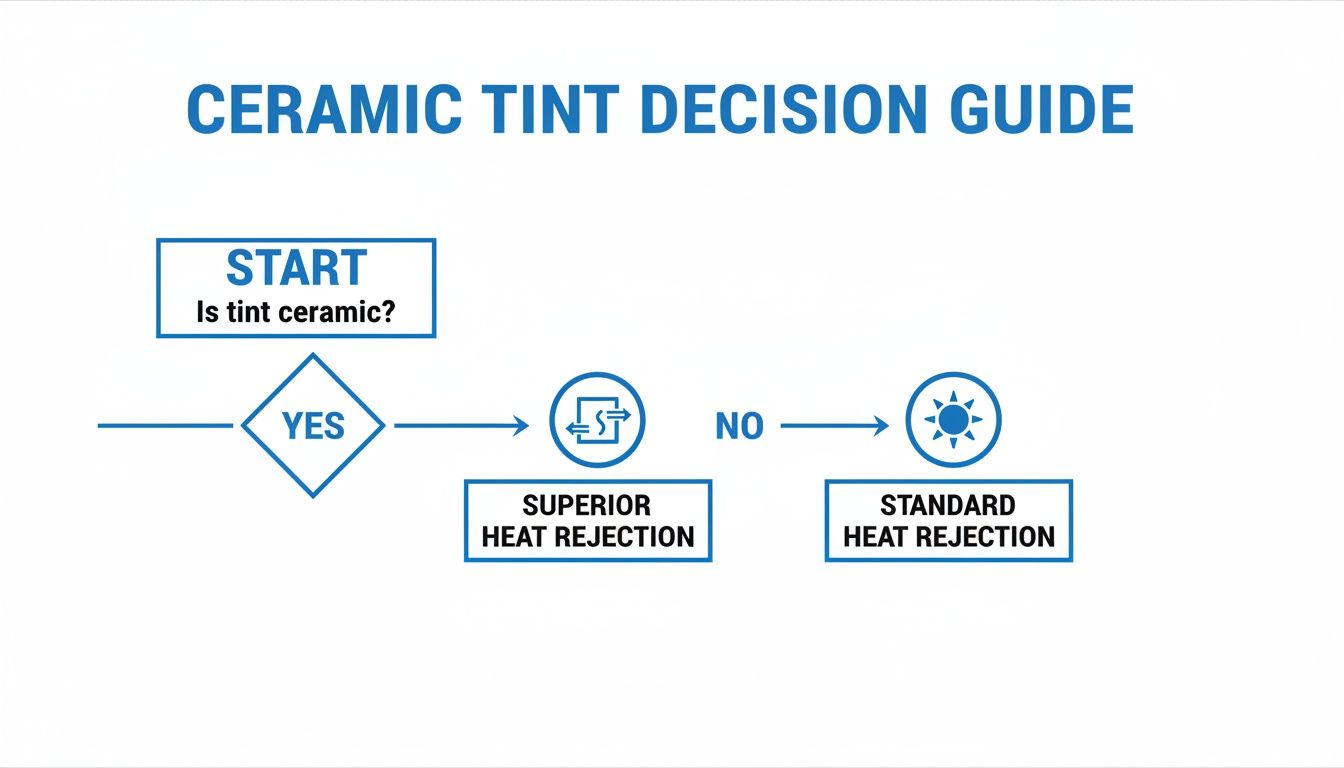
As the chart shows, superior heat rejection is the key. If your car tint is effectively blocking heat, chances are high that it's ceramic. When you're doing the heat test, it helps to know that nano-ceramic film is widely considered the best window tint to reduce heat, so a significant temperature difference is a very strong clue.
Key Takeaway: Performance doesn't lie. A noticeable drop in the heat you can feel is the single most reliable sign you have a genuine ceramic window tint installed on your car.
If your current auto tint just isn't cutting it in the heat, it might not be the high-performance film you paid for. To get a better handle on how these films work their magic, check out our guide on how window tint reduces heat. Ultimately, this hands-on test is your first and best line of defense against being sold a counterfeit or low-quality film.
Checking for Uninterrupted Signal Strength
One of the defining features of a genuine ceramic tint is what it’s made of—and, maybe more importantly, what it’s not made of. True ceramic films are completely free of metal, a crucial detail that sets them apart from older, signal-blocking metallic tints. This non-conductive makeup gives you a simple but surprisingly effective way to test what’s on your car’s glass.
Think of old-school metallic tints as a weak but persistent signal jammer. The tiny metal particles woven into the film can play havoc with the radio waves that your car's electronics depend on. Ceramic tint, on the other hand, is specifically engineered to be totally transparent to these signals.
Running a Simple Signal Diagnostic
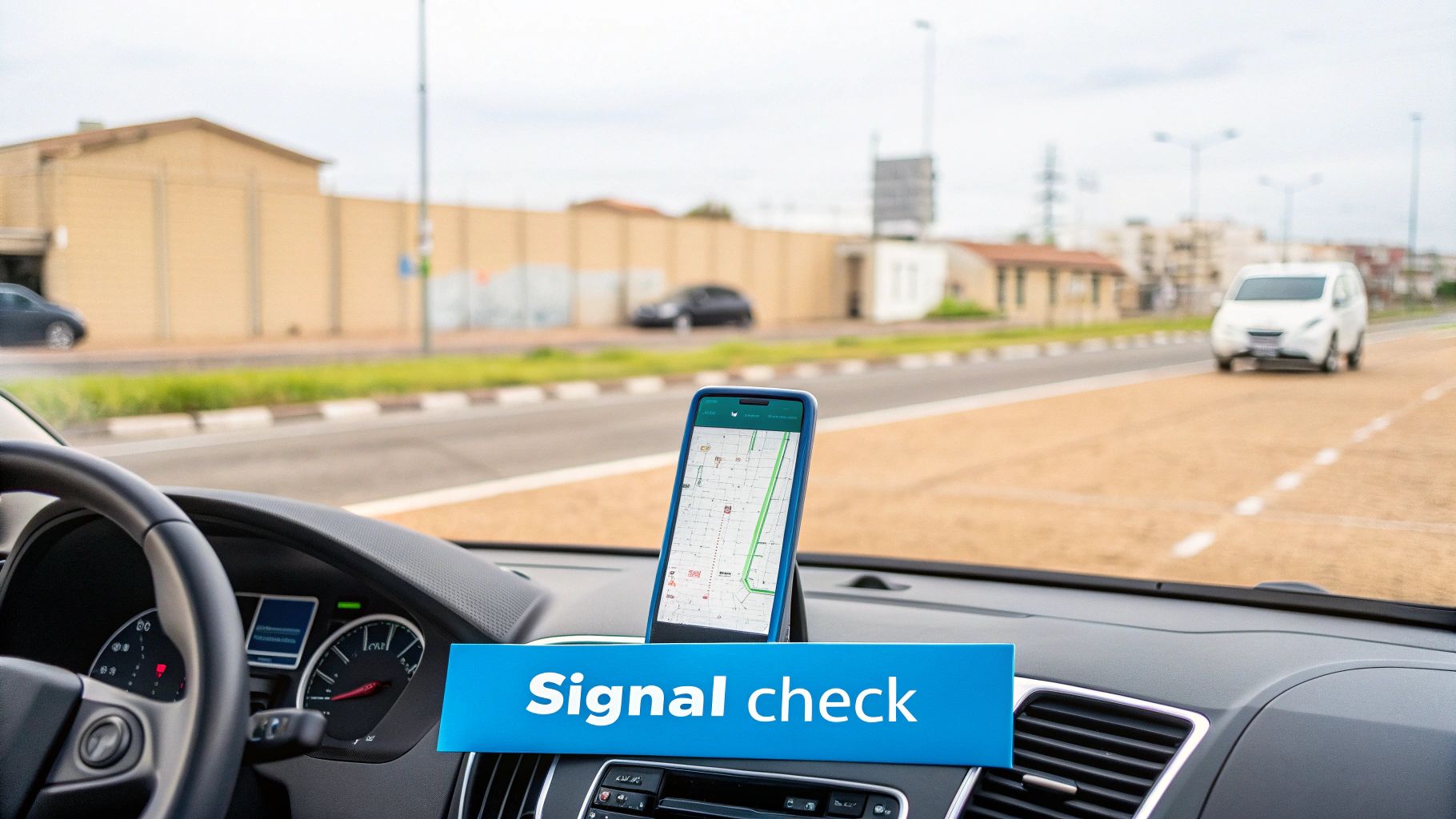
You don’t need any fancy equipment for this test, just the devices you use every day. Hop inside your car, close the doors, and run through a quick check of your electronic systems.
- Make a Phone Call: Dial a friend or family member. If the audio is crystal clear and the connection holds steady without dropping, that’s a solid first sign.
- Use Your GPS: Fire up a navigation app like Google Maps or Waze and punch in a destination. The system should lock onto a satellite signal almost instantly and track your location without any frustrating lag.
- Tune the Radio: Flip between a few of your go-to AM and FM radio stations. The sound should come in crisp and clean, without any weird static or fading as you move around.
If all these devices work without a hitch, it’s highly likely you have a non-metallic film installed. This is a strong clue that points toward either a ceramic or a high-quality carbon tint, both of which are designed for modern, connected cars. The differences between the two are significant, and you can dig into a detailed comparison of carbon vs. ceramic tints to understand what sets them apart.
The Problem with Metallic Films
Years ago, metallic tints were a popular choice for cars, but their tendency to cause signal interference made them a poor fit for today's drivers. A car with metallic tint might give you headaches like:
- Dropped calls, especially in areas with weaker service.
- A GPS that constantly lags or struggles to pinpoint your exact location.
- Radio reception that’s full of static and fuzz.
This becomes especially obvious when you're driving through areas like Kennesaw or Marietta, where a reliable GPS is practically a necessity. If you’re constantly battling your electronics, a metallic film is almost certainly the culprit.
Expert Insight: Clear, uninterrupted signals are a hallmark of modern, high-quality automotive tint. If your phone, GPS, and radio work perfectly, you have passed one of the key tests for identifying a non-metallic film like ceramic.
This simple check gives you powerful clues about the type of tint on your car. When you combine this test with the other methods, you'll get a much clearer picture of your film's true identity.
Finding Visual Clues in Color and Markings
While performance tests give you the most definitive answer, a good old-fashioned visual inspection can tell you a lot about your car's window tint. Knowing what to look for can help you spot the difference between a high-quality ceramic film and a cheap imposter right away.
The very first thing to look at is the color. A genuine ceramic tint has a rich, stable charcoal or black look that’s consistent from every angle. It's designed to hold that true color for life. On the flip side, cheap dyed films are notorious for their short lifespan. Sun exposure quickly degrades them, causing them to fade into that dreaded purplish hue. If you see even a hint of purple, you can be almost certain it's not ceramic.
Scrutinizing the Details
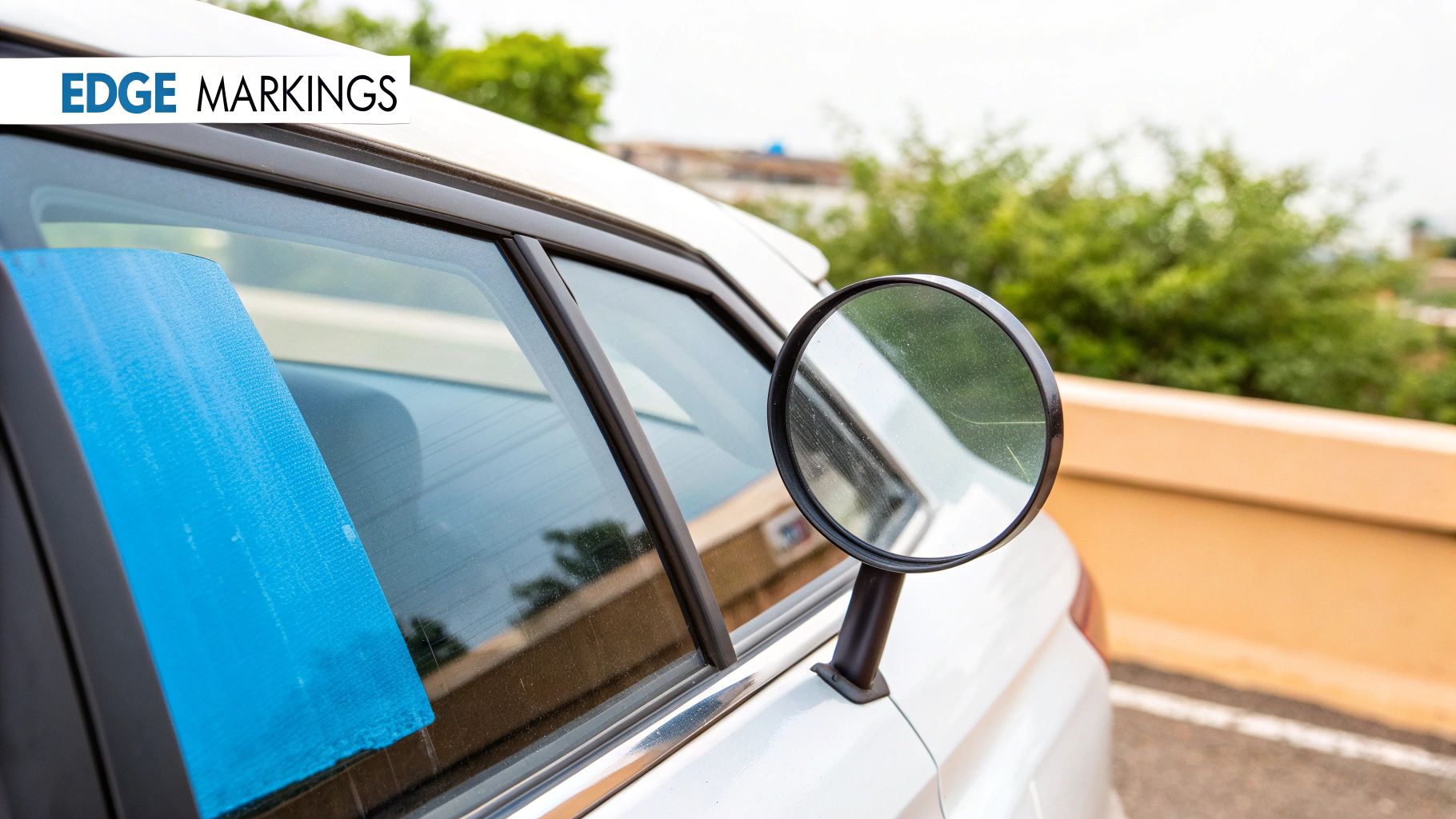
Beyond just the overall color, get up close and personal with the film's edges. Top-tier manufacturers like 3M or LLumar sometimes embed faint watermarks or logos directly into their films. You might need to roll the window down just a crack and look at the very top edge of the glass to spot them. Finding a brand name is a dead giveaway you’re looking at an authentic, professional-grade film.
Another huge clue is how well the tint is protecting your car's interior. A key feature of real ceramic tint is its UV protection—premium films are warrantied to block 99% or more of harmful UV rays. This is a benchmark that high-end ceramic films consistently hit. This is the kind of protection that stops your dashboard from cracking and your seats from fading, preserving your car’s value over time. You can dig deeper into how these films stack up by exploring research on ceramic tint technology.
Finally, take a hard look at the quality of the installation itself. A professional car tinting job stands out.
- Flawless Adhesion: A professional ceramic tint installation should be perfect. No bubbles, no peeling, no creases. Period.
- Clean Edges: The film should run right to the edge of the glass with a clean, almost invisible micro-edge cut.
- Uniform Appearance: The color and clarity should be completely consistent across every single window on the vehicle.
Key Takeaway: A premium ceramic tint is identified by its stable, true-black color, flawless installation, and potential manufacturer markings. Any signs of fading, bubbling, or a purplish tint strongly suggest a lower-quality, non-ceramic film.
Why a Professional Inspection Is the Only Surefire Method
While those at-home tests can give you some pretty strong clues, they aren't foolproof. The only way to know with 100% certainty if your automotive tint is a genuine ceramic film is to have a professional take a look. DIY methods can get you in the ballpark, but they just can't deliver the hard data needed for a definitive answer.
Guesswork simply isn’t good enough when your comfort and your vehicle's interior are on the line. That's why we rely on specialized equipment designed for one purpose: measuring car window film performance with scientific precision.
The Power of Professional Tint Meters
Here at The Tint Guy, our technicians in Kennesaw and Marietta use advanced transmission meters to analyze your car’s window film. These professional tools eliminate all doubt by providing exact measurements of your tint's capabilities. There's no hiding from the data these devices produce.
Here’s what a professional meter tells us in just a few seconds:
- Visible Light Transmission (VLT): We can instantly confirm the legal darkness of your tint.
- UV Rejection: This measures the percentage of harmful UV rays being blocked, which should be 99% or higher for any quality film.
- Infrared (IR) Rejection: This is the big one. It measures the exact percentage of heat-generating infrared rays your film is blocking.
A low IR reading is the smoking gun that proves a tint is not a high-performance ceramic film, no matter how dark it looks or how new it is. This data-driven approach is the gold standard for verification.
Your Complimentary Automotive Tint Analysis
If you're questioning the tint on your vehicle, don't leave it to chance. The Tint Guy offers a complimentary inspection service at both our Kennesaw and Marietta locations. We believe every car owner deserves to know exactly what they paid for.
Our Promise: We provide a no-pressure, data-backed analysis of your current automotive window tint. Our goal is to educate you on your film's performance and offer honest, expert recommendations.
During your free consultation, our experienced technicians will carefully test your film using our transmission meters. We'll then walk you through the results, explaining in plain English what the numbers mean for your comfort and your car’s interior protection.
If your tint passes the test, fantastic! We’ll give you that peace of mind. If it falls short, we can discuss your options for upgrading to a genuine, high-performance ceramic window tint from a world-class brand, backed by a lifetime warranty.
Don’t spend another day wondering if your auto tint is doing its job. Schedule your free, professional tint inspection with The Tint Guy today and get the definitive answer you deserve.
Common Questions About Identifying Ceramic Tint
Even with these tests and visual cues, a few questions always pop up when you're trying to figure out if you have a genuine ceramic tint on your car. We hear these all the time from car owners at our shops in Kennesaw and Marietta, so let's clear them up.
Can I Tell If My Car Tint Is Ceramic by Its Darkness?
No, darkness alone is not a reliable indicator. This is a common misconception we see all the time. The darkness level, known as Visible Light Transmission (VLT), is completely separate from the film's material.
A 20% VLT dyed film and a 20% VLT ceramic film will look equally dark from the outside. The real difference is in performance, not looks. The ceramic film is going to block a massive amount of infrared heat, keeping your car's interior worlds cooler. You have to rely on performance—like heat rejection and signal clarity—not just how dark the tint looks.
Does a Blue or Green Tint Hue Mean It Is Ceramic?
Not necessarily. While some high-end ceramic films might show a very faint blue or greenish hue in certain light, it's not a universal or dependable sign. So many things can affect the perceived color, including the angle of the sun and the type of glass on your car.
The most reliable tests are always performance-based. Ask yourself these two questions:
- Superior Heat Rejection: Does the tint actually block the sun's heat? Can you feel a real difference?
- Zero Signal Interference: Do your GPS, radio, and phone work flawlessly?
If you can answer a strong "yes" to both, you're likely dealing with a high-performance film. On the flip side, if your tint is bubbling, peeling, or has turned purple, that's a guaranteed sign of a failing, low-quality dyed film—definitely not ceramic.
What if I Discover My Automotive Tint Is Not Ceramic?
It’s definitely frustrating to find out your current tint isn't giving you the heat rejection or UV protection you thought you paid for. If you discover you have a lower-quality film, the best move is a professional upgrade.
At The Tint Guy, we specialize in the safe and complete removal of old or underperforming automotive window tint. Our technicians in Kennesaw and Marietta can efficiently strip that old film and replace it with a genuine ceramic tint from a top-tier brand like 3M or LLumar. This ensures you get the real performance, UV protection, and longevity you deserve, all backed by a lifetime warranty.
Expert Advice: Trying to remove old tint yourself often ends in a sticky, frustrating mess and can easily damage the delicate defroster lines on your car's rear window. It’s absolutely a job best left to experienced pros who have the right tools and techniques.
Is a Professional Tint Inspection From The Tint Guy Worth It?
Yes, and it’s one of the smartest things you can do—especially since our initial consultations are complimentary. When you bring your car to one of our locations in Kennesaw or Marietta, our technicians can use professional-grade solar transmission meters to get precise, undeniable data on your tint's performance.
This equipment gives us hard numbers on UV and IR rejection, providing a definitive answer and giving you complete peace of mind. From there, we offer honest, straightforward advice on whether upgrading to a genuine ceramic film is the right call for your vehicle and your needs.
Stop guessing and get the facts. If you're in the Kennesaw or Marietta area, let the experts at The Tint Guy give you a definitive answer on your car’s window tint. Schedule your free consultation today to ensure your vehicle has the high-performance protection it deserves. Visit us online to book your appointment.