
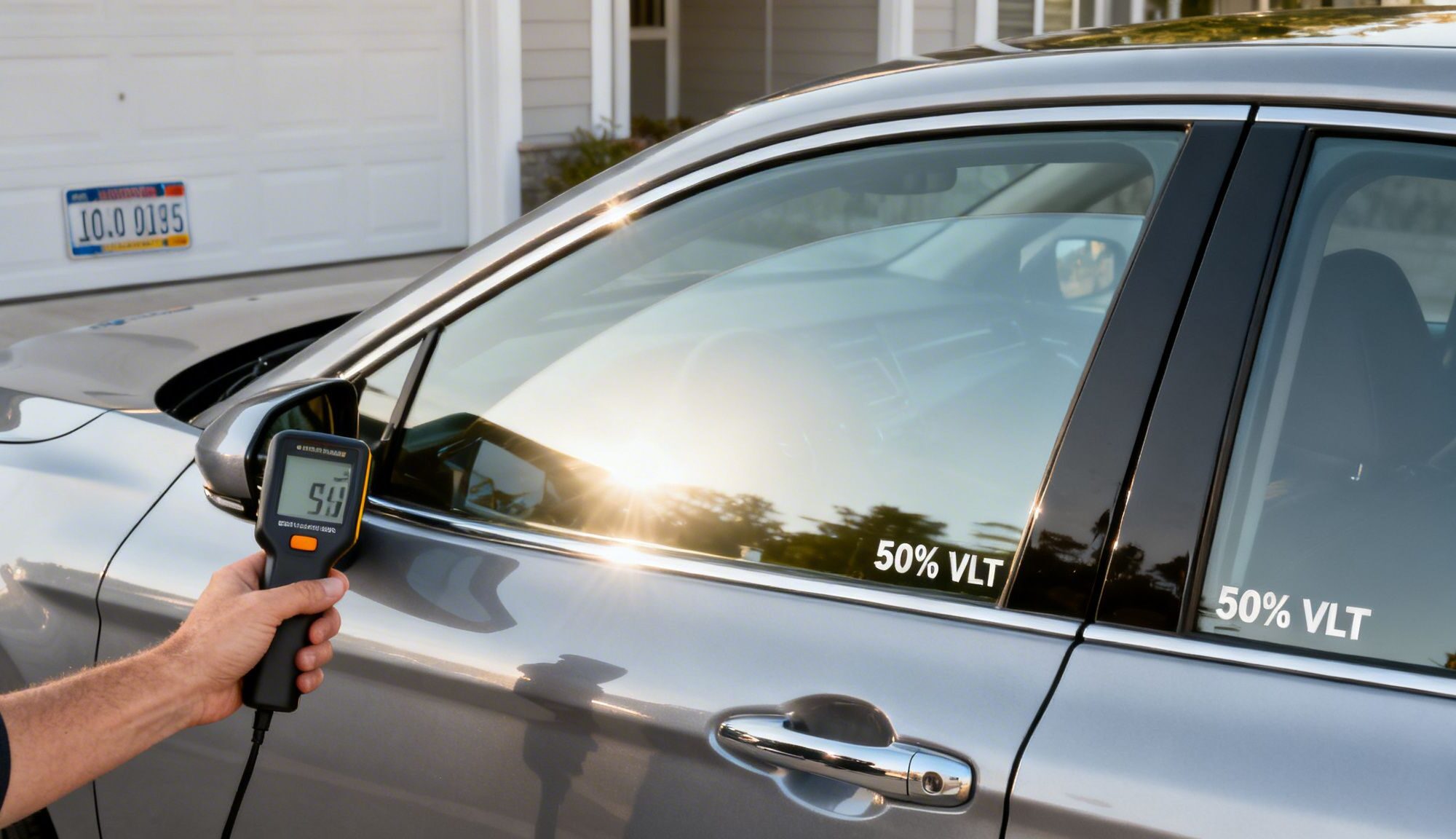
Navigating the rules around automotive window tinting can feel like a maze, but when it comes to Ohio, the regulations are refreshingly straightforward. Getting a handle on these laws is the first step to getting that perfect look for your ride while staying completely above board.
For car owners in the Buckeye State, there's one magic number to remember: 50%.
What Is The Legal Tint Limit In Ohio
It all comes down to a measurement called Visible Light Transmission (VLT). Think of it as the percentage of light that can pass through your window glass and the tint film combined. The lower the VLT percentage, the darker the tint.
Here at The Tint Guy, we live and breathe automotive window tinting. Our expertise means your car, truck, or SUV will not only get the top-tier benefits of a quality tint—like UV protection and heat rejection—but will also be perfectly in line with Ohio's legal standards.
Ohio's VLT Rules For Different Vehicle Windows
Ohio’s approach is all about balancing your comfort and privacy with road safety for everyone. The rules create a clear line between the windows a driver needs for a clear field of vision and the ones in the back.
The state actually made things pretty simple for us back in 2004 when they set the standards. The law says your front side windows must have a VLT of 50% or more, meaning at least half the light has to get through. For the windshield, a non-reflective tint is allowed, but only on the top 5 inches (above the AS-1 line).
This infographic gives you a quick visual breakdown of the main rules.

As you can see, the front doors have that strict 50% minimum, but for the back half of the car, you’re free to go as dark as you want.
Key Takeaway: The most important number for any Ohio driver is 50% VLT for the two front side windows. For every window behind the driver, you have total freedom to choose any shade you like.
Passenger Cars vs SUVs and Trucks
So, how do these rules apply to different vehicles? This is one of the best parts about Ohio's law: it's consistent. Whether you're driving a sporty coupe, a family sedan, a big SUV, or a work truck, the rulebook doesn't change.
Let's put all the rules in one simple table so you can see them at a glance.
Ohio Automotive Tint Laws At A Glance (VLT %)
| Window Location | Passenger Vehicle (Sedan, Coupe) | Multi-Purpose Vehicle (SUV, Van, Truck) |
|---|---|---|
| Windshield | Non-reflective tint allowed on top 5 inches | Non-reflective tint allowed on top 5 inches |
| Front Side Windows | Must be 50% VLT or lighter | Must be 50% VLT or lighter |
| Back Side Windows | Any darkness | Any darkness |
| Rear Window | Any darkness | Any darkness |
This unified approach makes it incredibly easy for vehicle owners to stay compliant. There's no need to second-guess if your truck has different rules than your car.
And to get a better sense of where tinting fits into vehicle modifications, it's always a good idea to be familiar with the general Ohio traffic laws.
Why Tint Reflectivity And Color Matter
Most of the talk around Ohio's tint laws focuses on darkness, or VLT. But there's another factor that's just as important: reflectivity. It’s not just about how dark your windows are; it's also about how shiny they look.
Ohio law is crystal clear on this. There's a strict, total ban on any reflective or mirrored tint films for any window on a car, truck, or SUV.
Think about it this way. Have you ever driven next to a car with super-shiny windows that act like a moving mirror, blasting sunlight right into your eyes? It's incredibly distracting and downright dangerous. To prevent exactly that kind of hazard, Ohio lawmakers banned any tint that makes your windows more reflective than untreated factory glass.

The Problem With Reflective Automotive Tint
Reflective tints, which you might hear called metallic or mirrored films, get that shiny look from a thin layer of metal particles embedded inside. While these films can be pretty good at blocking heat, that mirror-like finish is precisely what makes them illegal for any automotive use in Ohio.
This isn't some minor rule. It has a huge impact on the types of tint available to Ohio drivers.
Ohio's window tint laws are unique because of the complete ban on reflective materials. The regulations state that no reflectorized materials are permitted on any window. This blanket restriction removes about 15-20% of all commercially available automotive tint options that have metallic or mirror finishes.
This hard-line rule prioritizes road safety above all else, ensuring that every legally tinted vehicle in the state has a non-reflective appearance.
Compliant Films vs Illegal Films
So, how do you stay on the right side of the law? You have to choose a non-reflective tint. The good news is the best-performing automotive films on the market today are naturally non-metallic and fully compliant with Ohio's rules.
- Ceramic Window Tint: This is the best you can get for any vehicle. It uses advanced nano-ceramic particles that are non-metallic and non-reflective. Ceramic tint gives you maximum heat rejection, 99% UV protection, and amazing clarity without messing with your phone or GPS signals.
- Carbon Window Tint: This is another fantastic, compliant choice. Carbon film uses microscopic carbon particles to absorb heat. It looks great with a stylish matte finish that won't fade or turn purple like the cheap stuff.
- Metallic (Mirrored) Tint: This is the main type of illegal film. Its high reflectivity creates that mirror effect that is explicitly forbidden on any car window in Ohio.
Here at The Tint Guy, we only install professional-grade ceramic and carbon films. We do not carry, sell, or install metallic or mirrored films, which guarantees every vehicle we work on is 100% compliant with Ohio law.
What About Tint Color?
We get this question all the time: are certain tint colors illegal? The simple answer is no. Ohio law doesn't ban any specific colors. Standard automotive tint shades like gray, charcoal, bronze, and even blue are all perfectly fine.
But there's a big catch. The color doesn't matter if the film is reflective. A blue, bronze, or gray tint that has a shiny, metallic finish is just as illegal as a classic silver mirror tint. The single most important factor is always the reflectivity, not the color.
By choosing a professional automotive installer like The Tint Guy, you take all the guesswork out of it. We'll help you pick a high-quality, non-reflective film that looks and performs great while ensuring you're fully compliant with Ohio's tint laws. To get a better handle on how these films are made, check out our guide on window film types and their benefits.
Understanding The Penalties For Illegal Automotive Tint
Choosing a window tint that's darker than the legal limit in Ohio might seem like a small risk, but the consequences can be a lot more than just a minor inconvenience. Sure, the tint might look great, but a run-in with law enforcement will quickly show you the hidden costs of bending the rules.
So, what really happens if your car’s tint is too dark?
Getting caught with non-compliant tint is classified as a minor misdemeanor in Ohio. While that's a low-level offense, it still comes with real-world penalties, starting with the traffic ticket itself.

The Financial Cost Of An Ohio Tint Ticket
The fine for a tint violation usually lands around $120. This amount can vary a bit, but it’s an unexpected expense that can easily ruin your day. The ticket, however, is just the beginning of the financial headache.
The real sting isn't just the one-time fine; it's what we call the "pay twice" problem that comes next.
The "Pay Twice" Problem: When you get a ticket for illegal automotive tint, you first pay the fine itself. Then, you're ordered to remove the illegal film. This means you have to pay a professional for the labor-intensive process of tint removal—effectively paying for your tint a second time just to take it off.
This cycle turns a single aesthetic choice into a frustrating and costly mistake. You pay for the initial installation, you pay the fine, and then you pay again for removal. You end up right back where you started, without the tint you wanted in the first place.
The Inspection And Enforcement Process
How do police officers even know your tint is too dark? It’s not just guesswork. Law enforcement in Ohio is equipped with handheld devices called VLT meters, or tint meters.
During a traffic stop, an officer can easily and accurately measure the Visible Light Transmission of your windows right on the spot. Here’s how it usually plays out:
- The Stop: An officer might pull you over if your windows appear visually darker than what's normally allowed, giving them reasonable suspicion to investigate further.
- The Measurement: The officer places the two-piece tint meter on either side of your window glass. The device sends a beam of light from one side to the other, instantly calculating the exact percentage of light passing through.
- The Result: The digital screen on the VLT meter provides immediate, objective proof of whether your tint is compliant with Ohio’s 50% VLT requirement for front side windows.
If the meter shows a number below 50%, you'll get a citation. Along with the fine, you will be issued a "fix-it ticket" or compliance order, which legally requires you to have the non-compliant film stripped from your car, truck, or SUV.
This entire process highlights how important it is to get your automotive window tinting done right the first time. Working with a professional installer like The Tint Guy ensures your vehicle not only looks great but also adheres strictly to the legal tint limit in Ohio, saving you from the hassle and expense of tickets and removal.
How To Get A Medical Exemption For Darker Tint
For most Ohio drivers, the 50% VLT rule on front side windows is pretty straightforward. But for some folks, sun exposure isn't about comfort—it's a serious health concern. Ohio law gets this, and it provides a way for drivers with specific medical needs to get an exemption for darker window tint.
This isn't just a free-for-all for dark tint, though. It’s a specific, regulated process for people with a documented medical need. If you have a condition that gets worse or is triggered by UV light, this exemption can make a huge difference in your daily driving safety and comfort.
Who Qualifies For A Medical Tint Exemption
The state doesn't keep a master list of every single qualifying condition. Instead, the exemption is meant for people with diagnosed photosensitivity, which is just a technical way of saying your skin or eyes have a bad reaction to sunlight.
Some of the most common conditions that might qualify a driver include:
- Lupus: An autoimmune disease where sun exposure can set off painful skin rashes and flare-ups.
- Porphyria: A family of genetic disorders that can make skin extremely sensitive to sunlight.
- Xeroderma Pigmentosum (XP): A rare genetic condition that impairs the body's ability to repair DNA damage caused by UV light.
- Severe Sun Allergies: Medically diagnosed allergies where even a little bit of sun can cause hives, rashes, or other major reactions.
The key here is that your condition must be diagnosed by a licensed medical professional who can certify your need for the exemption. Just wanting darker tint for looks or comfort won't cut it.
The Official Application Process Step-By-Step
Getting a medical tint exemption in Ohio means following a very specific procedure. You can’t just stash a doctor's note in your glove compartment and call it a day. You have to file official paperwork with the Ohio Bureau of Motor Vehicles (BMV) to get a state-issued certificate.
Here’s exactly what you need to do:
- Talk to Your Doctor or Optometrist: The first move is to have a conversation with your licensed physician or optometrist. They need to agree that darker window tint is medically necessary for you to drive safely.
- Get a Sworn Affidavit: Your doctor will need to fill out and sign a sworn statement or prescription that explains the medical necessity. This is the single most important piece of your application.
- Submit Your Paperwork to the BMV: You'll send this official affidavit over to the Ohio BMV. They will look over your application to make sure it checks all the boxes for a medical exemption.
- Receive Your Certificate: Once you're approved, the BMV will mail you an official medical exemption certificate.
- Keep the Certificate in Your Vehicle: This is a big one. You are legally required to keep this certificate in your vehicle at all times. If you're ever pulled over, you’ll need to show it to the officer along with your license and registration to prove your tint is legal.
Important Note: A medical exemption allows for darker tint on the front side windows, usually down to 35% VLT. It does not give you permission to install "blackout" or limo tint. The idea is to provide medical protection while making sure you can still see well enough to drive safely.
Even with an exemption, working with a professional installer like The Tint Guy is key. We know the exact VLT levels allowed under medical guidelines and can install a premium ceramic tint that gives you the best UV protection and heat rejection for your car or truck, keeping you both healthy and legal.
Choosing The Right Tint And Installer For Your Car
Knowing Ohio’s tint laws is one thing, but actually picking the right film and installer for your car is where the rubber meets the road. This is about making a smart, practical decision for your vehicle. The right film and a truly skilled installer are your best defense against a tint ticket and the single best investment you can make in your car's comfort and longevity.
Choosing a tint film isn't just about picking a shade. It’s about the technology behind the film and how it works for you. For any car, truck, or SUV, you're mainly looking at dyed, carbon, and ceramic films. While basic dyed films are the cheapest option, they tend to fade and lose their effectiveness. That's why we focus on carbon and ceramic tints—they offer superior, long-lasting performance that also happens to be fully compliant with Ohio's non-reflective rules.
Comparing Your Automotive Tint Film Options
The type of film you choose has a direct impact on heat rejection, UV protection, and how long it will last. While any professional film will make your vehicle look sharper, their performance can be worlds apart.
- Carbon Window Tint: This is a fantastic mid-range option. Carbon tint uses actual carbon particles to absorb and block heat, so it does a great job of keeping your car cooler. It also offers good UV protection and has a stylish, true-black matte finish that won’t fade to that ugly purple you sometimes see. It’s a huge step up from basic films and offers excellent value.
- Ceramic Window Tint: For the vehicle owner who wants the best, this is it. Using advanced nano-ceramic particles, this film provides the highest level of heat rejection available—blocking up to 60% of solar heat—and an incredible 99% UV protection. Because it contains no metal, it will never interfere with your car’s GPS, cell phone, or radio signals.
What's amazing about ceramic film is that it delivers these benefits without having to be super dark. A perfectly legal 50% VLT ceramic tint can block more heat than a much darker, lower-quality film. This is how you get maximum comfort while staying well within Ohio law.
Expert Insight: The real magic of ceramic tint for Ohio drivers is getting top-tier heat and UV protection even at lighter, legal shades. It's the ideal way to keep your car’s interior cool and protected from sun damage without ever having to worry about a ticket for your front windows.
Why A Professional Automotive Tint Installer Is Essential
You could buy the best film on the market, but if it's not installed by a true professional, it won’t perform right and can look terrible. An installer who lives and breathes automotive window tinting is your best bet for a flawless, legal, and durable result.
Here’s what you get when you choose an expert:
- Guaranteed Legal Compliance: A pro shop knows the legal tint limit in Ohio like the back of their hand. They use calibrated meters to confirm your final VLT reading is safely above the 50% mark on the front side windows.
- Flawless Application: Experienced techs have the right tools and refined techniques to apply film without any bubbles, creases, or dust trapped underneath. They guarantee clean edges and a seamless, factory-finish look, even on the tricky curved windows common on modern cars and SUVs.
- Proper Curing and Care Advice: Your tint needs time to cure properly after installation. A pro will give you exact instructions on how long to wait before rolling your windows down and the right way to clean them to avoid any damage.
- Warranty Protection: Reputable shops like The Tint Guy stand behind their work. We offer a solid warranty that covers both the film and our labor, giving you total peace of mind for years to come.
Ultimately, a professional installation is the final, critical piece of the puzzle. It ensures the high-quality film you invested in delivers the performance you paid for, from incredible heat reduction to lasting protection for your car's interior. When you're ready to dig deeper, our guide on the best car window tint brands breaks down the top-tier films we trust and install every day.
Common Questions About Ohio Car Tint Laws

Even after you get the basics down, a few specific questions always pop up about Ohio's tint regulations. We get these all the time at the shop. Here are some quick, straightforward answers to help you feel confident about getting your vehicle tinted the right way.
Is 35 Percent Tint Legal On Any Window In Ohio?
This is probably the most common question we hear, and the answer is a little more nuanced than a simple yes or no. For your front side windows—the driver and passenger doors—a 35% VLT tint is not legal in Ohio. The law is very clear that these windows must let in at least 50% of the light.
However, you're perfectly fine to install a 35% tint on any window behind the driver. Ohio law doesn't place any darkness restrictions on the rear side windows or the back windshield, so you can go with 35% VLT, or even darker, for the back half of your car.
Do I Need A Sticker For My Car's Tint In Ohio?
Yes, you absolutely do. This is a small but critical legal detail that's easy to miss. Ohio law requires a sticker from the film manufacturer to be installed between the film and the glass on every window that gets an aftermarket tint.
Think of it as your on-the-spot proof that the film is certified and compliant. Any reputable installer, including our team at The Tin Guy, considers this a standard, non-negotiable part of a professional tint job. It’s a tiny detail that can save you a big headache.
Can I Tint My Entire Windshield?
No, definitely not. Tinting the entire windshield is illegal on any vehicle in Ohio, with no exceptions. The law is incredibly strict here, and for good reason: your forward visibility needs to be completely clear for safe driving.
The only thing allowed is a single, non-reflective tint strip at the very top of the windshield. This strip must be kept above the AS-1 line (a small marking on the glass) and can't extend more than 5 inches down from the top. Any film below that line is a guaranteed ticket and a serious safety hazard.
Crucial Safety Point: Your windshield is the most important piece of glass for driving safely. Any film that darkens your main field of vision puts you, your passengers, and everyone else on the road at risk.
What If My Car Came With Factory Tint?
Factory tint, which you'll often hear called "privacy glass," isn't a film at all. It's a pigment that's mixed into the glass itself when the car is made. Since it comes directly from the manufacturer, this type of tint is always legal.
Here’s the catch: if you apply aftermarket tint over that factory-tinted glass, the total light transmission has to meet Ohio’s 50% VLT limit on the front side windows. A lot of people mistakenly think putting a 50% film on factory-tinted glass is okay, but the combined darkness is almost always much lower and therefore illegal.
To avoid a costly mistake, have a professional measure the total VLT. We can measure your factory glass and help you choose a film that keeps you well within the legal limits.
How Is Automotive Window Tint Measured By Police?
Ohio law enforcement officers don't have to guess if your tint is too dark. They use a portable device called a VLT meter (Visible Light Transmission meter) to get an immediate, precise reading.
The process is fast and simple:
- The officer rolls down your window slightly and places the two-part meter over the glass.
- The device shines a calibrated beam of light from one side to the sensor on the other.
- The digital screen instantly displays the percentage of light that passed through.
If that number reads below 50 on a front side window, it's instant proof for a citation. This technology takes all the guesswork out of enforcement and is why getting your automotive window tinting done correctly is so important.
Does Ceramic Tint At 50 Percent Still Block Heat?
Absolutely. This is where modern ceramic window tint really shines. High-quality ceramic films are designed with nano-ceramic particles that are fantastic at blocking infrared radiation (the heat you feel from the sun) and harmful UV rays, no matter how light or dark the film is.
A top-tier 50% VLT ceramic tint—which is completely legal for front windows in Ohio—can reject more heat than an older, darker dyed film. You get to enjoy a cooler ride, protect your interior from fading, and block 99% of UV rays, all while staying 100% compliant with the legal tint limit in Ohio. For broader legal inquiries or to navigate complex legal information beyond car tint laws, an AI legal assistant can be a valuable resource.
Ready to upgrade your vehicle with a legal, high-performance tint that looks amazing and keeps you cool? The experts at The Tin Guy are here to help. We specialize exclusively in professional automotive window tinting and use only the highest quality ceramic and carbon films to ensure your car, truck, or SUV is 100% compliant with Ohio law.