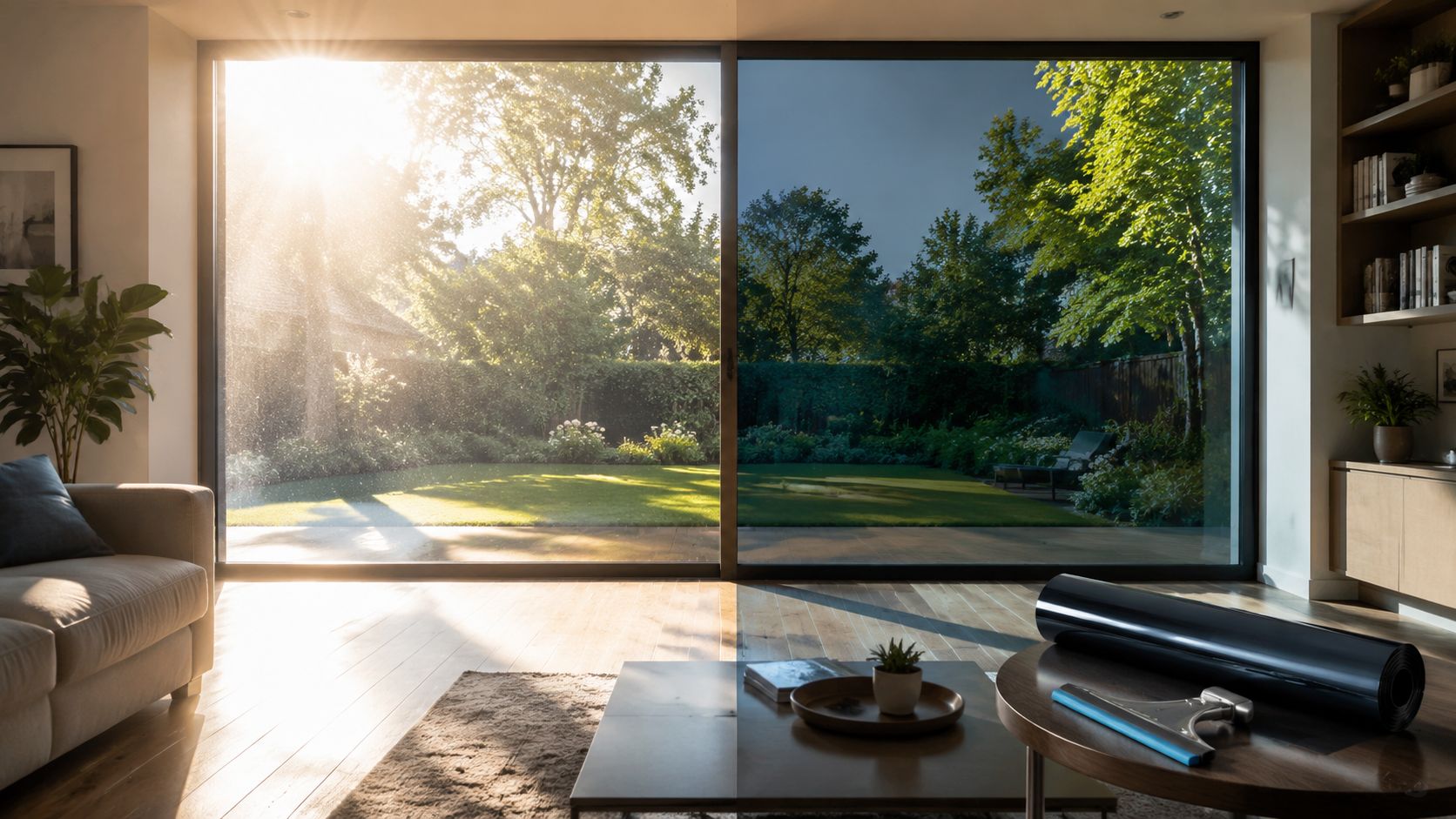
That afternoon sun hitting your living room is relentless. You see dust floating in the beam, feel the AC running harder than it should, and start thinking about what that light is doing to floors, furniture, and anything else sitting near the glass. For homeowners around North Metro Atlanta, that's usually the moment residential window tinting stops sounding optional and starts sounding practical.
The problem is that most residential window tinting reviews don't help much. They talk about darkness, brand names, or a vague promise that your home will feel cooler, but homeowners in Woodstock, Kennesaw, and Canton usually want clearer answers. They want to know what film technology matters, whether the installer works cleanly, what kind of warranty support exists, and whether the company has the precision to handle a house without sloppy edges or mismatched windows.
That's where local context matters. In this part of Georgia, a strong installer often has deep experience not only with homes, but also with automotive tinting in Woodstock and Kennesaw. Car tinting is unforgiving. Curved glass, clean cuts, heat shrinking, and finish quality expose weak workmanship fast. If a shop does high-end automotive tint well, that's often a strong signal they can handle residential film with the same discipline.
1. The Tint Guy

A homeowner in Woodstock or Kennesaw usually wants more than a basic film quote. They want to know who will measure correctly, explain the trade-offs between ceramic and standard films, and still be available if one window needs follow-up later. The Tint Guy stands out in that local-service category because they have been working in North Metro Atlanta for decades and maintain dedicated shops in both Woodstock and Kennesaw.
That local footprint changes the buying experience. Homeowners in Canton, Woodstock, and Kennesaw are dealing with a company that is built around this market, not a broad lead-generation brand sending different crews across the region. In residential tinting, that often shows up in cleaner scheduling, more consistent installation quality, and better accountability if you need service after the job.
Their automotive background adds another useful signal. Shops that spend every day handling car window tint, ceramic tint, paint protection film, and tint removal tend to be disciplined about edge alignment, glass prep, and finish quality. Those habits carry over well to residential work, especially on large living-room windows and highly visible front-facing glass where sloppy cuts are easy to spot.
Where they look strongest
The product mix is solid. They work with established film brands such as 3M, Llumar, and American Window Film, which gives homeowners real options for glare reduction, UV protection, privacy, and heat control. That matters more than a simple “darker is better” sales pitch, because the right residential film is usually the one that fits the room, the glass, and the sun exposure.
A tint company that can explain both Georgia legal shade choices for cars and film performance for homes in plain language is usually a sign you are talking to people who understand installation, not just quoting from a brochure.
Their residential offering also includes home privacy window film options for different rooms and visibility needs, which is useful for street-facing windows, bathroom glass, and areas where homeowners want privacy without blocking all natural light.
Trade-offs to know before you book
The Tint Guy does not present itself as a bargain shop, and that will matter to price-first shoppers. Residential pricing typically requires a consultation, which can frustrate homeowners looking for an instant online number. In practice, that is often the more honest approach, because home estimates depend on window count, pane size, access, existing film, and whether the goal is heat rejection, daytime privacy, or decorative coverage.
Scheduling can also be less flexible for some households. Their listed hours center on the workweek, so homeowners who want a Saturday consultation may need to plan ahead.
- Best for homeowners who value local accountability: Woodstock and Kennesaw locations make follow-up service more realistic than it is with remote scheduling models.
- Best for buyers comparing skill, not just price: Their automotive work in key North Metro cities is a practical indicator of installation discipline that often carries over to residential projects.
- Less ideal for quote-only shoppers: If your main goal is collecting the lowest number fast, another provider may feel easier at the start.
For North Metro Atlanta homeowners using a Cost, Tech, Warranty, and Service framework, The Tint Guy scores well on tech range and local service strength. Cost may land above stripped-down competitors, but the trade-off is a more established operation with the kind of precision that usually shows first in automotive tinting and then carries into residential work.
2. UHS Window Tinting & Blinds

UHS Window Tinting & Blinds fits a different type of homeowner. If the problem room gets hot in the afternoon, feels exposed at night, and still needs better light control, a film-only conversation can be too narrow. UHS has an advantage there because they also sell blinds and shades, so the recommendation can match how the room is used.
That matters in North Metro Atlanta, where many homes have large front-facing windows, open living spaces, and sun exposure that shifts hard from season to season. In that setting, the best answer is sometimes a solar film on the glass plus a secondary treatment for privacy or glare after sunset.
Why some homeowners prefer them
UHS offers in-home assessments, which is the right way to quote a house with mixed window sizes, different orientations, and rooms that need different outcomes. A west-facing bonus room needs a different solution than a street-level bathroom or a breakfast area with glare on screens.
They also carry recognizable film brands such as 3M and Solar Gard. For homeowners using a Cost, Tech, Warranty, and Service framework, that helps on the tech side because branded film lines are usually easier to compare by performance category, finish, and intended use. If you are starting your search with indoor window tinting options near you, UHS makes sense to include on the shortlist when the project may involve more than one product type.
Some homes do not need the darkest film or the highest heat rejection. They need the right mix of glare control, daytime appearance, nighttime privacy strategy, and clean installation.
There is a trade-off. UHS does not show much technical detail, pricing structure, or warranty language upfront on the website, so comparing them against other North Metro providers may take more effort. Homeowners who like to screen companies online before booking a visit may find that process slower than they want.
Despite the need for a consultation, UHS is a strong contender if your project includes layered light control, decorative goals, or privacy needs that film alone may not fully solve. They are less tied to the automotive-to-residential crossover that can be a useful reliability signal in places like Woodstock and Kennesaw, so I would weigh them more heavily on service approach and product range than on that specific indicator.
3. Solarworks Glass Tinting

Solarworks Glass Tinting has the kind of service mix many homeowners like to see. They handle residential, commercial, and automotive tinting, and they offer on-site home consultations. A Roswell-area company with that blend usually understands both presentation and precision.
That crossover matters more than many residential window tinting reviews admit. Home film has to look right all day, not just on install day. If a shop already deals with demanding auto customers, there's a better chance they care about clean edges, dust control, and uniformity.
What stands out in practice
Solarworks appears to lean premium in how it presents its service. The emphasis is on careful installation rather than bargain-first marketing, and that usually attracts homeowners who care more about long-term appearance than chasing the lowest estimate. Their local visibility and established Roswell presence add trust for buyers in North Fulton and nearby areas.
I also like that they offer consultation before quoting. Residential film isn't a commodity purchase. South-facing rooms, older glass, and privacy concerns all change the recommendation.
- Good fit for consultative buyers: Better for homeowners who want discussion and guidance than for shoppers who just want a quick online checkout.
- Good fit for mixed-use confidence: Their auto and residential mix can be reassuring if you see automotive precision as a sign of installer quality.
- Less ideal for spec-sheet shoppers: The website doesn't surface as many technical details as some buyers want.
What to watch for
The biggest limitation is transparency at the research stage. If you want a deep online breakdown of film families, warranty specifics, or side-by-side residential performance details, you may need to ask directly. That's not a dealbreaker, but it does mean more homework before signing.
For homeowners beginning the search in North Metro Atlanta, Solarworks fits best as a quote-and-conversation option. If you're still narrowing local providers, browsing a page on indoor window tinting near me can also help you compare what nearby companies emphasize before inviting anyone out.
4. Window Film Depot

Window Film Depot is the large-scale option on this list. If you like the reassurance of a bigger operation with broad project experience, industry recognition, and a substantial residential and commercial lineup, they deserve a look. Their Marietta presence also puts them within reach for many North Metro homeowners.
This is the type of company that often appeals to buyers who want an established process and broad manufacturer backing. They also handle safety and security films, which can be useful if your goals go beyond heat and glare.
Where a larger company helps
The main strength is breadth. If your project involves multiple buildings, specialty films, decorative needs, or layered security concerns, a bigger company often has the staff and manufacturer relationships to support it. That can be an advantage over smaller installers that focus mainly on straightforward solar-control jobs.
There's also a homeowner trust factor in seeing a company with local office presence and recognized dealer status. Not everyone needs that, but some buyers prefer it.
A bigger installer isn't automatically better. It is often better when the project has more complexity, more windows, or stricter scheduling demands.
Where it may not be the best fit
Big companies sometimes feel less personal. Homeowners with a smaller project, like one overheated living room or a set of west-facing windows, may prefer a shop where the consultation feels more direct and less process-heavy. Lead times can also stretch when larger firms are balancing many commercial and residential jobs.
Their pricing is consultation-based, so there's no instant cost clarity online. If you're comparing providers for broader home or office envelope work, it's worth also looking at how companies explain tinted windows for buildings because that usually reveals whether they think in terms of aesthetics alone or whole-building performance.
5. SunShades Glass Tinting

SunShades Glass Tinting fits a common North Metro Atlanta buyer scenario. A homeowner in North Fulton wants better heat control upstairs, less afternoon glare in the living room, and a company that has been around long enough to stand behind the work. SunShades checks several of those boxes on first review. They are locally owned, they have operated since 2001, and they handle residential, commercial, and automotive tinting.
That last point matters more than some homeowners realize. In places like Woodstock and Kennesaw, strong automotive tinting work usually reflects disciplined film handling, clean installs, and consistency under visibility-sensitive conditions. It does not guarantee a great residential result, but it is often a positive sign about installer habits and shop standards.
Why they make sense for a first-round shortlist
SunShades presents a useful range of film types, including dyed, metallic, ceramic, and security film. For a homeowner comparing providers by cost and technology, that is a good start. Ceramic usually costs more but avoids the shinier look some metallic films create. Security film serves a different purpose altogether. It helps hold broken glass together, but it is not a substitute for good solar heat control.
That distinction gets missed in a lot of buyer research. Heat reduction, glare control, privacy, fade protection, and glass hold strength overlap, but they are not the same purchase decision. A company that separates those categories is usually easier to quote accurately.
Industry demand also supports that shift toward performance-based buying. Grand View Research's window films market analysis lists the global window film market at USD 12.9 billion for 2025, with projected growth through 2033. For North Metro Atlanta homeowners, the practical takeaway is simple. Window film is no longer a niche add-on. Buyers are using it as part of a real plan for UV protection, comfort, and energy control.
Where the evaluation gets less clear
The website gives enough information to start a conversation, but not enough to score them fully on warranty and service without calling. That is the main limitation here. If you are using a structured framework, cost and general technology categories are visible. Warranty terms, product-specific performance data, and service expectations need to come from the estimate process.
I would ask direct questions. Which residential lines do they install most often? What warranty is manufacturer-backed versus labor-backed? How do they handle seal-edge concerns on older double-pane glass? Those answers usually tell you more than a polished homepage.
- Strong on local credibility: A long North Fulton track record helps if you want an established shop rather than a newer mobile-only operator.
- Strong on product range: Good fit for homeowners comparing ceramic, metallic, dyed, and security film options.
- Less clear on upfront buying details: Warranty depth, exact film specs, and service process need closer review during consultation.
6. Solar Control Glass Tinting

Solar Control Glass Tinting is a practical option for homeowners around the Cumming and Alpharetta corridor who want a company that speaks directly to residential needs. Some installers bury home services under automotive marketing. This one gives residential work a visible place, which is a good sign if your project is firmly house-first.
A physical shop presence also helps. Homeowners tend to feel more comfortable when the company has a real local footprint rather than a mobile-only identity.
Best use case for this company
This is the kind of installer I'd look at for straightforward residential jobs where responsiveness matters. If you have a few problem windows, a bright family room, or a home office with afternoon glare, a local firm focused on residential benefits can be a good fit. Not every project needs a giant operation.
Their presentation is less polished than some bigger brands, but that doesn't automatically mean weaker work. It often means the company relies more on quotes, reviews, and direct conversations than on heavy website marketing.
The limits
The review footprint appears more modest than the biggest Metro Atlanta shops, so buyers who want a long trail of public proof may rank them lower. You'll also need a quote to get into the details on film options, warranty coverage, and final scope.
One thing worth remembering while reading residential window tinting reviews in general is that ROI is highly home-specific. Industry guidance notes that home window tinting is often discussed in terms of reduced heat gain, lower energy bills, and UV protection, but climate, orientation, and installation quality still shape the actual value for the homeowner, as explained in this home window tinting ROI discussion.
7. Glass Tiger Window Tinting

Glass Tiger Window Tinting is a well-known Metro Atlanta name with strong visibility and a large review footprint. They're based in Lilburn, so they're not the closest option for Cherokee or Cobb homeowners, but they still come up often in broader regional searches. If you don't mind working with a provider farther east, they remain a serious contender.
Their residential service pages and Llumar film positioning help. Homeowners often want recognizable film brands because it gives them a sense of baseline quality, even when the more important variable is still the installer.
What they appear to do well
Glass Tiger looks like a high-volume shop with experienced teams and broad service coverage. That can work well for homeowners who feel more comfortable choosing a company that has already handled a large variety of projects across Metro Atlanta. Established repetition matters in tinting. Installers get better by doing a lot of film, not by talking about it.
The broader market direction also supports that type of service model. Residential buyers increasingly care about heat control, UV blocking, safety, and privacy, not just dark glass, which aligns with how SNS Insider describes demand across the window film market.
If a review focuses only on "looks great" and never mentions glare, comfort, privacy, or installation quality, it isn't telling you much.
Why some North Metro homeowners may still rank them lower
Distance is the main drawback. For homeowners in Woodstock, Canton, and Kennesaw, a closer provider can be easier to schedule and easier to hold accountable if a follow-up visit is needed. Pricing also appears to stay quote-based, which is normal, but it means travel and logistics may still be part of the final equation.
If you live on the north side and want a highly local experience, Glass Tiger may lose to shops with more direct North Metro presence. If your priority is choosing a bigger regional name with broad exposure, they're still worth comparing.
Top 7 Residential Window Tinting Reviews Comparison
| Provider | Implementation Complexity 🔄 | Resource Requirements ⚡ | Expected Outcomes 📊 | Ideal Use Cases 💡 | Key Advantages ⭐ |
|---|---|---|---|---|---|
| The Tint Guy | 🔄 Low–Moderate: shop-based installs, appointments (most cars 2–4h) | ⚡ Moderate: premium film & PPF inventory, trained installers | 📊 High heat/UV rejection, privacy, energy savings; durable PPF | 💡 Vehicle owners wanting premium ceramic/PPF; homeowners seeking energy/UV reduction | ⭐ Decades of local experience; Llumar SelectPro dealer; warranty-ready options |
| UHS Window Tinting & Blinds | 🔄 Low–Moderate: in‑home assessments, quote-based scheduling | ⚡ Moderate: major film brands plus blinds inventory | 📊 Reliable privacy and solar control; consistent customer feedback | 💡 Homeowners who want combined film and blinds with in‑home quoting | ⭐ Longstanding local presence; positive third‑party surveys |
| Solarworks Glass Tinting | 🔄 Moderate: on‑site consultations, meticulous install process | ⚡ Moderate: premium films and skilled installers | 📊 High-quality workmanship; strong aggregated ratings | 💡 Homeowners seeking premium, precise residential installs | ⭐ Strong review footprint; local BBB listing |
| Window Film Depot | 🔄 Moderate–High: large/commercial project coordination, variable lead times | ⚡ High: national resources, large teams, specialty films | 📊 Strong impact for large projects; industry-recognized outcomes | 💡 Commercial or large residential projects needing scale and specialty films | ⭐ 3M National Dealer recognition and industry awards |
| SunShades Glass Tinting | 🔄 Low–Moderate: free estimates, on‑site assessments, local shop | ⚡ Moderate: multiple film categories (dyed, metallic, ceramic, security) | 📊 Consistent quality and high customer satisfaction | 💡 North Fulton homeowners wanting a trusted local installer | ⭐ Two decades local presence; excellent review ratings |
| Solar Control Glass Tinting | 🔄 Low: residential-focused service with free quotes after assessment | ⚡ Moderate: residential materials and local shop capacity | 📊 Good responsiveness and quality; modest review volume | 💡 Forsyth/North Fulton homeowners seeking nearby convenience | ⭐ Clear residential focus and visible third‑party reviews |
| Glass Tiger Window Tinting | 🔄 Moderate: high-volume operations; wider service area logistics | ⚡ High: experienced teams, brand-name films, high installation capacity | 📊 Very high ratings and review volume; reliable results at scale | 💡 Metro Atlanta homeowners wanting proven track record and frequent availability | ⭐ Very large aggregated review counts and strong community recommendations |
Making the Right Choice for Your Home (and Car)
A west-facing living room in a Woodstock summer tells you pretty quickly whether a film recommendation was honest. The room gets hotter by late afternoon, glare pushes everyone away from the sofa, and the hardwood near the glass starts to show the cost of constant sun. Residential tinting solves those problems only when the film matches the glass, the exposure, and the way you use the room.
Reviews help, but they are easier to use when you sort them through four practical filters. Look at cost, film technology, warranty coverage, and service quality. Cost tells you whether the bid fits the product being offered. Technology tells you whether the film is built for heat rejection, UV filtering, privacy, glare control, or a mix of those goals. Warranty tells you how much risk the installer and manufacturer are willing to carry. Service quality shows up in the details, such as whether the shop asks about dual-pane glass, identifies sun exposure by room, and explains the trade-offs between appearance and performance.
Darkness is where many homeowners get off track.
A darker film can reduce visible light, but it does not automatically mean the best heat control for a house. On some windows, especially newer dual-pane low-E units, the better choice may be a lighter, higher-performance film that manages solar energy without making the room feel closed in. On older glass, the installer needs to be even more careful because film compatibility matters as much as shade.
In North Metro Atlanta, I also put real weight on a company's automotive work, especially in Woodstock and Kennesaw. Auto tinting demands clean edges, controlled shrinking, precise cuts, and consistent finishing. Those skills carry over well to residential installs where sloppy trimming, contamination, or poor sealing will show every day. A shop that handles ceramic film work on vehicles at a high level usually has the process discipline to do careful work on home glass too.
That is part of why The Tint Guy remains a strong option in this group. The company has visible local presence in Woodstock and Kennesaw and works across automotive, residential, and commercial film applications. For a homeowner, that crossover matters because it points to broader product familiarity and steadier installation habits, not just a sales pitch built around making windows look darker.
If you are narrowing the list, ask each company a few plain questions. What film line fits your specific glass. What problem is the film solving first. How is the warranty divided between manufacturer coverage and labor. What does the install process look like if a seal issue, edge defect, or appearance concern shows up later. And if heat is your biggest issue, it helps to read more about advanced window heat protection before the estimate so you can tell the difference between a generic recommendation and a well-matched one.
Homeowners in Woodstock, Kennesaw, and Canton usually make the best choice when they compare providers the same way an installer would. Start with the window, the sun exposure, the glass type, and the result you want. Then use the reviews to confirm whether the company delivers on that promise consistently in the field.