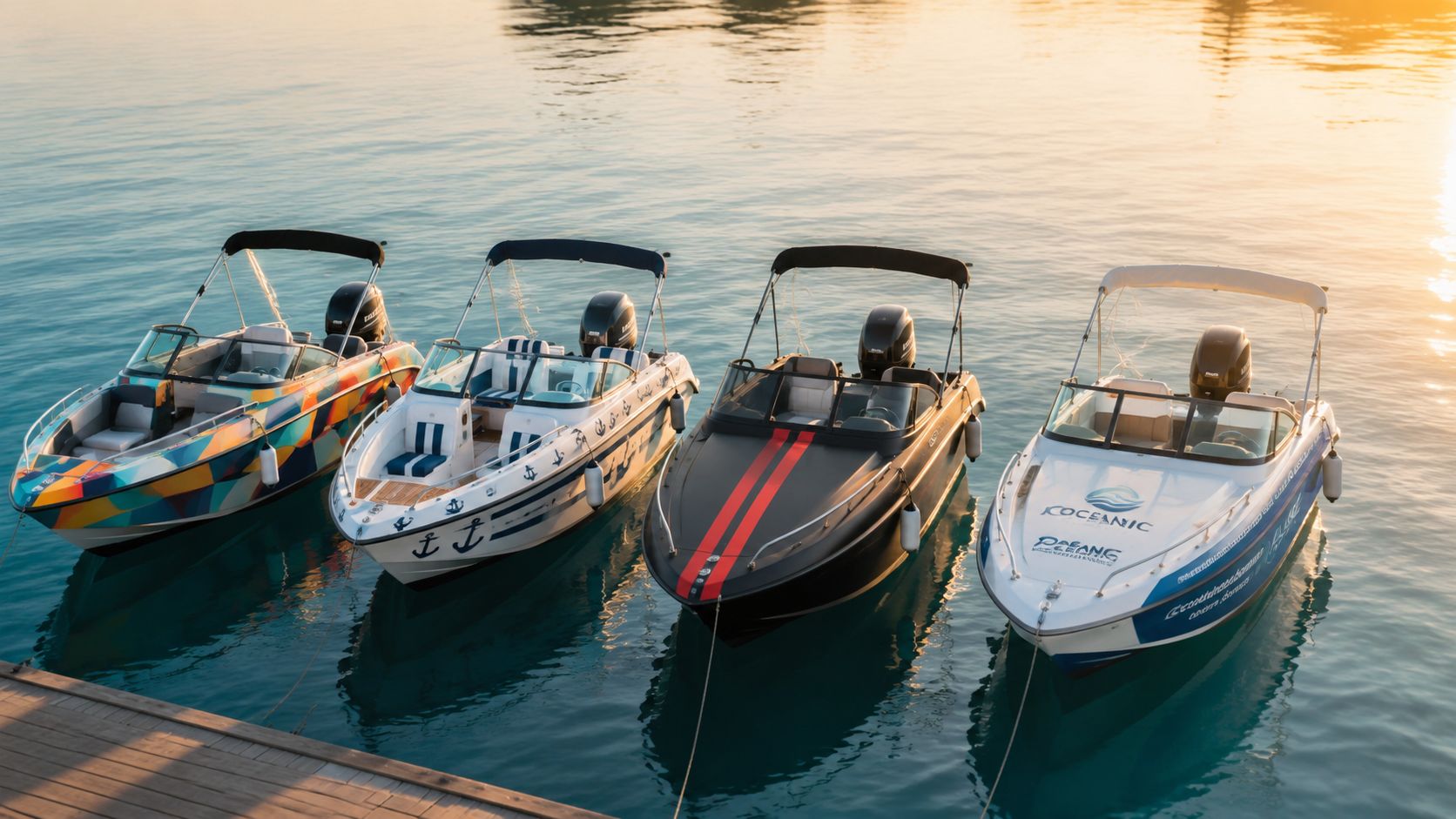
Your boat is more than just a vessel. It's a statement on the water. Whether you're cruising on Lake Allatoona or fishing on Lanier, you want it to look its best. While a new paint job is a classic option, modern vinyl boat wraps offer more creative freedom and easier visual updates.
A quality wrap can completely change your boat's appearance, help preserve the original gelcoat, and give you room to personalize without committing to permanent paint. In 2024, wrap demand grew with the recreational boating boom, and pricing ranged widely depending on size, design complexity, and material, from entry-level projects to premium custom work, according to Sea Magazine's 2024 look at boat wrap pricing and demand. If you've also been comparing wrap-style protection for your daily driver, it helps to understand the real options for your car's paint.
The best boat wraps ideas aren't just about what looks cool in a photo. They need to fit the hull shape, the way the boat is used, and how much maintenance you're willing to do after the install. Some designs look incredible at the dock and disappear at a distance. Others read clearly from across the water and still look clean a season later.
That practical side matters. The same is true in automotive work, where material choice, surface prep, and installation quality decide whether a finish looks sharp or starts failing early. Here are ten boat wraps ideas that are effective in practical applications.
1. Sleek & Modern Matte Finishes
Matte wraps work best when you want the boat to look intentional rather than loud. Matte black, charcoal, and military green flatten reflections, which gives center consoles, bass boats, and performance hulls a more aggressive shape from the dock and from a distance.
This look also plays well with polished hardware. Cleats, rails, windshields, and trim stand out more because the hull isn't fighting for attention with high gloss glare.

Where Matte Works Best
A matte finish usually looks strongest on boats with clean side profiles. A modern fishing boat with dark upholstery, black trailer wheels, and minimal chrome can pull off matte black without looking overdone. On a family runabout with bright seats and lots of stainless, satin is often the better compromise because it softens glare without looking too flat.
Practical rule: Matte film needs matte-safe cleaning products. The wrong cleaner can leave shiny spots that never quite disappear.
A few trade-offs matter before you commit:
- Best visual use: Dark matte tones pair well with silver, brushed metal, or tinted glass accents.
- Harder upkeep: Scuffs, oily fingerprints, and dock rash can show differently than on gloss film.
- Smarter compromise: Satin often gives you the same modern feel with easier day-to-day maintenance.
This is one of those boat wraps ideas that looks expensive because it's restrained. That same design thinking carries over to automotive styling too. A clean, low-reflective finish on a truck or SUV gets attention without needing a complicated graphic package.
2. Hyper-Realistic Fish & Marine Life
A fish mural can look amazing, or it can look like a print shop sample pasted onto a hull. The difference is scale, placement, and species choice. If you fish largemouth on inland water, a realistic bass composition feels right. If you run offshore, marlin, tuna, or sailfish graphics make more sense.
The strongest versions use the hull like a moving canvas. Instead of dropping one oversized fish in the middle, the design uses water movement, bait balls, depth gradients, or splash effects that follow the boat's body lines.
Make the Artwork Match the Boat
A tournament bass boat can carry more visual detail because people see it close up at ramps and weigh-ins. A larger cruising boat usually needs simpler, stronger imagery that still reads from farther away. Too much photographic detail on a curved hull can get lost once the boat is moving.
What works in practice:
- Choose one focal species: Multiple hero images often turn the wrap into visual clutter.
- Build around viewing distance: Docked boats reward detail. Fast-moving hulls need stronger silhouettes and contrast.
- Respect the hull breaks: Fish faces, eyes, and key anatomy shouldn't land on seams, vents, or sharp transitions.
Owners love this style because it tells people exactly what kind of boating life they live. It's also one of the most personal boat wraps ideas, especially for anglers who want the boat to reflect the species they chase.
If you're commissioning custom art, ask to see how the file is mocked up on your exact hull side, not just on a flat rectangle. That single step usually separates a custom-looking boat from one that feels generic.
3. Digital & Modern Camouflage
Digital camo gives a boat a tactical look without feeling stuck in old-school hunting graphics. The pixel structure keeps the pattern cleaner at a distance, and it adapts well to green, tan, gray, black, or even blue-based palettes.
This style is common on duck boats, but it also fits aluminum fishing rigs, bay boats, and certain performance boats that need a sharper, more structured visual language.

Pattern Scale Matters More Than People Think
One mistake shows up all the time. The camo pattern is either too small, so it turns muddy from a distance, or too large, so it looks cartoonish on a shorter hull. Scale should match the boat size and the amount of side profile available.
Keep the pattern big enough to read on the water, but not so big that a single pixel block dominates half the bow.
A few practical combinations tend to work:
- Gray and black digital camo: Strong for modern center consoles and urban-style builds.
- Green and tan digital camo: Better for hunting use and shallow-water rigs.
- Blue-based digital camo: Good when you want the tactical feel without a woodland look.
This is also one of the easier styles to coordinate with upholstery, powder coating, and trailer finishes. If the owner already has black rails, graphite seats, or dark flooring, digital camo ties the whole package together cleanly.
Among boat wraps ideas, this one is forgiving. Minor curve distortion doesn't ruin the look the way it would with stripes or photo-realistic artwork.
4. Classic Woodgrain & Nautical Themes
Some boats want to look newer. Others look better when you give them a little heritage. That's where woodgrain wraps earn their place. A convincing mahogany, teak, or cherry effect can bring warmth to a fiberglass hull that otherwise feels plain.
This style isn't about fooling a marina full of classic boat restorers. It's about borrowing the elegance of old wooden boats without inheriting the maintenance headaches.
Best Use Is Usually Partial, Not Full
A full fake-wood hull can work on the right vessel, but most boats benefit from restraint. Transom panels, cabin accents, helm surfaces, and upper side sections often deliver the classic look better than wrapping every visible inch.
Good pairings include:
- Mahogany look with cream accents: Feels traditional and upscale.
- Teak effect on interior panels: Works well around seating and deck-adjacent trim.
- Nautical striping or anchor details: Adds theme without turning the boat into a novelty.
What doesn't work is mixing too many themes. If you already have faux wood, rope-style graphics, compass roses, and anchor icons, the boat starts looking like a themed restaurant. Pick one dominant cue and let the rest support it.
This style appeals to owners who want boat wraps ideas that age gracefully. A clean woodgrain treatment is less likely to feel dated than a trend-heavy graphic package, especially on pontoon boats, cruisers, and gentleman-style runabouts.
5. Bold Geometric & Abstract Designs
Geometric wraps are ideal when you want energy without relying on literal imagery. Sharp angles, layered blocks, and contrast panels can make a wake boat or sport boat look faster even when it's tied up.
The best versions use the boat's natural lines. Chine breaks, window lines, rub rails, and transom angles become part of the design instead of obstacles the installer has to work around.

Contrast Sells the Design
High contrast matters on the water because reflections flatten detail. A wrap that looks dynamic in the design file can disappear outside if all the tones sit too close together. Dark navy against black might look elegant on screen, but stronger separation usually reads better in real life.
Useful design habits:
- Lead with two or three colors: Too many color blocks make the hull feel fragmented.
- Follow motion lines: Angles should push forward or sweep with the hull, not fight it.
- Use accent zones strategically: Bow entries, rear quarters, and transoms often carry geometry better than every panel.
The reason this style keeps showing up in good boat wraps ideas is simple. It adapts to many vessel types and budgets. You can go full coverage for a showpiece, or you can use angular side graphics and still create a custom look.
This same logic shows up in vehicle customization. Clean geometry can make a truck, coupe, or SUV feel more premium than an overloaded graphic set.
6. Full-Coverage Themed Graphics
Some owners want the hull to tell a story. That's when a full-coverage theme makes sense. Patriotic layouts, underwater scenes, dramatic skies, and custom concept art all fall into this category.
Done right, a themed wrap feels immersive. Done poorly, it feels like a collage. The difference usually comes down to whether the design was built specifically for the hull shape.
When Full Coverage Is Worth It
This approach works best when the boat is part of an identity. That might mean a show boat, a tournament rig, a patriotic family cruiser, or a brand-driven vessel that needs strong visual impact. If the owner only wants a little personality, full coverage is often too much commitment.
Below-the-waterline questions come up often with full themes, especially when artwork wraps low on the hull. Guidance on that area is still thin, and many installers avoid warrantying submerged sections, which is why the discussion around materials, overlap strategy, and edge sealing remains so important in this closer look at below-waterline boat wrap concerns.
Full-wrap visuals are only half the job. Surface prep, seam planning, and edge management decide whether the design stays beautiful.
If you're comparing finish goals, it also helps to understand the difference between styling film and impact-focused protection like PPF vs vinyl wrap.
A full theme can be unforgettable. It's also less forgiving than simpler boat wraps ideas. Every panel transition, contour stretch, and edge has to be planned before the first piece of film goes down.
7. Minimalist Racing Stripes & Accents
Not every boat needs a complete visual reset. Some just need one strong line. Racing stripes, side accents, registration-integrated graphics, and transom highlights can sharpen the whole boat without overwhelming it.
This is one of the most practical styles because it works on newer boats, older boats, and budget-conscious projects. It also leaves more original finish visible, which many owners prefer.
High Impact With Less Material
A stripe package works when it feels factory-correct. That means following body lines, staying consistent through curves, and resisting the urge to add extra details just because there's room for them.
A few winning uses:
- Centerline stripes: Best on performance shapes with visible deck symmetry.
- Hull-side accent lines: Great for breaking up tall side panels on pontoons or fish-and-ski boats.
- Logo and number integration: Registration graphics can become part of the design instead of a separate afterthought.
This is also where partial wraps shine. Emerging demand for selective coverage has made owners more interested in which areas deliver the most visual value, especially hull sides, transoms, and other highly visible zones, as discussed in design guidance tied to boat type and usage.
Minimalist treatments are some of the smartest boat wraps ideas because they age well. You're less likely to regret a clean stripe package than a louder trend-driven concept five seasons later.
8. Branded & Commercial Wraps
A commercial boat shouldn't just look decorated. It should communicate fast. Fishing guides, marine service operators, waterfront contractors, and charter businesses need people to understand the brand in a glance.
That changes how the wrap should be designed. Artistic complexity matters less than readability, logo hierarchy, and where people see the vessel, whether that's from a dock, a launch line, or another boat passing by.
Branding Rules That Hold Up on the Water
If the business name disappears at distance, the wrap isn't doing its job. If the phone number is tiny and buried in the artwork, it isn't helping either. Commercial wraps need cleaner structure than personal wraps.
Use these priorities:
- Lead with the business name: It should be readable before smaller details come into play.
- Keep contact details selective: One clear contact method beats cluttered text blocks.
- Design for motion and distance: Large, high-contrast branding holds up better than fine detail.
The broader wrap market keeps expanding in adjacent categories, and material innovation from vehicle wrap film is a useful reference point. For example, the automotive wraps films market is valued at USD 3.28 billion in 2025 and projected to reach USD 6.91 billion by 2034, with an 8.7% CAGR, according to Fortune Business Insights on automotive wraps films. That matters because premium marine branding increasingly borrows the same advanced film mindset.
If you're also evaluating vehicle branding on land, this guide on where to get my car wrapped near me is a useful next step, and so is this practical branding guide for tow hitch covers.
9. Color-Shift & Chrome Finishes
Specialty films are the attention-grabbers of the wrap world. Color-shift films change character with light and angle. Chrome throws reflections hard and can make a boat look almost liquid at the dock.
These finishes are best for owners who want a showpiece. They're rarely the most practical choice for a heavily used fishing boat or a vessel that lives a rougher life around gear, docks, and frequent trailering.
Know the Trade-Off Before You Buy
Specialty films usually cost more and install with less margin for error. Complex curves, mirrored surfaces, and visible seams demand a careful hand. Small defects that disappear in standard gloss film can stand out immediately in chrome or chameleon material.
Specialty wraps sell drama, not subtlety. Use them when the boat is meant to be seen, not hidden in hard daily use.
A few good use cases:
- Show boats: Ideal if dock presence is the whole point.
- Accent-only installs: Better than full coverage on many hulls.
- High-visibility custom builds: Works when the rest of the boat is equally polished.
Among boat wraps ideas, this is the least forgiving category. It rewards owners who understand that visual impact and easy maintenance usually don't come as a package deal.
10. Textured Wraps (Carbon Fiber, Brushed Metal)
Texture can be more effective than color when you want a technical, modern look. Carbon fiber, brushed metal, and other tactile films work well on consoles, dash areas, accent panels, and selected exterior zones.
A full hull in fake texture is usually too much. Small zones, though, can change the tone of the whole boat. Carbon-look side inserts or brushed-metal helm details can make a newer build feel more engineered and custom.
Best Used as a Detail Layer
Textured films are strongest when they support another finish rather than replace it. Pair a matte hull with carbon accents, or use brushed metal around instrumentation and trim pieces where the eye naturally lands.
A few smart placements:
- Dash and helm trim: Adds depth without dominating the cockpit.
- Transom or side accents: Good for performance-oriented boats.
- Interior feature panels: Works especially well where passengers see and touch the surface.
If you like the carbon look on marine and automotive projects alike, it's worth comparing modern protection-focused options such as carbon fiber PPF.
The material discipline behind clean textured installs overlaps with what professional shops do every day in automotive vinyl and film work. That crossover matters because precision around edges, contours, and surface prep never stops being the deciding factor.
10 Boat Wrap Ideas Compared
| Design | 🔄 Implementation Complexity | ⚡ Resource Requirements & Cost | ⭐📊 Expected Quality & Impact | Ideal Use Cases | 💡 Key Advantages / Tips |
|---|---|---|---|---|---|
| 1. Sleek & Modern Matte Finishes | Medium, professional install; careful surface prep | Moderate, matte-specific vinyl and care products | ⭐⭐⭐⭐, sophisticated, low-reflectivity look; high perceived value | Modern speedboats, center consoles, fishing boats | Minimalist, makes polished accents pop; consider satin as compromise |
| 2. Hyper-Realistic Fish & Marine Life | High, custom art, exact alignment over curves | High, high-res imagery, skilled designer/printer | ⭐⭐⭐⭐, very strong visual storytelling; tournament appeal 📊 | Tournament boats, charter guides, anglers | Best with high-resolution photos; can be full-hull or partial |
| 3. Digital & Modern Camouflage | Medium, pattern scale and seam matching matter | Moderate, custom patterning and color matching | ⭐⭐⭐, tactical, structured appearance 📊 | Duck-hunting boats, tactical/performance vessels | Match pattern scale to hull size; coordinate colors with upholstery |
| 4. Classic Woodgrain & Nautical Themes | Low–Medium, pattern repetition and fit | Moderate, high-quality wood-grain vinyl | ⭐⭐⭐, authentic vintage look without maintenance 📊 | Owners wanting classic/retro style; interior accents | Cost-effective wood look; pairs well with nautical stripes |
| 5. Bold Geometric & Abstract Designs | Medium, requires design flow with hull curves | Moderate, designer time and color-accurate printing | ⭐⭐⭐, eye-catching, conveys motion and energy 📊 | Performance and wakeboard boats | Use contrasting colors and follow hull lines for cohesion |
| 6. Full-Coverage Themed Graphics | Very high, complex layout and flawless installation | Very high, extensive design, large-format printing, install time | ⭐⭐⭐⭐, maximum visual impact; highly distinctive 📊 | Show boats, themed vessels, owners wanting unique identity | Significant investment; work with an experienced graphic designer |
| 7. Minimalist Racing Stripes & Accents | Low, simple panel placement; easier install | Low, minimal material; often DIY-capable | ⭐⭐, sporty enhancement with low cost 📊 | Budget upgrades, DIY projects, accenting plain hulls | Follow body lines for factory look; combine with registration numbers |
| 8. Branded & Commercial Wraps | Medium, layout for legibility and durability | Moderate, durable vinyl, professional print and install | ⭐⭐⭐, effective marketing tool; increases recognition 📊 | Fishing guides, charters, marine service providers | Use bold fonts and a QR code; prioritize readability at distance |
| 9. Color-Shift & Chrome Finishes | Very high, specialist materials and expert fitment | Very high, premium vinyls and meticulous installation | ⭐⭐⭐⭐, show-stopping, high visual impact 📊 | Show boats, owners seeking extreme customization | Premium cost and complexity; best for accents or show use only |
| 10. Textured Wraps (Carbon Fiber, Brushed Metal) | Medium, precise panel work for textured effects | Moderate, specialty textured films; durable | ⭐⭐⭐, adds tactile, performance-oriented detailing 📊 | Accent panels, dashboards, architectural highlights | Great for accents and scratch resistance; avoid full-hull use for heavy textures |
Your Vehicle Protection Experts in North Metro Atlanta
Good wrap work comes down to prep, patterning, clean edges, and knowing where a design will succeed or fail before installation starts. That skill set carries across boats, cars, trucks, and SUVs. The material may change, but precision doesn't. If you're already thinking about style, heat rejection, paint protection, or long-term finish care for your vehicle, a professional shop matters more than a flashy sales pitch.
The Tint Guy focuses on automotive results, and that specialization is a benefit. Vehicle owners want film installed cleanly around glass, trim, sensors, and body lines, with no shortcuts on prep. For drivers researching local tint and protection services, Georgia-specific details matter too. In Georgia, side windows, back side windows, and the rear window must allow more than 32% of light to pass through, and non-reflective tint is allowed only on the top 6 inches of the front windshield for sedans, as outlined in this summary of Georgia window tint law and 3M automotive films.
If you're comparing film options on price, the gap between basic and premium products is real. For a standard sedan in Woodstock, Georgia, basic dyed film typically costs between $150 and $250, while professional ceramic tint typically ranges from $300 to $600, including materials and labor, according to this Woodstock, Georgia tint cost guide. If you're dealing with old bubbling film before upgrading, tint removal in the North Atlanta area commonly ranges from $125 to $250 before new film goes on, based on North Atlanta tint removal pricing.
For homeowners comparing comfort upgrades, premium residential ceramic film also has a place in the conversation. Residential ceramic window films cost $8 to $12 per square foot and use nano-ceramics to block over 90% of infrared heat, with reported cooling-cost reductions of 25% to 40% in hot climates like North Georgia, according to this residential window tinting cost and performance overview. That same focus on heat rejection and long-term material quality is why premium automotive ceramic tint continues to draw serious interest from commuters and enthusiasts across the region.
If you need expert car window tinting in Woodstock, Georgia, The Tint Guy delivers the clean finish and legal-film guidance people need. For drivers in Kennesaw, Georgia, ceramic tint is a strong answer for summer heat, glare, and interior protection. And if you're in Canton, Georgia and want to shield your paint from chips, road rash, and everyday wear, professional PPF is still the strongest finish-preservation move available. If you're weighing wrap aesthetics against protection, start with a shop that knows film behavior, local conditions, and how to install it right. For more on long-term surface care, it also helps to compare durable car finish protection.
If you're in North Metro Atlanta and want a cleaner, cooler, better-protected vehicle, talk to The Tint Guy. Whether you need car window tinting in Woodstock, Georgia, ceramic tint in Kennesaw, Georgia, or paint protection film in Canton, Georgia, the shop focuses on precise installation, premium materials, and results that hold up in daily driving.