You're probably searching RV wrap near me because your rig no longer looks the way you want it to. Maybe the paint has started to dull. Maybe the Georgia sun has made the exterior tired-looking, and the cabin feels hotter than it should on a weekend drive through Woodstock, Kennesaw, or Canton.
That frustration is common. RV owners often start by asking who is closest, then realize the harder question is what they're buying. A wrap isn't just color on a vehicle. It's material choice, prep work, panel layout, labor skill, and long-term care. If your RV also has large side glass or driver-area windows, tint quality and Georgia tint law matter too, especially if you want heat control without legal trouble.
Road trips make that clear fast. You leave North Metro Atlanta for a long weekend, park in open sun, and come back to a hotter interior, more glare, and an exterior that shows every flaw. If you also want to improve comfort inside the cab, these expert tips for Utah camping are a useful companion read because they show how small upgrades affect the overall travel experience.
Introduction to RV Wrap Services
A good RV wrap solves two problems at once. It changes how the vehicle looks, and it adds a protective layer over the existing finish. For owners around Woodstock, Georgia, Kennesaw, Georgia, and Canton, Georgia, that matters because local driving often means long sun exposure, tree debris, road grime, and frequent temperature swings between shaded streets and open highways.
Most first-time buyers compare wrapping to repainting because paint is familiar. But a wrap behaves more like a fitted outer skin. Installers design the graphics, print the material, prep the vehicle, and apply large vinyl panels across the body. On a simple project, that can mean a clean color change. On a more complex one, it can include branding, stripes, logos, slide-out coverage, and accent panels.
Confusion usually starts with the search term itself. “Near me” sounds like a local shopping problem. In reality, the bigger issues are coverage level, material grade, installer skill, and whether your RV also needs automotive tinting for the driver compartment or other road-legal glass areas. Those details affect comfort, durability, and legal compliance far more than map distance alone.
Practical rule: Start by defining your goal. Do you want appearance, paint protection, business branding, cooler cabin glass, or all of the above? The right shop depends on that answer.
Understanding RV Wrap Services
An RV wrap is often pictured as one giant sticker, but that shortcut causes confusion. A professional wrap service works more like tailoring a fitted cover for a very large, uneven surface. The shop has to account for panel length, doors, seams, ladders, vents, storage hatches, and curves before any vinyl goes on the vehicle.
Here's a visual overview of that workflow.

What an RV wrap service actually includes
A good way to understand the service is to separate the visible result from the hidden labor. The visible part is the new color or graphics. The hidden part is where quality is won or lost. Time spent measuring body sections, checking panel alignment, cleaning old residue, and planning how each piece will be laid often has more impact on the final result than the printed design itself.
That matters because RVs are not flat boxes. Long sidewalls can make graphics drift out of alignment. Slide-outs create breaks in the visual flow. Front caps, rear caps, trim edges, and hardware add tension points where low-grade film or rushed installation can fail early. This is one of the hidden cost drivers many shoppers miss while focusing only on the phrase "near me."
A typical RV wrap service includes:
- Design consultation to define the goal, such as a color change, business branding, striping, or a cleaner updated exterior.
- Site measurement and layout planning so graphics line up across doors, compartments, and body transitions.
- Material selection based on surface shape, expected lifespan, and how the RV is stored and used.
- Graphic proofing so the owner approves placement, scale, and color before production.
- Surface preparation to remove wax, grease, oxidation, and contaminants that weaken adhesion.
- Installation using controlled heat, squeegees, trimming, and edge finishing.
- Final inspection to check bubbles, tension, edge security, and overall alignment.
Full wraps, partial wraps, and specialty coverage
Coverage level changes the job more than many first-time buyers expect. A full wrap covers most or all visible exterior body panels. A partial wrap covers selected sections, often for branding, accent graphics, or a targeted design update.
The easiest way to picture the difference is to compare it to remodeling a house. Repainting one room and renovating the whole exterior are both improvement projects, but they involve very different labor, material use, and prep time. RV wraps work the same way. A partial wrap may stay on flatter side sections. A full wrap often extends into harder areas such as front caps, rear contours, slide-outs, and trim-heavy sections where installation takes longer and mistakes show faster.
Shops may also offer specialty coverage, such as accent bands, logo packages, fleet-style branding, protective high-wear sections, or matching graphics for accessory panels. Those options can be useful, but they also introduce extra seams, design time, and installation complexity. In Georgia, they can raise another issue buyers rarely ask about early enough. Graphics must not interfere with required visibility, lighting, plate display, or road-legal glass areas. That legal side becomes more important if a project blends body wrap work with tint or branded window coverage.
Wrap work and window film are different services. A wrap goes on painted exterior panels. Automotive tinting applies to glass, and Georgia owners need to pay attention to state rules on visible light transmission and windshield restrictions before approving any glass-related add-ons.
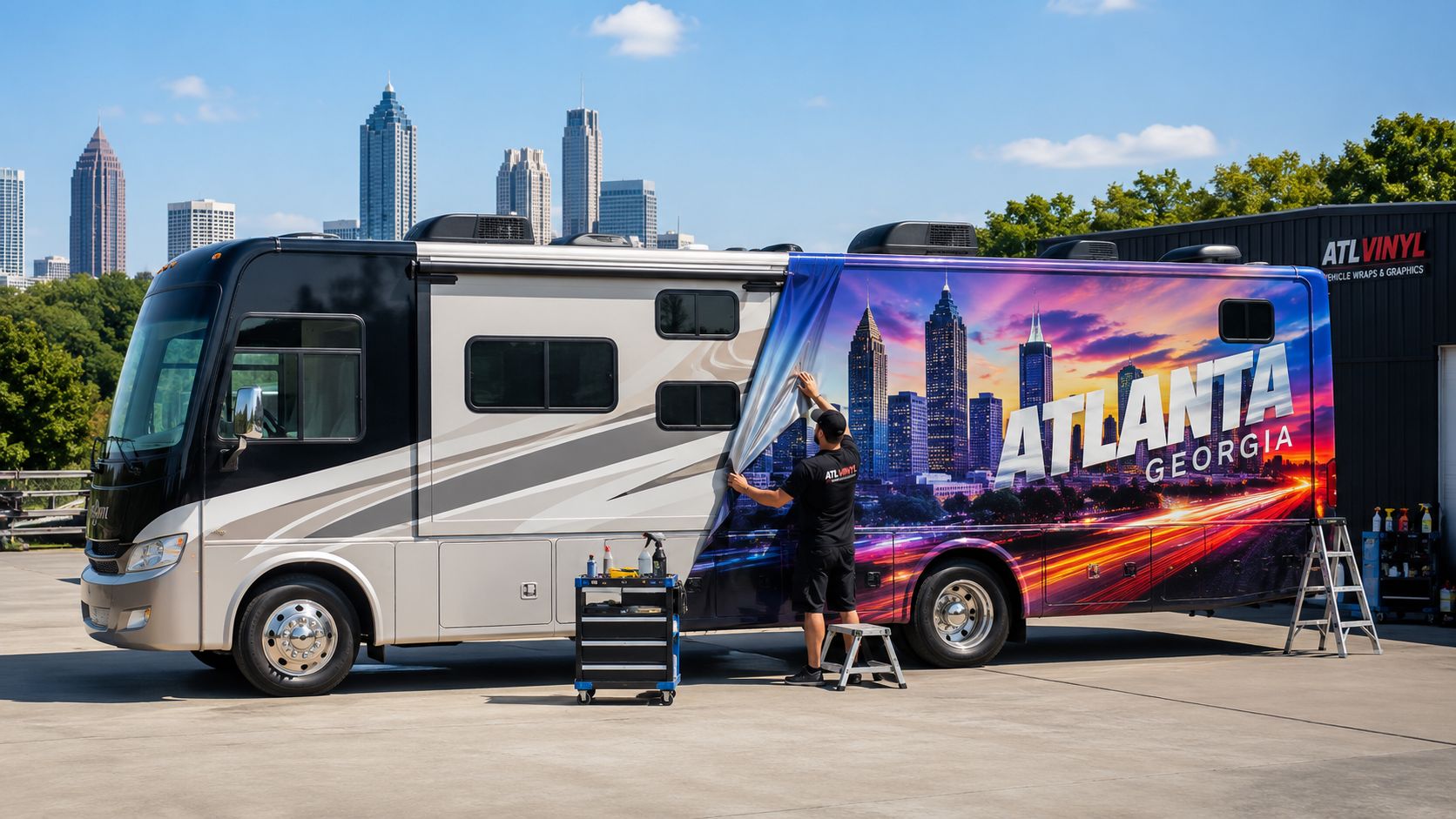
After the concept is approved, seeing a real installation helps make the process more concrete.
A polished result usually comes from boring discipline. Cleaning, measuring, test-fitting, and panel sequencing matter more than flashy sales language.
Materials and Technology Behind RV Wraps
Material choice is where many buyers either protect their investment or create future headaches. Two wraps can look similar on day one and behave very differently later, especially on an RV with long side panels, compound curves, and exposed edges.
This diagram helps sort the parts.

Cast vinyl and calendared vinyl
The simplest way to explain the difference is this. Cast vinyl behaves more like a flexible second skin. Calendared vinyl behaves more like a firmer sticker. Both have uses, but they don't perform the same on large RV surfaces.
Cast film is usually the better fit for wraps that have to conform around curves, recesses, and body details. It tends to lay down more naturally and puts less stress on edges. Calendared film can be more budget-friendly, but flatter surfaces suit it better. On a vehicle with slide-outs, front curves, and multiple panel transitions, that distinction matters.
If you want a broader vehicle wrap primer before talking to a shop, this vinyl car wrap guide gives useful baseline terminology.
Printing, laminates, and adhesive design
The vinyl itself is only part of the system. Printed wraps also rely on inks and laminates. Good print quality matters because RV graphics are large. If the file is weak or the print process is sloppy, color banding, muddy gradients, and poor logo clarity show up fast on broad side walls.
Lamination adds another protective layer. It helps the printed surface resist wear and helps preserve the finish the owner chose, whether that's gloss or matte. Adhesives matter too. Films with air-release channels are easier to position cleanly and help installers work out trapped air during application.
Why this matters for heat and glass discussions in Georgia
For owners in Woodstock, Georgia, Kennesaw, Georgia, and Canton, Georgia, wrap material decisions often overlap with tint questions. That's because an RV owner may be trying to solve two different problems at once. Exterior appearance on painted panels, and interior heat through glass.
Those are separate systems. On the tint side, nano-ceramic window tint technology uses microscopic, non-metallic, non-conductive ceramic particles in a multi-layer polyester matrix and can block 80% to 95% of infrared radiation, compared with 10% to 20% rejection by standard dyed films. The same source notes that certified products can achieve 99%+ UVA/UVB blockage and an SPF 1,000 rating. That doesn't change what wrap film does on painted panels, but it does shape the full comfort package if your RV has cab glass that needs legal automotive tinting.
The common mistake is treating all “vehicle film” as one category. Wrap film changes the exterior body. Ceramic tint manages heat, UV, glare, and privacy on glass.
Comparing RV Wraps to Paint Protection Film and Repainting
Most RV owners compare three options. They consider an RV wrap, paint protection film (PPF), or a full repaint. Each solves a different problem, so the best choice depends on whether you care most about style, preserving factory paint, or restoring a worn finish.
One point gets lost in local search results. The phrase RV wrap near me makes people assume city pricing is the main factor. But this Henderson wrap pricing explanation makes a useful point: wrap costs are driven by vehicle size and coverage area, not city, and quote differences often come from labor rates, material quality, and warranty terms rather than geography.
RV Wrap vs PPF vs Repaint Comparison
| Feature | RV Wrap | PPF | Repaint |
|---|---|---|---|
| Main purpose | Changes appearance and can protect existing paint | Primarily protects paint | Replaces the painted finish |
| Visual flexibility | High. Good for color changes and graphics | Limited compared with wraps | High, but permanent |
| Reversibility | Removable | Removable, depending on condition and installation | Not reversible |
| Spot repair | Often easier to replace a damaged section | Depends on panel location and film match | Usually requires paint blending |
| Best fit | Owners who want style plus protection | Owners focused mainly on paint preservation | Owners restoring damaged or failing paint |
Where PPF fits
PPF and wraps get compared a lot because both are film-based products. But they aren't the same decision. PPF is usually chosen for protection first. Wraps are often chosen for appearance first, with added surface protection as a secondary benefit.
If you want a more focused breakdown of those tradeoffs, this PPF vs vinyl wrap comparison is a practical companion resource.
Where repainting still makes sense
Repainting can still be the right call when the existing finish has failed badly or when a long-term permanent finish is the goal. But many owners prefer wraps because they can transform the vehicle without committing to a permanent paint change.
For business owners using an RV for promotions, wraps also function as advertising. According to vehicle wrap market statistics, wrapped vehicles can generate 30,000 to 80,000 daily impressions per vehicle, achieve a 97% recall rate, and have a $0.48 CPM, compared with $3.56 for billboards and $7.45 for transit advertising. That source also says the global vehicle wraps market was valued at USD 5.62 billion in 2022 and is projected to reach USD 18.4 billion by 2030 at a 15.8% CAGR.
Cost Timeline and Vehicle Class Considerations
A common mistake happens at quote time. An owner searches "rv wrap near me," gets three prices, and assumes the closest shop or the lowest number is the best answer. RV wrap pricing does not work like ordering the same tire from three stores. It works more like pricing a roof replacement. Size matters, but roof shape, access, damage, and material choice often change the bill more than the street address.

National averages and class-based pricing
National pricing is a better starting point than a ZIP-code mindset because RV classes vary so much. As noted earlier, full wraps usually sit in a much higher range than partial wraps, and the spread gets wider as the vehicle gets longer, taller, and more complex.
Vehicle class is the first filter.
- Class B camper vans usually cost the least because they have less surface area and fewer interruption points.
- Class C motorhomes often land in the middle because the over-cab section, storage doors, and mixed body shapes add labor.
- Class A coaches usually cost the most because they combine large panels with more challenging front and rear contours.
- Fifth wheels and travel trailers can vary sharply depending on nose shape, height, and the number of slide-outs.
Coverage level is the second filter. A full wrap, a partial wrap, a front-cap graphic package, and side-only branding are all different projects even if a shop casually labels each one a "wrap." That is why two estimates for the same RV can be far apart without either shop being wrong.
Hidden cost drivers buyers miss
The biggest pricing surprises usually come from labor details that are easy to miss in a phone quote. Geography matters less than condition, shape, and scope. That is the part many articles skip, and it is where buyers in Georgia often lose money by comparing cities instead of comparing work included.
Start with the body itself. Flat sidewalls are simpler than compound curves. A smooth van body is easier to wrap than a coach with deep channels, molded caps, storage doors, ladders, vents, and multiple slide-outs. Every interruption creates more cuts, more edge work, and more time.
Then look at the finish under the film. Oxidation, old adhesive, silicone residue, cracked decals, and failing clear coat all raise prep time. If the surface is unstable, the installer may need to stop and explain that wrapping over the problem will not hide it for long. Film follows the surface under it. It does not correct it.
Design choice changes the budget too. A solid color change is usually simpler than a printed commercial wrap with logos, gradients, panel alignment, and revision rounds. If a quote includes custom graphics, ask whether design time, print production, color proofing, and reprint risk are already included.
RV Share's wrap cost discussion also points out that labor and lifespan vary by RV shape and wrap scope. That matters because a low quote can reflect a smaller coverage area, fewer wrapped edges, or less disassembly rather than better pricing.
Budget filter: If one quote comes in far below the others, ask what is missing. Common exclusions include slide-outs, cap details, decal removal, trim removal, printed artwork changes, and post-install touch-up time.
How long should you plan for the job
Timeline depends on decision speed as much as installation speed. Owners often focus on "How many days will the RV be at the shop?" but the full schedule starts earlier. Design approval, print production, parts removal, prep cleaning, installation, and final inspection all affect the calendar.
A smaller van-based RV with a simple color change may move through the process much faster than a large Class A coach with custom graphics and multiple slide-outs. The difference is similar to wrapping a notebook versus wrapping a row of kitchen cabinets. Both use film. One has far fewer edges, openings, and fit problems.
Ask each shop three direct questions:
- What is included before installation begins? This reveals whether cleaning, decal removal, and surface correction are separate charges.
- How much time is reserved for print approval and fit checks? This helps prevent rushed artwork and panel mismatch.
- What happens after the film is installed? A careful shop builds in time for edge inspection, heating, and correction before pickup.
For Georgia owners, there is one more practical point. If your RV carries business branding, schedule enough time to review any company name, phone number, registration marking, or advertising language before printing. Reprinting film because of a compliance or branding error is a preventable cost, and installer credentials matter more than whether the shop is five minutes closer to home.
Preparing and Installing Your RV Wrap
Preparation is where good wraps are protected and bad wraps are exposed. If the surface is contaminated, if old decals were removed poorly, or if trim is left in place just to save time, the finish may look acceptable at pickup and then start lifting at the edges later.
What owners should do before drop-off
The owner's job is simple, but it matters.
- Wash the RV early: Remove road grime, bugs, and loose dirt before the appointment.
- Disclose prior repairs: Tell the installer about repainted panels, body filler, or peeling clear coat.
- Remove personal add-ons if possible: Magnetic signs, easy-to-detach accessories, and temporary hardware can slow prep.
- Decide on coverage before arrival: Last-minute changes to slide-outs, ladders, or accent pieces create delays.
If the project includes automotive tinting on the cab glass for a motorized RV, make that part of the conversation early. Shops need to know whether they're handling body film only or body film plus legal tint work for road-use glass in Woodstock, Kennesaw, or Canton.
What the installer does in the prep stage
A professional prep stage often includes degreasing, adhesive removal, edge cleaning, and checking any areas where the film must wrap around a panel edge. That's especially important around door seams, compartment hatches, and corners where tension can build.
A few examples show why labor differs so much:
- A 28-foot motorhome may look manageable from a distance, but side compartments, trim breaks, and front contours create more handwork than buyers expect.
- A converted van may have fewer square feet than a large coach, but mirrors, handles, textured plastic, and tight curves can still make installation tedious.
- A Class C often needs more care around the over-cab section because that shape creates transitions that aren't friendly to rushed film placement.
How the wrap goes on
Installers typically work panel by panel. They position the printed section, tack it in place, squeegee out air, use heat where needed, and trim carefully around hardware and edges. Slide-outs and curved front sections usually require slower, more deliberate work because the film has to conform without overstretching.
A smooth install depends on sequence. The technician has to decide what overlaps what, where seams should hide, and how to maintain graphic alignment across long side walls.
A clean-looking seam is not an accident. It's usually the result of panel planning before the liner is ever peeled.
Why RV shapes complicate installation
Cars are small by comparison. RVs add height, long runs, ladders, awning mounts, vents, trim rails, and broad printed graphics that must stay visually straight across a very large body.
That's why “full wrap” isn't one universal product. On one rig it may mean mostly flat side coverage. On another, it may involve extensive work on difficult front and rear sections, multiple slide-outs, and extra masking or removal steps.
Buyers in North Metro Atlanta often focus on the nearest shop first. A better approach is to ask the shop to walk you through the workflow for your exact RV type. If they can't explain prep, panel layout, and edge management clearly, the quote probably isn't detailed enough.
Maintenance Warranty and Georgia Legal Considerations
A wrap that looks great on delivery still needs upkeep. Dirt, harsh chemicals, abrasive brushes, and neglected edges shorten the life of the finish. If the RV also has cab or passenger glass that's been tinted, Georgia law becomes part of the ownership routine too.
Here's the maintenance checklist visual.

Day-to-day wrap care
Most wrap maintenance is straightforward. The goal is to keep the film clean without grinding dirt into it or using chemicals that attack the surface.
- Gentle washing: Use a mild automotive soap and soft wash media.
- Careful drying: A clean microfiber towel works better than rough shop rags.
- Avoid harsh cleaners: Strong solvents and abrasive compounds can damage the finish.
- Inspect edges: Look at high-stress points around corners, doors, and storage compartments.
A yearly professional inspection is a smart habit, especially for RVs that sit outside for long periods.
Warranty details that actually matter
Warranty language is easy to skim and easy to misunderstand. Buyers often assume every installation comes with the same protection. It doesn't. Certification and installation quality affect what coverage remains valid.
According to The Tint Guy's warranty information, professional automotive tint installations in Georgia typically carry a lifetime warranty covering peeling, bubbling, discoloration, and cracking, but that coverage depends on installation by a certified dealer such as a 3M Prestige Dealer. That point is about tint, not wrap film, but it's still useful because it shows why installer credentials matter in film-based automotive work.
Georgia tint law for RV glass and automotive use
If your RV includes road-use glass that you want tinted, Georgia law matters more than shop marketing. According to Georgia tint law guidance, automotive window tint in Georgia must allow at least 32% visible light transmission on side and rear windows, and the windshield may only have non-reflective tint on the top five inches.
For buyers in Woodstock, Georgia, Kennesaw, Georgia, and Canton, Georgia, that's the baseline legal rule. A more installer-focused guide for Georgia also notes that front side windows should allow more than 33% VLT, which is why 35% VLT is often recommended as a comfort margin for legal compliance, and that installers should provide spec sheets showing IRR above 80% with TSER values validated by ASTM E903 or ASTM D1003 when discussing legitimate ceramic film performance, as explained in this Georgia ceramic tint guide.
Why ceramic tint enters the RV wrap conversation
Owners often arrive asking about exterior wrap color and leave asking about interior heat. That's logical. The body and the glass contribute to comfort in different ways.
For local drivers searching RV wrap near me in Canton, Kennesaw, or Woodstock, the practical takeaway is simple:
- Wrap the painted body for appearance and exterior protection.
- Use legal, high-quality automotive tint on qualifying glass for heat, glare, and UV management.
- Keep your paperwork, warranty details, and product specs.
If a shop can't explain Georgia tint limits in plain language, don't trust them to solve a heat problem that involves legal glass.
Choosing a Trusted RV Wrapper in North Metro Atlanta and Conclusion
When you compare providers, ignore the loudest claim first. Focus on the proof. The best shop for an RV project in Woodstock, Georgia, Kennesaw, Georgia, or Canton, Georgia should be able to show real vehicle examples, explain material choices clearly, and tell you who installs the film.
What to ask before saying yes
Use a short decision checklist.
- Ask about film type: Find out whether the shop is recommending cast or calendared vinyl and why.
- Ask what the quote includes: Make them spell out slide-outs, front cap work, rear sections, trim removal, and design revisions.
- Ask about credentials: Certification matters for film products, especially when the project also includes legal automotive tinting.
- Ask about warranty terms: Coverage should be explained in writing, not casually mentioned at the counter.
- Ask to see similar vehicles: A van, a Class C, and a large Class A don't present the same installation challenges.
Why local buyers should think beyond distance
The best answer to RV wrap near me isn't always the closest pin on the map. It's the shop that understands the difference between a cheap quote and a complete one. It's the team that can discuss body film, legal tint, heat rejection, and product specs without hand-waving.
For broader travel readiness, it also helps to think beyond the wrap itself. If you're setting up your RV for longer trips, this RV hot water heater guide is a practical read because comfort upgrades rarely happen in isolation.
If you also want a local starting point for vehicle wrap search intent, this guide on where to get my car wrapped near me is helpful for comparing what serious wrap buyers should ask.
The big takeaway is simple. Geography doesn't explain most quote differences. Material quality, installer credentials, prep discipline, and a clear scope of work do. If your RV also needs legal window film for Georgia roads, that part deserves the same level of scrutiny.
If you want help from a certified local team, The Tint Guy serves North Metro Atlanta with automotive film expertise for drivers in Woodstock, Kennesaw, and Canton. Reach out for a personalized quote, ask about legal Georgia tint options, and get clear guidance on whether your project needs a wrap, ceramic tint, PPF, or a combination that fits how you use your vehicle.