You're probably here because you searched for Powder Coat Calipers Near Me after seeing faded, rusty, or plain factory calipers behind your wheels. Maybe you found a shop in Woodstock, Georgia, Kennesaw, Georgia, or Canton, Georgia that says it does powder coating, but the descriptions all blur together. Some mention paint. Some mention high heat. Very few explain what occurs to the caliper.
That's where it's common to get tripped up.
Brake calipers aren't trim pieces. They live next to serious heat, brake dust, road grime, and moisture. So if you're comparing local shops in North Metro Atlanta, you need more than a pretty photo gallery. You need to know what real powder coating is, why the curing process matters, how to spot shortcuts, and what a fair price looks like before you book the job.
Understanding Powder Coating Calipers
A brake caliper sits in one of the harshest environments on your car. It gets hot, dirty, wet, and blasted with road debris. That's why the finish on it matters more than many owners realize.
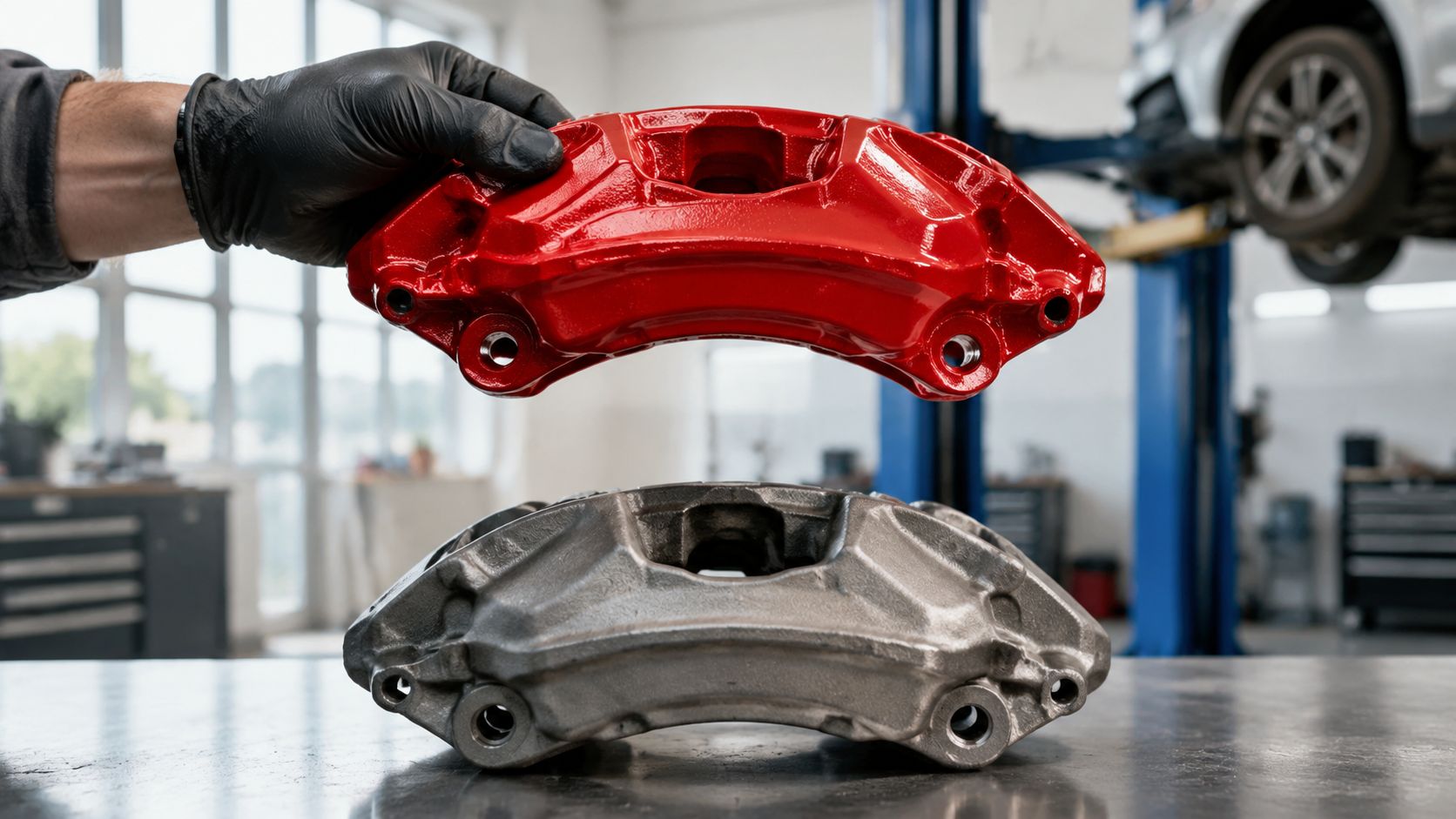
Powder coating isn't the same thing as spraying on a colored liquid and letting it dry. A shop applies a dry powder to the metal, usually with an electrostatic process, then cures it with heat so the coating fuses into a hard shell. The easiest everyday analogy is baking on a finish. Once the coating melts and bonds correctly, it becomes far tougher than a casual spray-can coating.

What makes powder coating different
Think of regular paint like brushing color onto the surface of a coffee mug. Think of powder coating more like firing a finish onto that mug so it becomes part of the outer layer. That's why a properly coated caliper can hold up better against chips, scratches, and corrosion.
For local drivers in Woodstock, Georgia, Kennesaw, Georgia, and Canton, Georgia, this matters because daily driving mixes brake heat with humidity, rain, pollen, and grime. A weak finish starts looking tired fast. A stronger finish gives the caliper a better shot at staying clean-looking over time.
Why shops need to treat calipers as functional parts
Many people search for Powder Coat Calipers Near Me because they want a cosmetic upgrade. That's fair. Bright red, black, yellow, or custom colors can completely change the look behind open-spoke wheels. But the caliper is still a brake component first.
A good shop treats the finish like part of a protection system, not just decoration. Surface prep, cleaning, and curing all matter because the coating has to survive real use.
Practical rule: If a shop talks only about color choices and never talks about prep or cure steps, ask more questions before you book.
This is the same mindset car owners use when comparing surface protection options for bodywork. If you've ever looked into paint protection solutions for vehicle surfaces, you already understand the core idea. The finish is only as good as the preparation underneath it.
Where buyers usually get confused
Three points cause the most confusion:
- “Powder coat” vs paint: Some listings use the words loosely.
- Heat resistance: People assume any “high-temp” product is enough.
- Disassembly: Owners often don't realize brake parts inside the caliper can't just be baked carelessly.
That confusion is why local vetting matters so much. The finish may look fine on pickup day and still fail later if the shop skipped critical steps.
Benefits and Risks of Powder Coating Calipers
A well-done caliper coating job can make a car look sharper every time you walk up to it. It can also help the metal resist corrosion and make routine cleaning easier because brake dust doesn't cling as stubbornly to rough, deteriorated surfaces.
But this upgrade has two sides. Powder coating can be excellent when the shop handles disassembly, cleaning, coating, and reassembly properly. It can also become an expensive cosmetic headache when a shop treats brake calipers like ordinary brackets.
What owners usually like about it
The first benefit is appearance. Powder coating usually gives a more even, richer-looking finish than a quick aerosol job. On cars with open-spoke wheels, that alone can transform the whole profile of the vehicle.
The second benefit is durability. A proper coating is meant to stand up to road grit, moisture, and repeated wash cycles better than a casual painted finish. For a daily driver in North Metro Atlanta, that matters more than a showroom-only shine.
A third benefit is consistency. If the shop knows what it's doing, the calipers tend to have a cleaner, more uniform look across the full set.
Where things go wrong
The biggest risk isn't the color. It's the process.
If a shop doesn't strip the parts correctly, the coating may not bond well. If contamination remains on the metal, the finish can lift. If the shop handles the caliper like a decorative part instead of a brake part, internal components can be exposed to heat they shouldn't see.
A beautiful finish on a badly prepared caliper is still a bad job.
Another common problem is false confidence from advertising. A listing may sound professional, but the actual work may be closer to painted dressing than true powder coating. That's why asking how the shop handles teardown, masking, and curing matters more than asking which color chart they use.
A realistic way to think about the tradeoff
If you want the shortest, simplest cosmetic route, powder coating may feel like more work than you expected because proper execution involves real labor. That doesn't make it a bad option. It means the job should be priced and explained like a brake-component service, not like coloring a valve cover.
Use this quick filter when comparing local shops:
- Ask about disassembly: If they're vague, that's a concern.
- Ask about prep: Surface cleaning should sound methodical, not casual.
- Ask what they won't coat: Good shops know where coating doesn't belong.
- Ask who reassembles the calipers: Brake work shouldn't sound improvised.
The upside is strong when the process is disciplined. The downside comes from shortcuts, not from the coating itself.
High Temperature Requirements for Brake Calipers
You pick up your car after a caliper coating job, and the finish looks excellent in the parking lot. Then a few hard stops later, the concern is no longer color. The critical question is whether the coating was cured correctly and whether the shop treated the caliper like a brake component instead of a decorative metal part.
Heat is the whole story here.
Brake calipers sit beside rotors that can get extremely hot during repeated braking, mountain driving, towing, or aggressive stop-and-go traffic. The caliper body has to live near that heat after the job is done, and the coating has to survive the oven heat during the job itself. Those are two different temperature problems, and good shops explain both.
The coating phase is often the overlooked one. Powder coating works like powdered sugar on a hot pastry. Until heat melts and bonds it, it is just dust on the surface. Powder manufacturers such as Prismatic Powders explain that thermoset powders are cured by reaching a specified metal temperature for a set time. That sounds simple, but on brake calipers it raises a serious shop-quality question. What was removed before that oven cycle started?
Why cure temperature matters
A proper cure is not just "put it in the oven until it looks done." The shop has to reach the right temperature at the metal, hold it long enough, and avoid exposing seals and other soft parts to heat they were never meant to handle.
That is where many local listings become hard to judge from photos alone.
A glossy caliper in an Instagram post does not tell you whether the shop monitored part temperature, whether they cured by powder spec, or whether they baked a partially assembled caliper and hoped masking tape would solve the problem. If you have ever read about how protective finishes hold up only when the preparation and curing are done correctly, the same basic lesson applies here. The finish only performs as well as the process behind it.
What needs to come out before the oven
The caliper body is metal. Pistons, seals, boots, and other internal pieces are a different story.
A useful way to picture it is baking a cast-iron pan with a rubber spatula still clipped to the handle. The pan can take the heat. The soft part cannot. Brake calipers follow the same logic. The metal housing may be suitable for curing. Internal rubber components are the concern.
That is why piston and seal removal matters so much. If a North Metro Atlanta shop answers with vague wording like "we mask it off" or "we usually leave the internals alone," keep asking questions. Masking protects areas from powder. It does not magically make internal soft parts immune to oven temperatures.
What to ask local shops in North Metro Atlanta
Local vetting then gets more specific than a generic "powder coat calipers near me" search.
If you are calling shops in Woodstock, Kennesaw, Canton, Roswell, Alpharetta, or Marietta, ask them to describe the cure process in plain language. A competent shop should be able to explain:
- the cure range they use for the powder they selected
- whether they track oven air temperature or actual part temperature
- whether calipers are fully stripped before curing
- which parts are removed, replaced, or rebuilt after coating
- how they keep coating away from sealing surfaces, bleeder threads, and piston bores
Listen to how they answer, not just what answer they give. Clear, methodical wording usually means they have a repeatable process. Evasive wording often means the heat side of the job is being treated casually.
The quality signal most buyers miss
Color selection gets the attention. Cure discipline is what separates a durable job from a cosmetic gamble.
A strong shop should be comfortable discussing oven temperatures, cure schedules, and teardown steps without sounding annoyed or surprised by the question. If they act as though heat management is a minor detail, that is a warning sign. On brake calipers, heat is not a footnote. It is the condition that decides whether powder coating behaves like a durable bonded finish or just an expensive layer waiting to fail.
Powder Coating Process and Preparation
A professional caliper job follows a sequence. When that sequence gets broken, quality falls fast. If you're calling shops around Woodstock, Georgia, Kennesaw, Georgia, or Canton, Georgia, listen for whether they describe a real workflow or just a result.
The order matters because each step sets up the next one. You can't get durable adhesion on top of grease, corrosion, or leftover coating.
The basic workflow

A solid process usually sounds something like this:
Disassembly
The caliper comes off the vehicle and is broken down so the coating work doesn't interfere with braking components.Surface stripping or blasting
Old finish, rust, and contamination need to go. If the old layer stays, the new one is only as strong as the weak material underneath.Degreasing
Brake components collect grime fast. Oil and residue can ruin adhesion.Powder application
The powder gets applied to the prepared metal, not to a dirty or loosely scuffed surface.Controlled oven cure
Heat fuses the coating into a durable shell.Inspection and reassembly
Good shops don't stop when the color looks nice. They check the finish, then reassemble with care.
A short visual makes the sequence easier to follow:
What to listen for when a shop explains its process
You don't need to be a coating engineer. You just need to hear signs of discipline.
A quality-minded answer usually includes specific prep language, not just “we spray and bake them.” Words like sandblasting, degreasing, stripping, masking, and inspection suggest the shop sees this as process work rather than a quick appearance job.
Shop check: The more clearly a technician can walk you through prep and reassembly, the more likely they've done this carefully before.
How this compares to other finish protection work
This same principle shows up across automotive surface care. Good outcomes come from method, not hype. Owners who care about finish longevity often look at how to protect a new car's paint from wear and contamination with the same mindset. Preparation, controlled application, and aftercare determine whether the finish holds up.
For calipers, the biggest takeaway is simple. Don't judge the job by color alone. Judge it by the steps the shop is willing to explain.
Cost Estimates and Turnaround Time for Local Services
This is often the first section consulted, and it's where sticker shock often kicks in. You'll see one shop quote a few hundred dollars and another quote luxury-level pricing that sounds completely disconnected from the rest of the market.
The reason is scope.
According to ColorWerks' brake caliper pricing breakdown, the standard market cost for powder coating a complete set of brake calipers typically ranges between $200 and $400, while specialized luxury shops may quote $2,600 when the package includes added work such as decal application and rotor hub rust removal. The same source notes that bundled restoration services can take 3–4 business days.
Typical Powder Coating Cost Estimates
| Service Type | Price Range |
|---|---|
| Complete set of brake calipers at a standard market rate | $200 to $400 |
| Premium luxury package with added services | $2,600 |
That's a wide gap, but it makes more sense once you separate basic powder coating from a more involved cosmetic restoration package.
What affects the final bill
The base price often changes because shops aren't always quoting the same job. One place may be pricing the coating itself. Another may be wrapping in removal, stripping, decals, rust cleanup, and reinstall labor.
The same ColorWerks reference also notes that if calipers already have coatings that must be stripped before paint application, pricing for raw paint application in that market can jump to $2,000, while powder coating on stripped units remains the more durable financial option in the $200–$400 bracket for many daily drivers.
A fair quote should tell you what's included, such as:
- Removal and reinstall labor
- Stripping old coating
- Prep work like blasting and degreasing
- Extra cosmetic details
- Vehicle downtime
How to think about turnaround
Turnaround depends on whether the shop is doing only coating work or a broader cosmetic package. A more thorough service may keep the vehicle longer because braking components have to be removed, processed, reassembled, and checked carefully.
If a quote sounds unusually low or unusually fast, ask what the shop is skipping. The cheapest number on the phone isn't always the least expensive outcome once rework enters the picture.
Powder Coating vs High Temp Paint
You call a shop in North Metro Atlanta and ask for powder-coated calipers. The quote sounds fine. The finish looks glossy in photos. Then you learn they are spraying a high-temp paint. That mix-up is common, and it matters because these two finishes are built in different ways.
Powder coating uses electrically charged dry powder that is baked onto properly prepared metal. High-temp paint is a liquid coating that is sprayed or brushed on and then cured by air, heat, or both, depending on the product. They can look similar at first glance, the same way tile and laminate can both look clean from across the room, but they do not go on the surface the same way and they do not ask the same level of prep from the shop.

Side by side differences
| Feature | Powder Coating | High Temp Paint |
|---|---|---|
| Application method | Dry powder applied and oven cured | Liquid coating sprayed or brushed |
| How it adheres | Heat-fused onto well-prepared metal | Depends heavily on primer, paint chemistry, and prep quality |
| Finish thickness | Usually thicker and more uniform | Usually thinner and more technique-dependent |
| Shop setup needed | Requires blasting, masking, curing equipment, and temperature control | Often needs less equipment and can be done faster |
| What buyers miss | Some shops advertise it without offering a true powder process | Some paint jobs are sold using powder-coat search terms |
The overlooked part is curing temperature. Brake calipers live beside rotors that generate serious heat. A shop can only call the job powder coating if it has the right oven process and can cure the coating according to the powder manufacturer's specification. If that step is sloppy, rushed, or done with the wrong product, the finish may look fine at pickup and disappoint later.
That is why local vetting in places like Woodstock, Kennesaw, Alpharetta, Roswell, and Canton needs to go beyond photos. Ask whether the shop powders brake calipers regularly or mainly handles patio furniture, wheels, and railings. Ask what powder line they use for calipers, what cure schedule they follow, and whether they verify metal temperature or just oven air temperature. A shop with disciplined process control will answer clearly. The mindset is similar to enhancing service quality for operations managers, where checklists and repeatable steps reduce expensive mistakes.
Which one fits which owner
A well-done high-temp paint job can make sense for an owner who wants a cosmetic refresh, lower entry cost, or a simpler service path. That choice can be reasonable if the shop says plainly that it is using paint.
Powder coating usually fits the owner who wants a thicker baked finish and is willing to pay for the extra prep, masking, curing, and reassembly care. The problem is not that paint exists. The problem is paying for one process and getting the other.
This kind of confusion shows up in other automotive protection choices too. The difference between products can sound small in a search result and become large once you understand how they work. That is the same pattern discussed in paint protection film versus ceramic coating for surface defense.
The practical takeaway
When looking for Powder Coat Calipers Near Me in North Metro Atlanta, ask one direct question first. “Are you doing true powder coating with oven curing, or a high-temp paint service?”
Then ask one more. “How do you confirm the caliper coating reaches its required cure?”
That second question filters out a surprising number of weak listings. A real caliper powder-coat shop should be able to explain the heat-cure process in plain language, not hide behind marketing terms.
Questions to Ask When Choosing a Powder Coat Shop
A strong shop interview doesn't need to sound aggressive. It just needs to be precise. The right questions expose whether a shop has a disciplined process or just polished marketing.
The easiest way to think about it is quality control. Manufacturing teams use checklists because repeatable work beats assumptions. If you want a broader example of that mindset, this piece on enhancing service quality for operations managers shows why structured checks matter before work goes out the door.
Use this phone script
Start with these questions in plain language:
“Do you fully disassemble the calipers before coating?”
This gets to the heart of whether the shop treats the caliper as a brake component or a decorative part.“What prep work do you do before coating?”
You want to hear more than “we clean them up.” Good answers mention stripping, blasting, or degreasing.“What gets masked or left uncoated?”
A careful shop knows there are areas where coating thickness can cause problems.“Who handles reassembly?”
If the answer sounds vague, don't ignore it.
Listen for clarity, not buzzwords
A weak shop often leans on generic terms like durable, premium, or high-temp without explaining procedure. A better shop sounds calm and concrete. They can describe the sequence without making it feel mysterious.
Ask follow-up questions if you hear fuzzy language:
- What does your teardown include?
- How do you deal with old coatings or corrosion?
- How do you inspect the finished parts before reinstalling them?
Good sign: The technician answers in steps.
Bad sign: The answer keeps circling back to color options.
What a trustworthy answer sounds like
You're listening for signs that the shop has done this enough times to explain it clearly. The best answers usually feel ordinary, not theatrical. They sound like someone following a proven routine.
If the conversation leaves you more confused than when it started, keep shopping. Brake caliper coating shouldn't require blind faith.
Finding and Vetting Powder Coating Caliper Services Near Me in North Metro Atlanta
Local search results can make every shop look equally qualified. They're not. If you're searching around Woodstock, Georgia, Kennesaw, Georgia, or Canton, Georgia, your job is to verify that the shop's words match its process.
Start with the search terms people typically use. Try combinations like Powder Coat Calipers Near Me, brake caliper powder coating Woodstock Georgia, caliper coating Kennesaw Georgia, and brake caliper refinishing Canton Georgia. Location-based searches help surface businesses that may not rank for broader metro-wide terms.
How to read local listings more carefully
Don't stop at star ratings. Read the wording in reviews and service pages.
Look for signs that customers mention actual process details, such as disassembly, prep, turnaround, or reassembly. Be cautious if every review focuses only on appearance and none mention workmanship, communication, or durability.
If you're interested in how local businesses improve visibility in map results and nearby searches, this 2026 guide to local ranking gives useful background on why some shops appear prominently even when their service descriptions are thin. It's helpful because ranking well and doing careful caliper work are not the same thing.
A practical vetting checklist for North Metro Atlanta
Use this in Woodstock, Kennesaw, and Canton:
- Check the gallery closely: Do photos show bare calipers in prep stages, or only glossy finals?
- Ask for process details: A serious shop should explain prep and cure steps without dodging.
- Confirm the exact service type: Make them say whether it's true powder coating or paint.
- Look for brake-specific language: Shops that work on brake components usually sound different from general cosmetic shops.
- Pay attention to location convenience: Since the car may be down for a period, distance and scheduling matter.
Keep your expectations grounded
Some owners in North Metro Atlanta want the strongest finish possible. Others just want a cleaner look behind the wheels. Either goal is fine. The mistake is assuming every listing labeled “powder coating” delivers the same level of work.
Search smart, ask blunt questions, and judge the process more than the photo set. That's the cleanest way to avoid a finish that looks good for a moment and disappoints later.
If you're in Woodstock, Georgia, Kennesaw, Georgia, or Canton, Georgia and want help improving comfort, glare control, privacy, and heat management in the same vehicle you're upgrading cosmetically, The Tint Guy is a strong local option for premium automotive window tint. Georgia law requires 32% VLT on side and rear windows, with non-reflective tint allowed above the windshield's AS-1 line, as outlined by The Tint Guy's Georgia tint law guidance. For drivers focused on heat rejection, premium nano-ceramic films can block up to 98% of infrared radiation and 99% of UV rays, with interior heat reduction of 15–25°F compared to standard dyed or carbon tint, according to Atlanta Tint Lab's Woodstock auto window tinting page. If you want premium film options in North Georgia, The Tint Guy's 3M automotive film lineup includes 3M Crystalline and Prestige series.