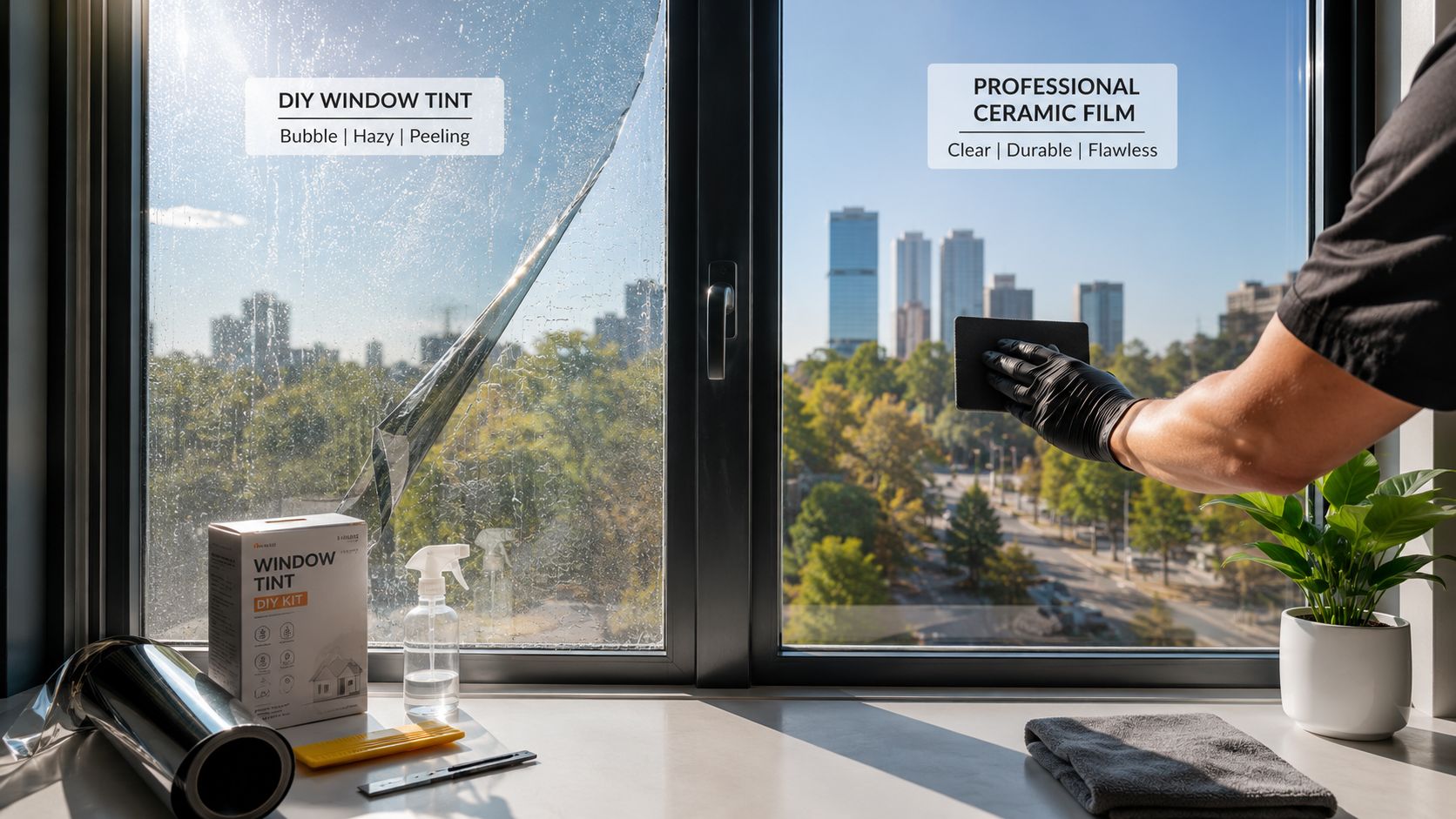
You're probably looking at a car that feels hotter every week. The steering wheel burns your hands, the dash looks like it's taking a beating, and the seats stay warm long after sunset. In Woodstock, Kennesaw, and Canton, that's a familiar problem. The next step often seems obvious. Search for UV blocking film at Home Depot, buy a roll, and handle it over the weekend.
That move makes sense on the surface. Big-box film is easy to find, the packaging promises UV protection, and DIY always looks cheaper at the start. The mistake happens when people assume all “UV blocking film” is basically the same, and that a residential product can do the job of automotive tint.
It can't. Some DIY film has a legitimate place. A car window isn't that place.
The Sun Is Winning Is Home Depot Film the Answer
A lot of drivers in North Metro Atlanta arrive at the same question from two directions at once. They notice the living room windows are fading a rug or sofa, and they notice the car parked outside feels like an oven by lunch. One trip to Home Depot seems like it should solve both.
That's where the confusion starts. The packaging language sounds close enough that it's easy to lump every film product together. UV blocking. Heat control. Privacy. Glare reduction. If you're standing in an aisle with a roll of film in your hand, it's reasonable to think you've found a practical fix.

Why this search happens so often
For homeowners, store-bought film can look like a simple answer for flat glass. For drivers, the same product seems like a shortcut to cooler cabin temperatures and less fading inside the vehicle. The problem is that the use cases split fast.
A house window stays put. A car window rolls up and down, curves, flexes, and lives through constant temperature swings. Automotive glass also puts much higher demands on optical clarity and long-term adhesion. That difference is often underestimated when searching for UV blocking film Home Depot options.
What people usually want
Most shoppers aren't looking for film as a hobby project. They want a result:
- Less cabin heat: They want the car to stop baking in the Georgia sun.
- Interior protection: They want to protect leather, plastic, trim, and screens from sun damage.
- A cleaner appearance: They want tint that looks even, not purple, hazy, or bubbly.
- A legal install: They don't want to deal with a stop, ticket, or forced removal later.
Residential film can be a decent DIY product for the right flat glass project. It becomes the wrong product the moment you try to make it act like automotive tint.
That distinction matters most for drivers in Woodstock, Kennesaw, and Canton, where summer sun, commuting, and parking lot exposure turn a small product choice into a daily comfort issue.
Understanding UV Blocking Film Technology
The first thing to know is simple. UV blocking and heat rejection are not the same thing. A film can be good at one and average at the other.
Quality UV-blocking window films, including those sold at Home Depot for residential use, can block up to 99% of harmful ultraviolet rays, which helps limit skin damage and interior fading, according to this window film performance overview. That's why DIY film gets attention in the first place. On the UV side, decent products can perform well.
What UV protection actually means
UV protection matters because sunlight does more than create glare. It breaks down dyes, dries out surfaces, and ages materials faster. That applies to house interiors and car interiors alike.
But UV is only one slice of the problem. Drivers in Georgia usually complain first about heat, not just fading. That brings in two other terms that matter when comparing films:
- VLT: Visible Light Transmission, or how much visible light passes through
- TSER: Total Solar Energy Rejection, a broader measure of how much solar energy the film rejects
If you want a deeper look at how UV-focused products work on glass, UV protection film for glass gives useful background on the protection side of the equation.
Why residential and automotive films are different products
A residential film is built for flat, stationary glass. It doesn't need to contour over compound curves or deal with the stress of a door window moving up and down every day. Automotive tint does.
That changes everything about the install. Automotive film has to be handled differently, shaped differently, and bonded with the expectation that it will face vibration, repeated movement, direct sun exposure, and more aggressive thermal cycling. A home film can still be a solid home product. It just wasn't engineered for that environment.
What matters beyond the label
Home Depot film listings often mention UV blocking first because it's an easy benefit to understand. Real-world automotive performance depends on more than that.
For car owners, the practical questions are usually these:
- Will it stay clean and clear on curved auto glass?
- Will it reject enough heat to change how the cabin feels?
- Will it hold up without peeling, bubbling, or edge failure?
- Will it remain legal once installed on the specific windows of that vehicle?
Those are automotive questions. A residential kit doesn't answer them well, even when the box sounds promising.
DIY Home Depot Film vs Professional Installation
Here's the side-by-side comparison most shoppers need. Not marketing language. Just the trade-offs.
| Criteria | DIY film from Home Depot | Professional automotive tint |
|---|---|---|
| Intended use | Primarily residential flat glass | Engineered for automotive glass |
| Upfront cost | Lower at purchase | Higher at purchase |
| Installation difficulty | High for beginners, especially on car windows | Installed by trained technicians |
| UV blocking | Can offer strong UV blocking on suitable products | Strong UV blocking plus automotive-specific performance |
| Heat management | Varies widely by film type | Better options available for serious heat control |
| Fit on curved glass | Poor match for vehicle glass | Designed to be shaped and fitted correctly |
| Finish quality | Prone to dust, creases, fingers, and edge lift | More consistent appearance |
| Longevity in vehicles | Unreliable | Built for automotive use |
| Warranty support | Limited compared with professional installs | Typically stronger product and labor support |
| Legal guidance | You're responsible for figuring it out | Installer can match film to Georgia limits |

What the material differences look like in practice
A lot of big-box residential films use multi-layer sputtered polyester construction and can block 99% of UV radiation, with visible light transmission commonly in the 40 to 70% range. Premium ceramic-style residential variants can reach 45 to 60% TSER, while standard dyed films are typically around 25 to 35% TSER, according to product information referenced through Home Depot Canada.
That sounds good until you apply it to a car. Automotive performance needs more than a respectable spec sheet on flat glass. It needs film that shrinks correctly, sits cleanly on curved windows, and survives daily use. Those are different demands.
Where professional film separates itself
Benchmark testing tied to the International Window Film Association says high-performance ceramic window films must meet ASTM E903 standards for spectral transmittance, with TSER values exceeding 55% and UV rejection at 99.9% across the 290 to 400nm wavelength range, while non-ceramic acrylic or dyed alternatives typically cap TSER at 30 to 40%. That comparison appears in this cited Home Depot Canada product reference.
That's the main reason ceramic tint costs more. You're not just paying for darkness. You're paying for a stronger material, better heat management, and performance that holds up under automotive conditions.
If you want a practical consumer comparison on store-bought privacy products versus professional work, privacy window tint Home Depot is a useful reference point.
Practical rule: If the film was marketed for your house first, treat it like a house product until proven otherwise.
The install itself is a major dividing line
Even decent film can look bad if the install is sloppy. On vehicles, common DIY problems show up fast:
- Contamination: Dust and lint get trapped under the film and stay visible.
- Edge failure: Corners lift first, especially on rolled windows.
- Poor shrinking: Residential film doesn't conform well to compound curves.
- Optical issues: Haze, distortion, and uneven application become obvious in sunlight.
A professional install solves material and technique at the same time. That matters more than the roll price on the box.
When to DIY and When to Hire a Professional
There are times when DIY film is perfectly reasonable. They're just narrower than most shoppers think.
DIY can make sense in a few home situations
A store-bought UV film is often acceptable when the project is simple, flat, and forgiving. Think a small window in a garage, a temporary rental situation, or a low-stakes space where a few cosmetic flaws won't bother you.
DIY also makes sense when your priority is basic UV reduction on stationary glass, not a showroom finish. If the glass is easy to clean, easy to reach, and easy to replace mentally if the result is average, a Home Depot roll may be enough.
Hire a professional when the result actually matters
Vehicles belong in this category every time. So do larger glass areas, difficult edges, and projects where appearance matters.
You should lean professional when you need:
- Automotive durability: Door glass moves. Rear windows curve. Cabin temperatures swing hard.
- Cleaner optics: On a windshield-adjacent area or side glass, distortion gets annoying fast.
- Reliable heat control: If comfort is the goal, material choice matters more than package claims.
- Long-term finish quality: A neat install matters if you plan to keep the car.
A simple decision filter
Ask three questions:
- Is the glass flat and stationary?
- Are minor flaws acceptable?
- Is this a short-term fix, not a long-term upgrade?
If the answer is yes across the board, DIY might be fine. If the project involves a vehicle in Woodstock, Kennesaw, or Canton, the answer changes immediately. Cars are exposed, visible, regulated, and expensive to redo when the first attempt fails.
Good DIY film is still the wrong tool when the glass curves, moves, and has to stay legal.
That's the line generally needed.
The Critical Difference for Your Car's Windows
A common error occurs. A lot of people assume that if a film blocks UV, it should work on a car. That assumption leaves out the hardest part of automotive tinting.
Car windows are not just smaller house windows. Rear glass is curved. Side glass drops into door seals. Modern vehicles have tight trim, defroster lines, sensors, and visibility demands that expose every install flaw.

Why residential film fails on cars
Residential film is designed for flat residential glass. It isn't built around the shaping and durability requirements of vehicle windows. Even before performance becomes an issue, the physical fit is a problem.
Common failure points include:
- Curved rear glass: The film may not heat-form the way automotive film does.
- Door window movement: Repeated up-and-down use stresses the edges.
- Adhesive mismatch: A house film may not tolerate vehicle conditions well.
- Finish defects: Fingers, creases, and tension marks are much more visible on a car.
The heat problem people actually feel
A driver in Canton or Kennesaw usually doesn't start shopping because they're thinking about UV wavelengths. They start shopping because the cabin is miserable after parking outside.
That's why infrared performance matters. According to this Home Depot review page reference discussing the distinction, residential UV-blocking films typically block 99% of UV rays but only 10 to 30% of infrared heat, while premium ceramic auto tints block 40 to 60% more infrared heat. That same reference notes that professional ceramic auto tint can deliver infrared rejection of up to 90%+, and that residential films lack the durability needed for automotive use.
That's the gap most buyers don't see until after installation. A residential film may help with UV exposure. It often won't do enough for the heat that makes a parked car unbearable in North Atlanta.
What works better in actual driving conditions
Professional automotive ceramic tint is built for the problem drivers are trying to solve. It's designed to:
- maintain clarity from the driver's seat
- fit curved glass properly
- survive rolling windows and seasonal temperature changes
- improve cabin comfort in direct sun
- protect interior materials without turning the install into a legal gamble
A bad tint job on a vehicle is hard to ignore because you see it every day. You also touch it every day, especially on side windows. That's why this isn't just a materials discussion. It's a usability discussion.
If you're comparing UV blocking film Home Depot options because your vehicle is overheating in Woodstock, Kennesaw, or Canton, the safer conclusion is simple. Buy home film for home windows. Use automotive tint for automotive glass.
Georgia Tint Laws and Local Automotive Services
Performance matters, but legality matters just as much. A film that looks good in the box can still cause problems once it's on the car.
For drivers in Woodstock, Kennesaw, and Canton, Georgia law sets the baseline. The front side windows on all vehicle types must have a legal minimum Visible Light Transmission of 32%, and for sedans that 32% rule applies to all side and rear windows. SUVs, trucks, and vans can use any darkness on rear side and rear windows, according to Georgia tint law guidance.

What happens if the tint is too dark
This isn't a minor paperwork issue. Violating Georgia tint law is a misdemeanor with penalties of up to a $1,000 fine and up to 12 months in jail, according to this Georgia tint law penalty summary. That same source notes officers may stop vehicles if the windows appear darker than the legal threshold and that legal installations must include a compliance label on the driver's side window.
That's one reason professional installation has practical value beyond appearance. A qualified automotive tint shop should know the difference between what looks good and what will meter legally on your specific vehicle.
For a more focused explanation of state requirements, Georgia window tinting law is worth reviewing before you book anything.
Why local service quality matters
A local tint shop in Woodstock, Kennesaw, or Canton isn't just selling film. It's managing fitment, law compliance, and the customer experience from estimate to pickup. Shops that answer quickly and clearly usually set the tone for the whole job. For owners evaluating how modern businesses handle incoming calls, this look at AI for automotive shop calls is useful because responsiveness matters when customers need legal answers and scheduling help, not voicemail loops.
Here's the video overview for readers who want a quick visual explanation:
A practical legal checklist
- Know your vehicle type: Sedans and SUVs don't follow the same rear-window rules.
- Don't guess by appearance: Tint shade can look legal and still meter wrong.
- Ask about the compliance label: It's part of a proper legal install.
- Use a shop that knows Georgia law: That matters more than a low quote.
A legal tint job should leave you cooler, not worried about the next traffic stop.
The Clear Choice for Performance and Peace of Mind
Big-box UV film has a place. For a simple home window project, it can be a workable DIY solution. That's especially true when the glass is flat, the expectations are modest, and the goal is basic UV reduction.
Cars are different. A vehicle needs film that can handle curved glass, rolling windows, heat load, visibility demands, and Georgia tint law. That's why the comparison isn't really between cheap film and expensive film. It's between a residential product being forced into the wrong job and an automotive system designed for it.
For drivers in Woodstock, Kennesaw, and Canton, professional automotive tint is the cleaner long-term decision. You get better heat control, stronger durability, a more consistent finish, and a legal installation that doesn't leave you guessing. That matters every time you park outside, every time you touch the door glass, and every summer afternoon when the cabin would otherwise trap heat.
If your search started with UV blocking film Home Depot, the useful answer is straightforward. Buy home film for home windows if the project fits. For your car, use professional automotive tint and avoid doing the job twice.
If you want automotive tint done correctly in North Metro Atlanta, The Tint Guy is the place to start. They specialize in vehicle tinting for drivers who care about heat reduction, UV protection, clean installation quality, and legal compliance across Woodstock, Kennesaw, Canton, and the surrounding area.