The Georgia sun is already doing its work before your A/C catches up. You get into the car in Woodstock after lunch, grab the wheel, and the steering wheel is hot enough to make you shift your hands. The dash looks fine today, but season after season that same sunlight dries plastics, fades trim, and beats on your skin through the glass.
That's where UV protection film for glass stops being a cosmetic add-on and starts acting like a practical upgrade. Good automotive film isn't just “dark tint.” It's a layered material designed to manage what comes through the glass, including the part of sunlight you can't see. For drivers around Kennesaw, Canton, and the rest of North Metro Atlanta, that matters every day, not just in peak summer.
A lot of car owners start by asking about looks or privacy. Fair enough. But the smarter question is what the film does when your car sits in a parking lot, runs down I-575, or spends hours commuting across Cobb and Cherokee County. Comfort, interior preservation, glare control, and legal compliance all come into play. If you want a grounded overview instead of sales talk, this is the one.
What Is UV Protection Film and Why It Matters
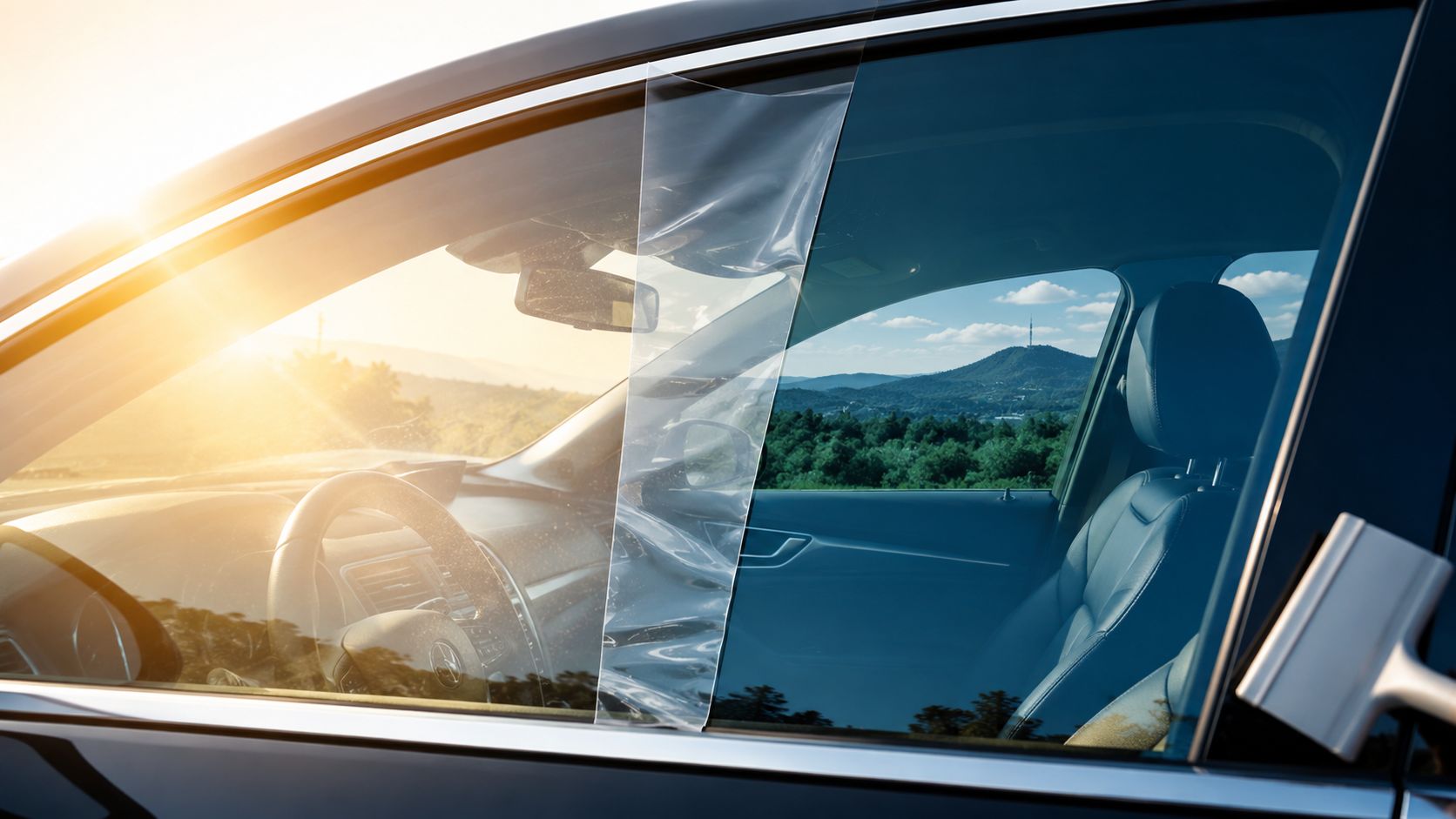
UV protection film for glass is a thin laminate applied to automotive windows to reduce the sun's damaging effects inside the vehicle. It's installed on the interior side of the glass, and depending on the film type, it can target ultraviolet light, heat-producing infrared energy, glare, and privacy at the same time.
Most drivers in Woodstock, Georgia don't first notice UV. They notice the cabin feeling harsh, the seat bolsters getting cooked, or the dash starting to lose its rich finish. UV is one of the forces behind that wear. It also reaches occupants during normal driving, which is why window film has practical value beyond appearance.
The biggest misconception I see is that tint is only about making the car look cleaner from the outside. That's part of it, but it misses the useful part. A quality film changes how the car feels at noon, how your interior ages over time, and how much punishment comes through the side glass during daily driving.
Practical rule: If you're shopping for tint in Canton or Kennesaw, ask about UV performance first and shade level second. Darker doesn't automatically mean better protection.
That matters because some films look good on day one but don't hold up well. Others stay clear, stable, and effective much longer. The material, the adhesive system, and the installer's process all affect the result.
For a closer look at the skin-protection side of automotive film, this guide on reducing skin cancer risks with window films is worth reading. It helps explain why many drivers who originally came in for style end up choosing film for health and comfort instead.
Why Georgia drivers care more quickly
North Metro Atlanta drivers put film to the test fast. Cars sit in open lots at work, in school pickup lines, and in driveway sun for long stretches. That constant exposure makes weak film show its flaws sooner.
The result is simple. If the film isn't built well or installed correctly, you'll notice it. If it is, you'll notice that too.
How UV Protection Film Works to Block Sun Damage
Think of UV protection film for glass as high-tech sunscreen for your windows. The goal isn't to block all light. The goal is to filter the harmful parts of solar energy while keeping the car usable, visible, and legal to drive.

The three parts of sunlight that matter in a car
When sunlight hits your side glass or rear glass, you're dealing with three different concerns.
- Ultraviolet light: This is the part tied to skin exposure and fading of interior materials.
- Infrared energy: This is the heat you feel building inside the cabin.
- Visible light: This affects brightness, glare, and how dark the tint appears from outside and inside.
Those three don't behave the same way, and good film treats them differently. That's why two cars can have a similar look from the street but feel very different when you sit inside them.
What the film is actually doing
Automotive window film uses layered construction. The exact recipe varies by product line, but the basic idea is consistent. The film uses specialized materials to absorb or reject parts of solar radiation before they pass deeper into the cabin.
A basic dyed film usually leans more on appearance and glare reduction. A better carbon or ceramic film is engineered to do more selective filtering. That means it can stay relatively clear to your eyes while still cutting a lot of the solar load you don't want.
A film can be light in appearance and still do serious work. Shade alone doesn't tell you the full story.
That's important for drivers who want a legal, clean-looking installation in Woodstock or Kennesaw without going extremely dark.
Why factory glass isn't the whole answer
A lot of vehicles already have some tint in the rear glass from the factory. That helps with appearance and privacy, but factory privacy glass usually doesn't give you the same performance profile as a high-quality aftermarket film applied across the full vehicle.
Front side windows are where many drivers feel the difference most. That's where the sun hits your arms, hands, and face during long drives. Adding the right film brings the side windows into the same protection strategy as the rest of the car.
What works and what doesn't
Here's the plain version:
- What works: Professionally installed film matched to your goals, whether that's UV protection, lower cabin heat, glare control, or signal-safe performance.
- What doesn't: Buying based only on darkness, choosing the cheapest roll available, or assuming every film with the word “ceramic” performs the same.
- What else matters: Clean glass prep, proper shrinking on curved rear windows, and edge finishing. Bad installation ruins good film.
If you understand UV, infrared, and visible light as separate jobs, the rest of the buying decision gets much easier.
Choosing Your Shield A Guide to Tint Film Types
Not all tint films belong in the same conversation. Some are budget materials that mainly change appearance. Others are built for long-term performance in vehicles that spend real time in Georgia sun. If you're comparing options for a truck in Canton, a commuter sedan in Kennesaw, or a Tesla in Woodstock, it helps to think in tiers.
Dyed film
Dyed film is the entry-level option. It uses dye to darken the glass and reduce some glare. For drivers who mainly want the tinted look and some visual relief, it can do the job.
The downside is durability and performance. Dyed film typically doesn't handle long-term heat and sun exposure as well as premium products, and lower-grade versions can shift in color or lose their original appearance over time.
Metallic film
Metallic film uses tiny metalized components to reflect solar energy. It can improve heat management compared with basic dyed film, and it often has a distinct reflective appearance.
That same metal content creates the usual trade-off. It can interfere with electronic signals, which matters more now than it used to. If you rely on phone signal, GPS, toll readers, or modern vehicle electronics, metallic film is often not the first recommendation.
Carbon film
Carbon film sits in the middle of the market. It usually offers a cleaner, less reflective look than metallic products and better stability than cheap dyed film. Drivers who want a step up without moving all the way into ceramic pricing often land here.
Carbon can be a sensible choice for older daily drivers or vehicles where the owner wants better performance but still has a firm budget ceiling. The quality spread is wide, though. Good carbon and low-end carbon aren't the same thing.
Ceramic and nano-ceramic film
Ceramic film is where the conversation changes. It's built for high performance without relying on metal, which means it's usually signal-safe and optically cleaner. Better ceramic films do a much stronger job of managing the harshness you feel through the glass while keeping visibility crisp.
Nano-ceramic is the premium end of that category. In practice, what most drivers notice is this: the cabin feels less punishing, the film stays stable, and the glass doesn't take on the shiny look that turns some people off older products.
For a broader breakdown of material categories, this overview of window film types and benefits is a useful companion.
Window Film Technology Comparison
| Film Type | UV Rejection | Heat Rejection | Signal Safe | Average Lifespan |
|---|---|---|---|---|
| Dyed | Basic to good, depends on product quality | Basic | Yes | Shorter than premium films |
| Metallic | Good | Good | Often no | Durable, but signal trade-offs matter |
| Carbon | Good | Better than dyed | Yes | Better long-term stability |
| Ceramic | High-quality UV-focused performance | Strong | Yes | Long-lasting when professionally installed |
| Nano-ceramic | Premium UV-focused performance | Excellent relative to other non-metal films | Yes | Long-term premium option |
How I'd match film types to real drivers
Different cars and owners need different answers.
- Budget-first daily driver: Dyed or entry carbon can make sense if the main goal is appearance and moderate glare control.
- Tech-heavy modern vehicle: Ceramic is usually the safer route because signal interference isn't part of the deal.
- Long-term ownership: Premium ceramic or nano-ceramic is easier to justify when you plan to keep the vehicle and care how the interior holds up.
- Work truck or family SUV: Carbon or ceramic usually fits better than metallic because the cabin gets used hard and electronics matter.
The cheapest film often costs more in frustration. Peeling edges, purple fade, and weak heat control are what people come in wanting to fix later.
When customers ask me which category is worth skipping, it's usually bargain-basement dyed film with no real track record. It may solve the look problem for a while, but it rarely solves the whole sunlight problem.
Beyond the Shade Key Benefits of Professional Tinting
The benefit that gets the most attention is usually comfort, but that's only one piece of the value. Professional tinting changes how the car lives day to day. The cabin feels less harsh, the interior takes less abuse, and the drive is easier on your eyes.

UV protection that actually matters
This is the one hard fact every driver should know. The Skin Cancer Foundation recommends window tint as part of an overall sun protection program, as it can block up to 99.9% of harmful ultraviolet radiation according to The Skin Cancer Foundation's sun protection guidance.
That matters in a car because side glass exposure is repetitive. You may not think much about short drives, but repeated driving time adds up. Good film helps reduce that constant exposure while also helping protect the surfaces inside the vehicle that fade first.
Daily comfort and visibility
The initial practical benefit experienced is less strain. Not just less brightness, but a less aggressive cabin overall. The sun doesn't feel as sharp through the side windows, and the car doesn't feel as punishing when it has been sitting outside.
Professional tint also improves glare control. That helps on bright afternoon commutes, low-angle sun, and reflective pavement. It's one of those upgrades that sounds minor until you drive with it every day.
Interior preservation and a cleaner ownership experience
A vehicle interior ages in layers. Dash panels dry out. Leather and vinyl lose their rich look. Trim starts looking tired before the mechanical parts do. Film slows that wear by limiting the kind of sun exposure that causes the most obvious cosmetic damage.
Here's where professional installation matters:
- Cleaner edges: Precision cutting and proper shrink work keep the finish looking factory, not aftermarket.
- Better material match: A pro can match film type to how you use the vehicle, not just how dark you want it.
- Fewer headaches later: Cheap installs are where you see dust, edge lift, hazing, and uneven rear glass results.
Privacy without turning the car into a cave
A well-chosen film also gives you a more settled cabin. People outside don't get the same easy view in, especially on the rear glass and back doors, but you don't need to make the vehicle overly dark to get that effect.
That's the balance savvy car owners usually want in Woodstock, Canton, and Kennesaw. Protection, comfort, cleaner looks, and legal usability. Not a boy-racer tint job that becomes a problem every night or every traffic stop.
Ceramic vs Regular Tint Is The Upgrade Worth It
“Regular tint” usually means dyed film or a lower-tier carbon product. Ceramic sits in the premium lane. The question isn't whether ceramic costs more. It does. The key question is whether the difference shows up in daily use enough to justify it.
For a lot of North Metro Atlanta drivers, it does.
Where regular tint still makes sense
If your main goal is appearance, basic glare reduction, and some privacy, regular tint can be enough. On an older car, a short-term vehicle, or a strict budget build, there's nothing wrong with choosing a simpler film as long as you know what you're buying.
That matters. Some people buy regular tint expecting premium heat management and end up disappointed. The film did what it was built to do, just not what they hoped it would do.
Where ceramic earns its price
Ceramic is the upgrade for drivers who care about cabin comfort, optical clarity, and long-term stability. It's especially noticeable in vehicles with large glass areas, dark interiors, and long commute patterns.
A ceramic-tinted car parked in the same sun as a regular-tinted car usually feels less punishing when you open the door. I'm keeping that qualitative on purpose, but the difference is real enough that customers who've owned both rarely need much convincing after the second car.
If you keep a vehicle for years, premium film usually feels like ownership insurance for the interior and your daily comfort.
Ceramic also avoids one of the classic metallic-film drawbacks. It doesn't rely on metal to perform, so signal interference isn't the concern.
Best-fit scenarios
Here's the simplest way to decide.
- Choose regular tint if: you want the look, need to control spending, and can accept more modest overall performance.
- Choose ceramic if: you commute a lot, park outside often, drive a newer vehicle, or want a tint you won't second-guess later.
- Choose ceramic sooner if: the car has a large windshield feel, a panoramic roof feel, or lots of side-glass exposure that makes heat and brightness more obvious.
The mistake to avoid
Don't compare only by darkness and price. That's where most bad tint decisions happen. Compare by how the film behaves over time, how clear it looks from inside the car, whether it plays nicely with electronics, and whether the installer can explain the product without hiding behind vague language.
For most owners who care about the driving experience and not just the outside look, ceramic is the upgrade that usually proves itself after installation, not just at the sales counter.
Automotive Tinting in North Metro Atlanta
Georgia drivers need two things from a tint job. It has to perform, and it has to stay within state law. If you're driving in Woodstock, Georgia, Kennesaw, Georgia, or Canton, Georgia, the legal side matters just as much as the product choice.

What Georgia drivers should check before choosing tint
Georgia tint laws are based on visible light transmission, often called VLT. That's the amount of visible light allowed through the glass after the film is installed. The legal limit depends on which window you're tinting and what type of vehicle you drive, so this isn't something to guess at from a friend's car or a photo online.
That's one reason professional installation matters. A shop that works with automotive tinting every day can match the film to the vehicle and avoid the common mistake of selecting a shade that looks good on the sample card but doesn't work legally on your glass.
For drivers searching for professional window tinting near me, that local familiarity matters. A North Metro Atlanta installer should know how to talk through legal film choices for sedans, trucks, SUVs, and Teslas without turning the conversation into a guessing game.
Why local conditions change the recommendation
Cars in Woodstock, Kennesaw, and Canton all deal with the same broad Georgia problem. Strong sun, hot parking lots, and daily driving exposure. But the right film choice still varies by how the car is used.
- Commuter vehicles: Drivers often care most about glare control and cabin comfort during repeated daytime miles.
- Family SUVs: Rear-seat comfort and interior preservation usually move higher on the priority list.
- Performance cars and Teslas: Owners often want a cleaner, high-clarity finish that doesn't fight the design of the car.
- Work trucks: Durability and practical heat relief often matter more than making the glass as dark as possible.
A quick visual helps show the kind of clean, modern result many drivers want from a legal tint setup.
Installation quality decides whether the tint feels premium
A legal film can still look bad if it's installed badly. You'll see contamination, fingers along the edges, poor shrinking on the rear glass, or gaps that make the whole vehicle look unfinished. That's why the installer matters as much as the product card.
This is also the one place I'll mention a local option directly. The Tint Guy provides automotive UV-blocking window tint for cars, trucks, vans, and SUVs in North Metro Atlanta, including ceramic options for drivers in Woodstock, Kennesaw, and Canton who want a signal-safe film installed professionally.
If you're comparing shops, ask direct questions. What film lines do they install? How do they handle rear glass? What does the warranty cover? Can they explain the legal side clearly? Straight answers usually tell you a lot about the shop before the car ever goes in.
Your UV Protection Film Questions Answered
How much does car window tint cost
Cost depends on the vehicle, the film type, and the glass layout. A coupe, crew-cab truck, Tesla, and full-size SUV don't take the same material or labor. Ceramic costs more than regular dyed film, and complex rear windows take more time than simple ones.
The better way to shop is by value, not by finding the lowest quote. Ask what film you're getting, whether it's ceramic or regular, what warranty comes with it, and whether the installation is cut and finished cleanly.
How long does installation take
Most standard automotive tint jobs can be completed in part of a day, but the exact timing depends on the vehicle and the film package. Rear windows with heavy curves, frameless glass, and larger SUVs usually take more attention than a simple sedan setup.
A good shop won't rush prep work just to promise a faster turnaround. Clean installation takes time where it matters.
How long does window film last
Lifespan depends heavily on film quality and installation quality. Premium films generally hold up better than bargain products, especially under Georgia sun. Cheap film tends to show its age sooner through discoloration, edge failure, or visual haze.
Will tint interfere with electronics
Some films can, especially metallic products. Ceramic and other non-metal constructions are usually chosen specifically to avoid that issue. If you use GPS, mobile data, toll tags, or modern connected-car features, ask whether the film is signal-safe before you book.
Is darker always better
No. Darker tint changes appearance and privacy, but it doesn't automatically mean better overall solar performance. A lighter premium film can outperform a darker low-grade film where it counts in real use.
Ask for the film type first, then choose the shade. That order saves people from a lot of regret.
Can UV protection film be clear
Yes. Some films focus more on protection and clarity than on a dark appearance. That can be useful for drivers who want to keep a lighter look while still improving comfort and limiting UV exposure.
What should I do after installation
Follow the installer's aftercare instructions closely. Don't start scrubbing the film right away, and don't panic if you see a little haze or moisture texture during the cure period. Fresh film needs time to settle and fully bond to the glass.
Is professional installation worth it
Yes, if you care how the car looks and how long the film lasts. DIY kits and low-skill installs are where you usually see contamination, peeling corners, mismatched seams, and rear windows that never look right. Professional work costs more up front, but it usually prevents the do-over.
If you're ready to upgrade your vehicle with UV protection film for glass, The Tint Guy is a practical place to start for drivers in Woodstock, Kennesaw, and Canton. Whether you want a clean legal tint, a ceramic upgrade, or help comparing regular tint versus premium film, the next step is simple. Get a quote based on your vehicle, your goals, and your driving habits.