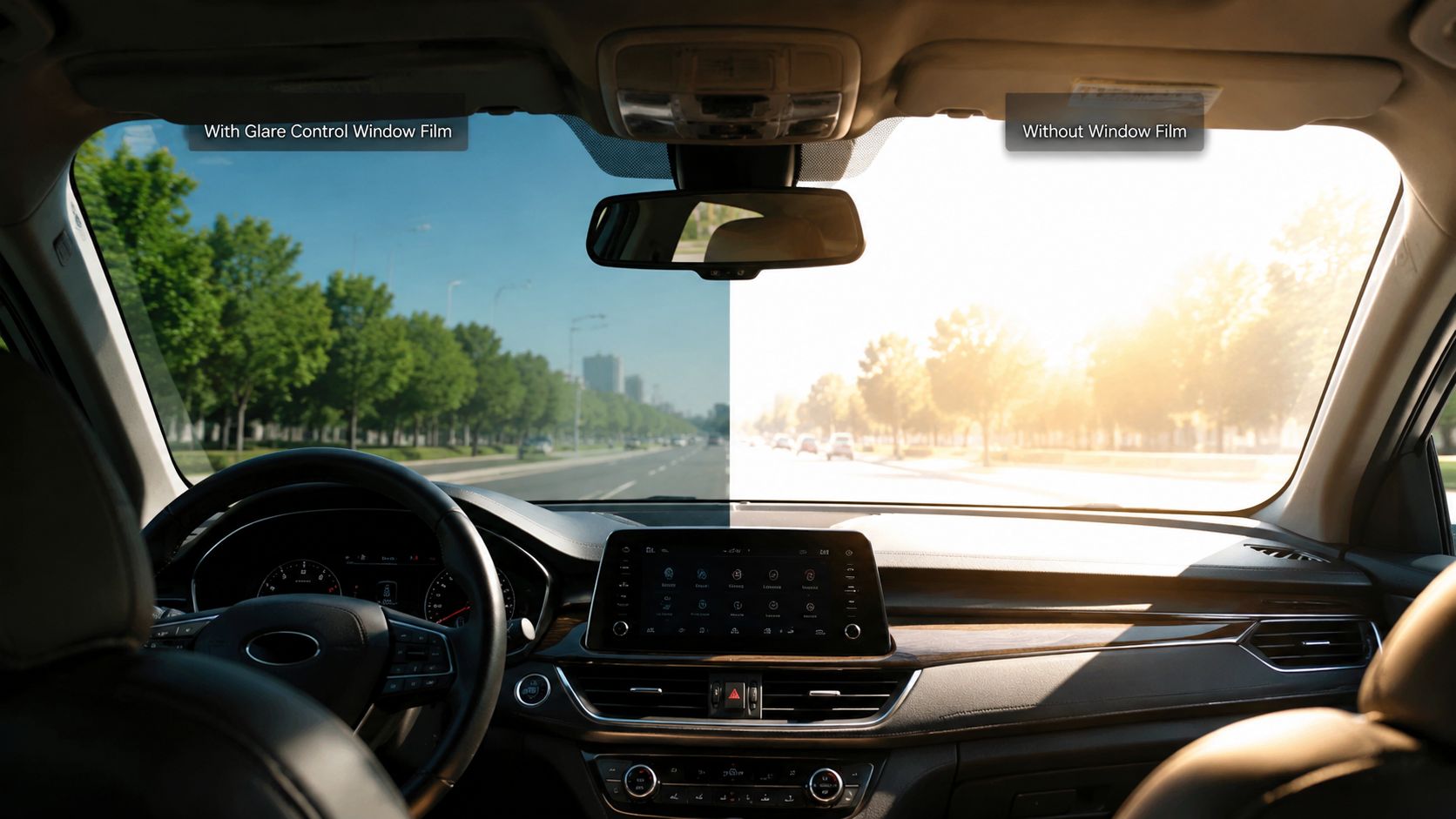
You know the feeling. You pull out in Woodstock after lunch, head through Kennesaw traffic, or catch late afternoon sun on the way back to Canton, and suddenly the windshield and side glass turn the road into a bright white wash. You tilt the visor, shift in the seat, and still end up squinting. That kind of glare isn't just annoying. It wears you out, makes screens and mirrors harder to read, and turns a normal drive into a strain.
For drivers in North Atlanta, glare control window film solves a problem that shows up almost every day. It's not just about making the glass darker. A good film helps manage harsh light, cuts cabin heat, and protects both people and interiors from sun exposure. The right setup also needs to stay legal in Georgia, especially on front side windows.
Tired of Squinting Through the Georgia Sun
A lot of drivers start looking into tint because they're tired of feeling blasted by sunlight during the morning or evening commute. That's common in Woodstock, Georgia, Kennesaw, Georgia, and Canton, Georgia, where a routine drive can mean long stretches of direct sun bouncing off pavement, hoods, and surrounding traffic.

Glare control window film is the upgrade people usually wish they had done sooner. It changes the driving experience in a practical way. Instead of fighting bright side windows and overheated glass, you get a cabin that feels calmer and easier on the eyes.
What drivers usually want fixed
Most customers aren't asking for a technical product. They're asking for relief from specific problems:
- Sun in the side window: The worst moments often happen when the sun sits low and hits from the left or right.
- Cabin discomfort: Even a short stop at a store can leave the interior feeling loaded with heat.
- Eye fatigue: Constant squinting makes a longer drive feel longer.
- Interior wear: Dash panels, leather, vinyl, and trim all take sun exposure over time.
A good overview of that day-to-day problem is covered in this guide on window tint for glare reduction, especially if you're trying to decide whether your issue is brightness, heat, or both.
Practical rule: If you keep reaching for sunglasses and the visor inside the same drive, your glass is letting in light you could be controlling better.
The key is choosing film for the way you drive. A daily commuter in Kennesaw may need a balanced setup that keeps visibility comfortable all day. Someone parked outside for hours in Canton may care just as much about heat build-up as glare itself. The right film handles both without turning the car into a cave.
How Glare Control Film Actually Manages Light
A common assumption is that tint works by darkening the window. That's only part of the story. Glare control window film works more like smart sunglasses for your car. It manages how light behaves when it hits the glass.

Darker isn't always better
A very dark film can reduce visible brightness, but darkness alone doesn't solve every glare problem. If a film only cuts light and doesn't manage reflection well, you can still end up with harsh contrast and eye strain. That's why two cars with similar-looking tint can feel very different on the road.
The better products use a mix of optical control methods like diffusion, absorption, reflection, and selective filtering. If you want a foundation on the differences between film types, this primer on window film types and benefits is useful before you pick a shade.
What diffusion actually does
The most important concept is diffusion. According to the product explanation for Gila glare control window film, the diffusion mechanism in glare control films causes reflected light to be spread over a broader area, which reduces the luminance contrast between the bright window and darker interior surfaces, directly alleviating eye strain and improving visual comfort during daytime driving.
That matters in real driving because your eyes don't just react to raw brightness. They react to contrast. A bright side window next to a darker dashboard creates a sharp visual jump. Good glare film softens that jump.
Good glare control doesn't just block light. It smooths it out so your eyes don't keep readjusting every few seconds.
What works and what doesn't
Here's what usually works well in automotive applications:
- Films built for optical comfort: These reduce harsh reflection, not just overall brightness.
- Balanced visible light transmission: Enough light stays in for a natural view, without the window feeling bare.
- Non-metallic performance films: These are often the safer choice on modern vehicles with electronics.
What usually disappoints people:
- Choosing by darkness alone: A darker look can still produce unpleasant daytime contrast.
- Cheap film with weak optical quality: It may look acceptable at first but feel tiring in use.
- Ignoring the vehicle's glass area: Large side glass and panoramic glass make glare problems more obvious.
The Key Benefits for Your Vehicle and Comfort
Georgia drivers usually notice two problems first. The sun is too bright, and the cabin gets too hot. A quality glare control film addresses both while also protecting you and the interior.

According to Window Film Depot's anti-glare film guide, glare control window film can reduce harsh sunlight by up to 76%, block 99% of harmful ultraviolet (UV) rays, and can reject over 50% of solar heat gain, significantly improving thermal comfort. That's the practical reason this upgrade matters in a car, not just in a showroom.
For a closer look at the skin and interior side of the issue, this page on UV protection for car windows helps connect the comfort benefit with long-term protection.
Why glare reduction matters behind the wheel
Driving east in the morning or west in the evening can make even familiar roads uncomfortable. If you commute between Woodstock and Kennesaw, you already know how quickly low-angle sun can wash out contrast through the side glass. Reducing glare makes it easier to read the road, monitor mirrors, and keep your eyes relaxed.
This isn't just about convenience. Less visual strain makes the car easier to live with every day.
Heat rejection changes the whole cabin
Heat control is what turns a cosmetic purchase into a useful one. Glass lets in energy that builds up fast when a vehicle sits in an open lot or driveway. A film that rejects solar heat makes the interior feel less punishing when you first get in, and it helps the A/C work in a more manageable cabin.
Shop advice: If your first complaint is “my steering wheel is burning hot every afternoon,” you need a film with real solar control, not just a darker appearance.
UV protection helps the parts you don't think about
When considering sun damage, skin often comes to mind first, but car interiors take a beating from sun exposure. Dash tops fade. Leather dries out. Plastic trim loses its original look. Blocking 99% of harmful UV rays helps reduce that wear at the glass level, where the problem starts.
Secondary benefits drivers appreciate
A good film also tends to improve day-to-day ownership in smaller ways:
- Better cabin privacy: People can't see in as easily during daylight.
- Less harsh reflection on screens: Infotainment and console surfaces are easier to view.
- A more composed look: The vehicle usually looks cleaner and more finished.
- More comfort on longer drives: Less eye strain and less radiant heat add up.
For North Georgia drivers, that combination is why glare film keeps moving from “nice to have” into “should've done this already.”
Choosing Your Film Ceramic vs Standard Tints
Not every tint product solves glare and heat the same way. In the shop, the biggest decision usually comes down to standard film versus ceramic film. Both can improve the look of the vehicle. Both can help with glare. But they don't deliver the same long-term experience.
What standard film does well
Standard film is often the entry point because it gives the car a cleaner look and adds basic glare control. Depending on the product, this category may include dyed film or carbon-based film. For a driver mainly focused on appearance and moderate comfort improvement, standard film can make sense.
The trade-off is performance and longevity. Lower-tier films can fade, shift color, or lose effectiveness faster than premium products. If the main goal is serious heat control with a stable finish over time, standard film usually isn't the top option.
Why ceramic stands apart
Ceramic film is the premium choice for drivers who care about glare, heat, and durability together. It uses non-metallic ceramic technology, so it avoids the old problem metallic films could create with electronics. That matters on modern vehicles that rely on GPS, phones, wireless connectivity, and integrated driver tech.
The durability difference is substantial. According to Market Report Analytics, premium ceramic window films, which are commonly used for glare and heat control, have a lifespan of 20–25 years, significantly outperforming basic dyed films that may degrade in 5–10 years.
Ceramic vs Standard Window Film Comparison
| Feature | Standard Film | Ceramic Film |
|---|---|---|
| Glare control | Basic to moderate, depending on shade and quality | Stronger optical performance with a more refined feel |
| Heat control | Varies by product, often more limited | Better suited for drivers who want stronger solar control |
| Signal interference | Depends on construction | Non-metallic options are a strong fit for modern vehicles |
| Appearance over time | Lower-end products may fade or discolor | Typically maintains a more stable appearance |
| Long-term value | Lower upfront entry point | Better choice if you want performance to last |
| Best fit | Drivers focused on appearance or simple tinting | Drivers focused on comfort, premium feel, and durability |
What I'd tell a daily driver in Woodstock, Kennesaw, or Canton
If you spend a lot of time in the car, ceramic is usually the better buy. Not because it sounds premium, but because it solves the complaint people care about most after installation. They want the cabin to feel more comfortable in real sun. They want less glare through broad side glass. They don't want to come back in a few years with purple tint or a tired-looking finish.
Standard film still has a place. It can be a sensible choice if you want a darker look and basic improvement at a lower entry point. Carbon film can also sit in the middle, offering more durability than the most basic dyed products.
The cheapest film often costs more in the long run if you end up removing it early, replacing it, or living with a result you never liked.
A better way to decide
Ask three questions before you choose:
- How long are you keeping the vehicle? Long-term ownership usually points toward ceramic.
- What bothers you most, glare or heat? If it's both, ceramic is hard to beat.
- Do you drive a tech-heavy vehicle? Teslas and newer vehicles benefit from non-metallic film choices.
For most drivers in this part of Georgia, ceramic is the film that best matches the climate, the road time, and the expectation that tint should do more than just darken glass.
Georgia Tint Laws and Professional Installation
Choosing the right film means staying comfortable and staying legal. In Georgia, the law is straightforward on front side windows, and it's important to get that right before any film goes on the car.

According to Georgia Code section 40-8-73.1, the legal limit for window tint on front side windows is 32% Visible Light Transmission (VLT), with an allowable variance of plus or minus 3 percent. That applies to passenger cars, and also to the front side windows of SUVs, trucks, and vans.
What that means for different vehicles
For sedans and coupes, the rules are stricter all around. Based on the Georgia tint summary from GForce Films, the rear windshield and all side windows must allow at least 32% of light through, so a very dark rear setup that might be common elsewhere isn't legal on a passenger car in Georgia.
For SUVs, trucks, and vans, the front side windows still have to meet the 32% VLT requirement. The rear side windows and rear windshield are treated differently, which gives those vehicle types more flexibility in the back.
Why legal compliance matters in real life
Tint law isn't something to shrug off. According to Kevin Fisher Legal, violating Georgia's window tint law constitutes a misdemeanor offense, and a typical window tint violation ticket costs approximately $124, with repeated infractions leading to escalating financial penalties.
That's why a professional shop should talk about legality before talking about shade preference. If someone only asks, “How dark do you want it,” that's not enough.
What professional installation changes
A clean install isn't just about looks. It affects longevity, edge finish, clarity, and whether the film cures properly. Automotive tint needs careful glass prep, precise cutting, heat shaping when needed, and clean squeegee work so contamination and trapped moisture are minimized.
A quick video helps show why the process matters in skilled hands:
Poor installation usually shows up fast. You'll see dirt under the film, lifting edges, uneven shrinking, or a finish that never looks right in direct sun.
What to expect from a proper shop visit
A solid installation process usually includes:
- Film selection by use case: Matching glare, heat, and legal goals instead of selling by shade alone.
- Vehicle-specific cutting and fitment: Curved glass and tight edges need accuracy.
- A controlled workspace: Dust and debris are the enemy of clean film.
- Clear aftercare instructions: Fresh film needs time to settle and cure.
For drivers in Woodstock, Kennesaw, and Canton, legal tint plus professional installation is the combination that avoids headaches later.
Your Local Tint Expert in North Atlanta and FAQs
Whether you're in Woodstock, Kennesaw, or Canton, a more comfortable drive is just an appointment away. The right glare control window film should make the vehicle easier to drive in bright Georgia sun, help keep the cabin more livable, and stay within the law on the windows that matter most.
Local service matters here because driving patterns, parking conditions, and vehicle use are different from one part of North Atlanta to the next. Someone who commutes daily through Kennesaw may prioritize eye comfort. A driver parked outside in Canton may care more about heat load. A family SUV in Woodstock may need a legal front-window setup with stronger privacy and comfort in the rear. Businesses in this area think about local visibility the same way, and resources like Data Hunters Agency's marketing guide show how much location-specific search behavior shapes who customers trust.
Common questions drivers ask
Will quality film bubble or turn purple?
Cheap film is far more likely to age poorly. Better products and better installation hold up far better over time, especially when the film itself is chosen for durability.
Will I be able to see at night?
That depends on the film selection and the vehicle. Going too dark can make nighttime driving less comfortable, especially on side glass. A balanced film usually gives better all-day usability than chasing the darkest possible look.
Is ceramic worth it?
For many daily drivers, yes. If glare and heat are the two main complaints, ceramic usually solves both more convincingly than entry-level tint.
Can I just choose whatever shade looks best?
Not on front side windows in Georgia. Legal compliance has to come first, especially when a violation can lead to a misdemeanor and a ticket that typically runs about $124, as noted earlier from the Georgia legal reference.
Does every car need the same film?
No. A Tesla, truck, sedan, and family SUV can all need different recommendations based on glass area, electronics, driving habits, and where the vehicle spends most of the day.
If you want a legal, clean, high-performance tint setup for glare, heat, and UV protection, The Tint Guy is the shop to contact. They handle automotive tinting for drivers across North Metro Atlanta and can help you choose the right film for your vehicle, your driving habits, and Georgia law.