
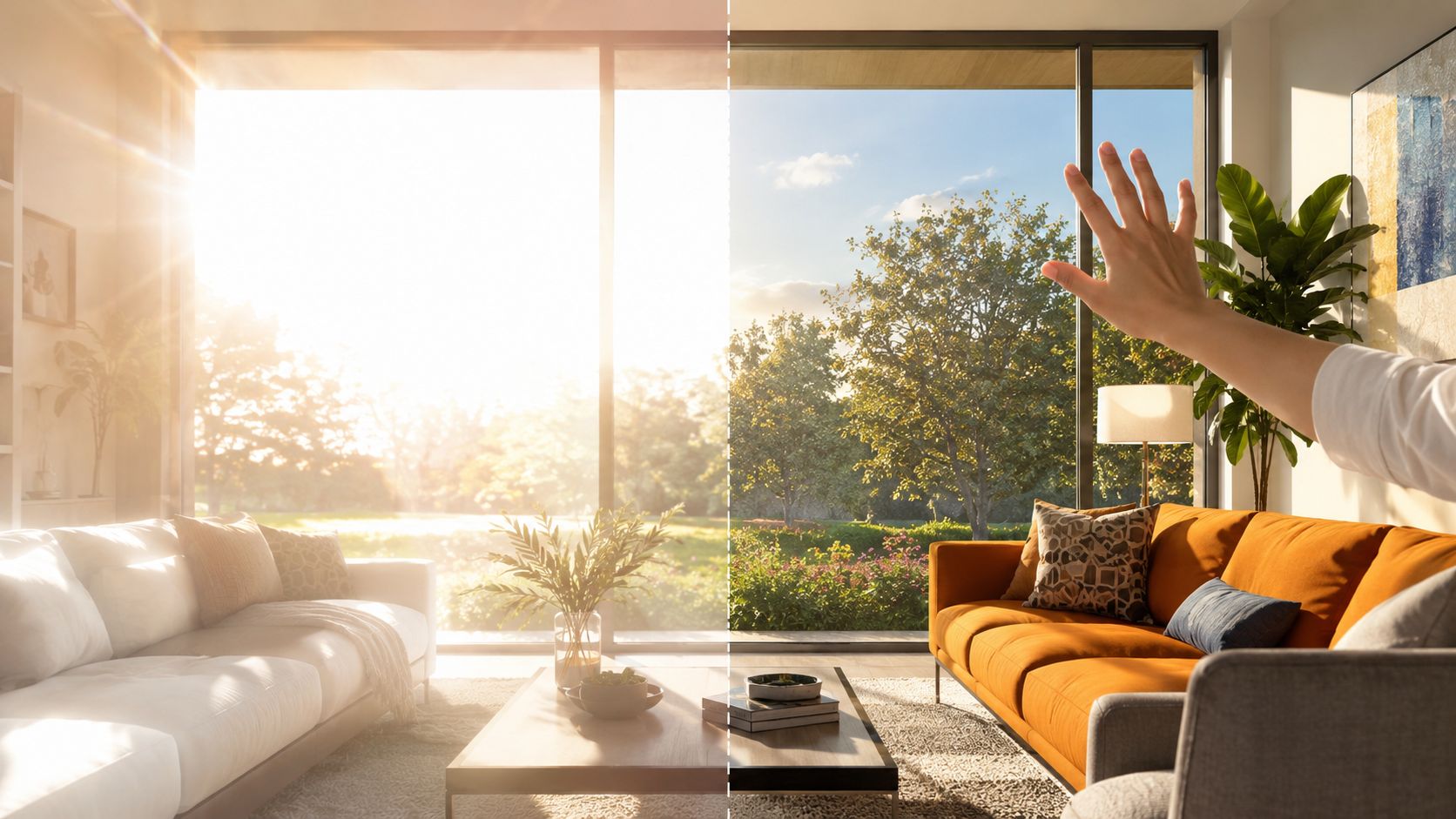
The afternoon sun hits the same rooms every day. By two o'clock, the bonus room is hotter than the hallway, the TV looks washed out, and the hardwood near the windows keeps taking the worst of it. In North Metro Atlanta, that pattern shows up in homes all over the map, especially where big rear windows or second-story glass catch long hours of direct exposure.
Most homeowners start in the same place. They lower the blinds, close the curtains, and run the air longer. That helps a little, but it also makes the room darker and doesn't solve what the glass is letting in. House window film for sun protection is different because it upgrades the window you already have. It cuts heat, glare, and UV exposure without giving up the view.
Reclaim Your Home from the Sun's Heat and Glare
A lot of Georgia homeowners don't call about every window in the house. They call about one room. It's the living room that turns bright and uncomfortable in the late afternoon. It's the home office where the monitor catches glare. It's the upstairs bedroom that never seems to cool down as fast as the rest of the house.
That's usually the moment when window film starts making sense. You keep the natural light. You keep the existing glass. But you change how that glass handles solar exposure. For homes dealing with harsh brightness and hot spots, that's a more targeted fix than shutting the room off behind heavy coverings.
For many families, the first problem they notice isn't temperature. It's usability. They stop sitting in the room that gets hit with direct sun. They move furniture. They angle screens. They start living around the window instead of enjoying it. A well-chosen film can restore that space without changing the character of the house.
If glare is your main problem, this guide on glare control window film is a useful starting point. Glare and heat often travel together, but they don't always need the exact same film choice.
Good residential film shouldn't make a bright room feel shut down. The right product filters the problem parts of sunlight and leaves the room usable.
The practical question isn't whether film works. It's which film makes sense for your glass, your sun exposure, and your expectations. That's where homeowners usually need straight answers instead of sales talk.
How Window Film Delivers Total Sun Protection
By the time a room feels hot, the sun has usually been causing three separate problems for hours. Heat is only one of them. The same glass also lets in glare that makes screens hard to use and UV exposure that slowly fades floors, fabrics, and wood finishes.

Sunlight has three different problems
Untreated residential glass does very little to manage the parts of sunlight that create comfort issues indoors. In North Atlanta homes, I see that most often on west-facing living rooms, two-story foyers, and upstairs bedrooms that take direct afternoon sun.
- UV rays contribute to fading and add unnecessary exposure near the glass.
- Visible light creates harsh brightness and screen glare.
- Infrared heat is a major reason a sunny room feels warmer than the rest of the house.
High-performance residential sun control film is designed to address all three at once. Analysts at the International Window Film Association note in this summary of sun control film performance that good film can lower cooling demand in hot climates by reducing solar heat gain at the glass.
Homeowners often assume window tint is mainly about making glass darker. The better products are built for selective solar control. They cut the parts of sunlight that create damage and discomfort while keeping the room usable in daylight.
What gets blocked and what stays
A well-chosen film does not shut down a room the way closed blinds do. It keeps the view, keeps the daylight, and reduces the parts of solar energy that make the space hard to enjoy.
For Georgia homes, that distinction matters. Summer sun is strong, air conditioning runs hard, and many homeowners want relief without replacing every window in the house. Film works well in that middle ground. It upgrades the performance of the existing glass, which is often a more practical step than full window replacement and a more livable solution than keeping shades closed all afternoon.
Practical rule: If a room is bright but uncomfortable, the target is usually solar heat and glare, not daylight itself.
For homeowners comparing options, window film types and benefits gives a clearer breakdown of how different products perform. Two films can look similar from the driveway and behave very differently at 4 p.m. in a sun-facing room.
What homeowners notice first
In real homes, the first changes are usually easy to spot.
- The room feels more even. The area near the windows is less punishing in the afternoon.
- Screens are easier to see. TV reflections and monitor glare calm down.
- The space stays open. You keep the natural light and outside view instead of covering the glass.
That last point is where film separates itself from shades and blinds. Window coverings can help, but they only work when they are closed, and closed coverings also block the room itself. Film is always on the glass, so the protection is there all day without changing how you use the space.
Choosing the Right Film Ceramic vs The Rest
Most homeowners don't need a chemistry lesson. They need to know what works, what ages poorly, and what's worth paying for. The short version is that not all film is built the same, and the cheapest option usually reveals itself later.

Dyed and metallic films
Dyed film is usually the entry-level choice. It can help with glare and appearance, but it's not where I'd point a homeowner who wants serious solar control in a hot room. It tends to be more of a visual tint solution than a true high-performance heat management product.
Metallic film improved heat control years ago, but it comes with trade-offs. It can create a more reflective look than many homeowners want, and metallic construction isn't always ideal when you care about signal-friendly performance or a more neutral appearance.
Carbon and ceramic films
Carbon films sit in the middle of the market. They generally offer a cleaner look than dyed film and avoid the mirror-like finish that some metallic products create. For some homeowners, that balance is enough.
Ceramic is where premium residential performance starts to separate itself. High-performance nano-ceramic window films use billions of embedded microscopic ceramic particles to absorb and scatter infrared wavelengths, rejecting up to 80% of IR energy while maintaining high optical clarity. Unlike metallic films, this technology doesn't interfere with cell phones, GPS, or Wi-Fi signals, as described in ARCAT's nano-ceramic film specification overview.
That last point gets talked about more with vehicles, but the broader takeaway matters in homes too. Ceramic technology gives you strong performance without relying on metal and without pushing the glass into a flashy, overly reflective look.
Why ceramic usually wins in homes
Ceramic film is the option I'd put in front of a homeowner who says any of these things:
- “I want heat reduction without dark glass.” Ceramic is strong when you need performance with a more natural look.
- “I don't want a mirrored exterior.” That rules out a lot of older reflective styles.
- “I'm planning to stay in this home.” Better film tends to age better, look better, and hold value longer.
This video gives a useful visual look at film differences and installation context:
Cheap film can solve the immediate glare complaint and still be the wrong long-term choice. In a sun-heavy room, clarity, durability, and glass compatibility matter just as much as shade.
The one-size-fits-all approach doesn't work here. A west-facing living room, a bright kitchen, and a street-facing bathroom may all need different answers.
Film vs New Windows vs Blinds A Cost and Benefit Analysis
Homeowners usually compare three paths. Keep the existing windows and add film. Replace the windows. Or add blinds and shades and try to manage the problem that way. Those choices aren't equal, because they solve different parts of the problem.

What each option actually does
Replacement windows make sense when the existing units are failing. If seals are gone, frames are deteriorated, or the glass itself needs replacement, film isn't the fix. If your windows are structurally sound but let in too much sun, replacement can be more project than you need. For homeowners researching that route, these South Mountain window replacement insights give a practical look at how window replacement decisions get priced and scoped.
Blinds and shades are useful, but they mostly manage light after it has already hit the window. They help with privacy and can reduce glare, but they also block your view and don't upgrade the performance of the glass itself.
Film changes the behavior of the glass. That's why it often becomes the most practical middle ground for homes with good windows and bad sun exposure.
Sun Protection Options Compared
| Factor | Window Film | Replacement Windows | Blinds & Shades |
|---|---|---|---|
| Cost | Lowest initial investment | High upfront cost | Moderate cost |
| Energy Efficiency | Significant heat rejection | Improved insulation | Limited thermal barrier |
| UV Protection | Blocks 99% UV | Varies by glass type | Minimal protection |
| Glare Reduction | Effective, maintains view | Some improvement | Blocks view, adjustable |
| Installation Time | Hours to days | Days to weeks | Minutes to hours |
| Aesthetic Impact | Subtle, preserves view | Can change home's look | Can alter interior design |
For many homes around North Metro Atlanta, the decision comes down to whether you want to upgrade the glass you have or start over with a full replacement project.
When film is the right answer
Film usually makes the most sense when these conditions are true:
- Your windows are in good shape. The issue is sun load, not structural failure.
- You want to keep the view. Heavy coverings solve glare by closing off the room.
- You want a less disruptive project. Film installs with far less interruption than full replacement.
If you're still weighing budget and value, residential window film cost is where most homeowners get a clearer sense of what to expect before they commit.
The Professional Installation Process and Lifetime Value
By the time a North Atlanta homeowner calls us, there is usually one room everyone avoids in the afternoon. The TV washes out. The floor near the windows runs hot. Someone has already tried keeping the shades shut, and now the room feels darker without feeling much better.
That is usually an installation problem to solve, not just a product to pick.
What a professional install looks like
A good film job starts with the glass itself. We check window orientation, pane type, existing seal condition, and how the room is used. A west-facing bonus room in Alpharetta needs a different approach than a street-facing living room in Roswell where appearance matters just as much as heat control.
Preparation decides how clean the finish looks months later. Glass has to be cleaned down to the small debris and residue that show up as specks, fingers, or lifting edges after the film dries. Then the film is trimmed, positioned, and squeegeed with enough pressure to remove water evenly without stressing the material or contaminating the adhesive.
Cure time matters too.
On day one, some windows can look slightly hazy or show small water pockets. In Georgia's humidity, that settling period can take longer than homeowners expect, especially on less sun-exposed glass. That does not mean the install failed. It usually means the film is still bonding.
Where the long-term value really comes from
The value of residential film shows up after the crew leaves. Rooms stay more usable during peak sun hours. Furnishings get better protection from UV exposure, and the house often feels more balanced from window to window without the cost and disruption of full replacement.
That long-term return depends on two things. The film has to fit the glass, and the installation has to be clean. Cheap film can discolor, haze, or fail at the edges early. Good film, installed correctly, holds its appearance and performance for years, which is why manufacturers often back residential products with strong warranty coverage, as noted earlier.
I tell homeowners to judge film like any other home upgrade. Look at how it performs after one summer, not just how it looks an hour after installation.
What homeowners should do after installation
A few simple habits protect the finish and help you get the full service life from it:
- Give it time to cure. Early moisture patterns and light haze can be normal.
- Clean with soft materials. Use a non-abrasive cleaner and a soft cloth, not anything that can scratch the surface.
- Pay attention to the edges. If something ever needs service, edge lift usually shows up before anything else.
- Ask about the warranty in plain language. Know what is covered by the film manufacturer and what is covered by the installer.
At The Tint Guy, this is the part we stress most. Film is only a good value when the installation is matched to the window, the expectations are clear, and the product keeps doing its job year after year.
Georgia Homeowner Questions and Building Considerations
The question that comes up most often is simple. Will film crack my double-pane windows? The honest answer is that the blanket fear is overblown, but glass compatibility still matters.
The double-pane cracking myth
The common fear that film will crack double-pane windows is largely a myth. The risk depends on the film's Solar Heat Gain Coefficient being correctly matched to the window. The Florida Solar Energy Center notes that for hot climates, a film is effective only if the Visible Transmittance is greater than the SHGC, and the SHGC should be below 0.3 to 0.5 to minimize heat stress. The same source also notes that quality films can extend a window's life, with the Euromed European Window Film Association pointing to an optimum service life of 25 years, as outlined in this FSEC window film guidance.
That's the main takeaway. Film doesn't automatically endanger insulated glass. Problems come from poor product matching, poor installation judgment, or applying the wrong film to the wrong unit.
What homeowners should check before installation
Not every concern is about the glass itself. A few practical checks matter before any film goes on:
- Manufacturer warranty language. Some window manufacturers have specific film provisions.
- Existing glass condition. Old seals, chips, or existing damage should be identified first.
- HOA appearance rules. Georgia doesn't create one statewide residential tint look standard for neighborhoods, but your HOA may care about exterior reflectivity or visible appearance.
If someone gives you a yes-or-no answer about every double-pane window without asking about the glass, they're skipping the part that actually matters.
The right way to approach a sun-heavy home
Start with the windows causing the complaint. Usually that means south-facing or west-facing glass, upper floors, or large living areas with long afternoon exposure. Then match the film to the glass package and the room's use.
A media room has different priorities than a breakfast nook. A decorative front room may need a lighter, clearer finish than a home office where glare control matters more. Good recommendations come from that level of detail, not from choosing the darkest film on the sample board.
Your Trusted Tint Experts in North Metro Atlanta
Residential film and automotive tint aren't the same product category, but they rely on the same habits that matter in any tint job. Correct film selection. Clean prep. Precise cutting. And knowing where performance claims stop and legal requirements start.

For homeowners in North Metro Atlanta, that overlap matters because the same shop that understands residential solar control often handles automotive tinting too. If you're in Woodstock, Georgia, Kennesaw, Georgia, or Canton, Georgia, the legal side of vehicle tint is where professional installation becomes especially important.
Georgia vehicle tint law in the cities people search most
For vehicles in Georgia, front side windows must allow at least 32% Visible Light Transmission, with a plus or minus 3% tolerance, according to Georgia tint law guidance. That means guessing based on “how dark it looks” is a bad plan.
The penalty side also matters. Illegal tint violations can lead to misdemeanor charges, with a maximum penalty of a $1,000 fine and up to 12 months in jail, while routine tickets can also be issued repeatedly until the film is corrected, according to this explanation of Georgia tint penalties.
That's why location-specific searches like car window tint in Woodstock, ceramic tint in Kennesaw, or window tint near Canton need more than a price quote. They need legal compliance and clean installation.
Where local expertise helps most
In practice, a local tint shop is most useful when you need help with one of these situations:
- Residential hot spots: one or two rooms are driving the whole problem.
- Commercial glare issues: offices with screen glare and harsh afternoon exposure.
- Vehicle compliance: you want ceramic tint for your car, truck, SUV, or Tesla without crossing Georgia limits.
The Tint Guy is one local option for residential window film, commercial window film, and vehicle tinting across North Metro Atlanta, including Woodstock, Canton, Kennesaw, Acworth, Alpharetta, Roswell, Marietta, Holly Springs, Cumming, Ball Ground, Milton, Johns Creek, Cherokee County, Cobb County, North Fulton, and Forsyth County.
Local service matters in tinting because climate, sun exposure, and compliance rules all change what the right recommendation looks like.
If your house has one room you avoid every afternoon, or your vehicle needs tint that performs without risking a citation, the next step is a straightforward consultation and a film recommendation that fits the glass.
If you want help choosing the right solution for your home or vehicle, contact The Tint Guy for a free consultation.