
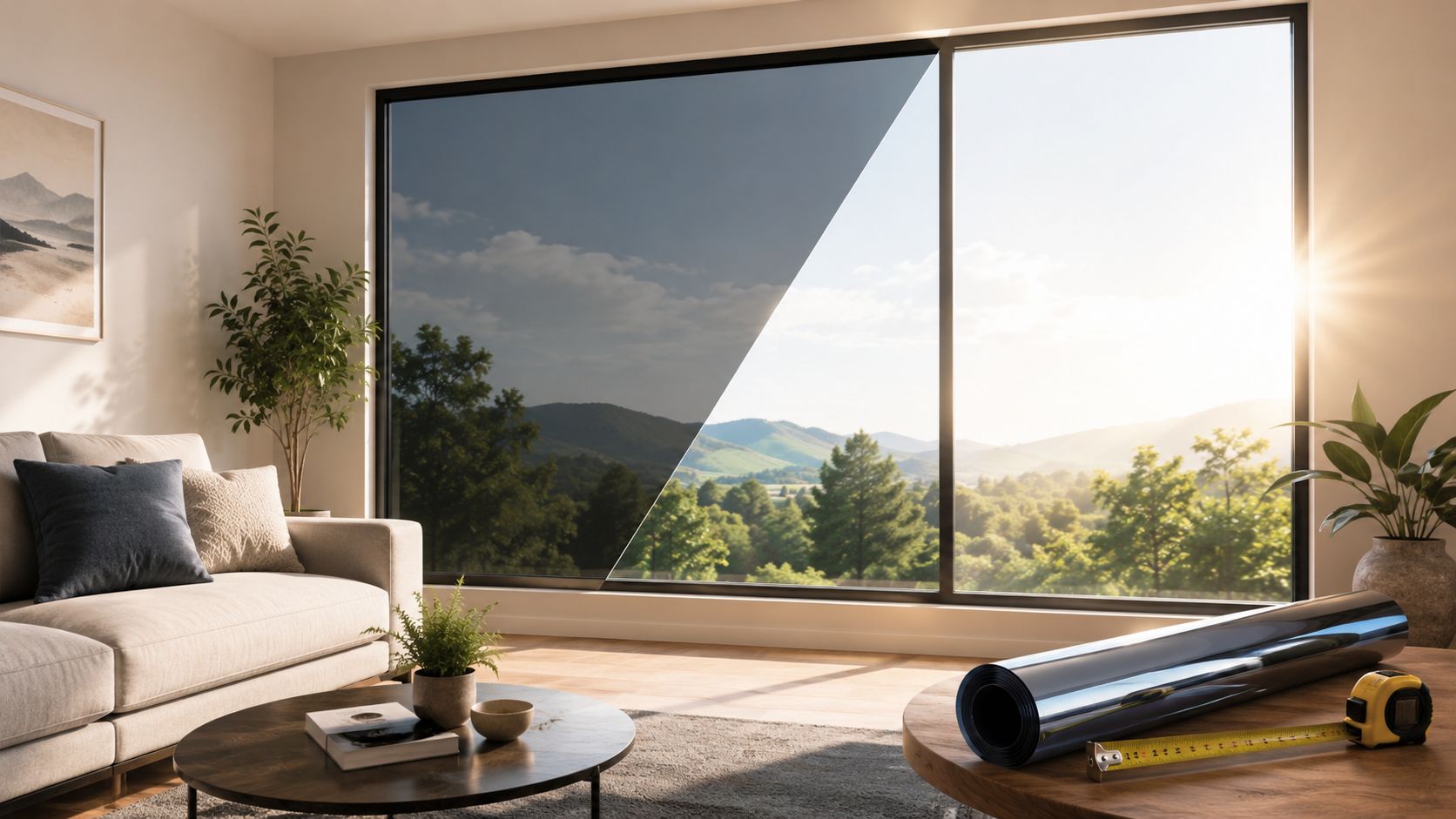
Most homeowners pay about $6 to $8 per square foot installed, and a typical home project often lands around $435 to $1,145 total, with a national average near $706. That's a useful starting point, but residential window film cost can swing well outside that range once film type, window access, and project size enter the picture.
A lot of people start looking at window film after the same kind of week. The sun hits one side of the house hard every afternoon, the living room feels hotter than the thermostat says it should, and glare starts making the TV or home office annoying to use. Then the quote requests begin, and the prices don't all look alike.
That price spread isn't random. Installers are pricing material, labor, risk, and difficulty. A simple ground-floor job with standard solar film is one thing. Tall foyer glass, specialty shapes, or premium ceramic film is another.
Understanding Your Home Window Tinting Investment
The homeowner usually isn't shopping for “film.” They're shopping for relief from a problem. Too much heat in one room. Fading floors near a wall of glass. A bathroom window that needs privacy without losing daylight.
That's why the cheapest quote on paper often isn't the lowest-cost decision in practice. If a film doesn't solve the glare issue, doesn't hold up well, or looks too reflective for the house, the savings disappear fast. Good window film is less about darkening glass and more about matching the product to what the room needs.

What homeowners are really paying for
A residential quote usually combines three things:
- Film performance: Basic privacy and glare control cost less than high-performance heat-rejection film.
- Installation time: Large flat panes go faster than divided glass, arches, or hard-to-reach windows.
- Finish quality: Clean edges, contamination control, and proper shrinking matter if you want the film to look right years from now.
For many homeowners, the better way to think about the purchase is as a glazing upgrade without replacing the glass. That's one reason window film stays attractive to people who want comfort improvements without the cost and disruption of new windows.
Practical rule: If two quotes look far apart, ask what film category each installer is actually using. “Window film” is not one product.
A broad understanding of window film types and benefits helps before you compare bids. Some films are there mainly for appearance or daytime privacy. Others are built for solar control and interior protection.
Why averages can mislead
An average assumes a normal job. Homes aren't normal in the same way cars aren't. One house may have a set of standard double-hungs on the first floor. Another may have oversized rear-facing glass, transoms, and stairwell windows that require more setup and more care.
That's why a homeowner can hear an “average” installed price and still get a quote that feels unexpectedly high or surprisingly reasonable. The square footage matters, but so does the shape of the work.
Decoding Window Film Prices Per Square Foot
Most professionals price residential film by square foot, not by window. That method is more accurate because windows vary so much in size. A small bathroom pane and a large picture window can't be priced fairly as if they're the same unit.
A solid national benchmark is that many U.S. homeowners pay about $6 to $8 per square foot installed, with a typical project averaging around $706 and a common range of roughly $435 to $1,145, according to Thumbtack's window tinting price guide. That gives you a baseline, not a final quote.
How to ballpark your own project
You don't need perfect measurements to get a rough idea. Measure the visible glass width and height in feet, multiply them for each pane, then add the panes together. That gives you approximate square footage.
For example, if a room has several similarly sized windows, the per-square-foot model helps you compare options faster than asking, “How much per window?” A per-window quote can hide whether you're paying for actual glass area, a small-job minimum, or a more expensive film type.
Here's a simple way to think about pricing models:
| Pricing model | How it works | Best use |
|---|---|---|
| Per square foot | Prices material and labor by glass area | Most residential comparisons |
| Per window | Uses a flat figure per opening | Only useful for very similar windows |
| Project total | Bundles labor, setup, and film together | Final quote review |
What's usually included
Installed pricing generally covers the film itself, surface prep, cutting, application, and finishing. What it may not include is anything unusual, like old film removal, ladder work, or difficult access.
A square-foot quote is useful only if you know what kind of film and what kind of labor it includes.
Homeowners weighing film against replacement often find it helpful to compare the categories first. A resource like Superior Home Improvement on energy efficient windows can help frame that bigger decision. In many cases, film and replacement solve different problems at very different price levels.
Why installers prefer this method
Per-square-foot pricing protects both sides. The homeowner gets a quote tied to measurable glass area. The installer can account for material use and labor without pretending that all windows install the same way.
It also makes upgrades easier to compare. If one quote uses a standard solar film and another uses a ceramic product, the price difference makes more sense when the format is consistent.
Key Factors That Determine Your Final Cost
A homeowner can show me two houses with nearly the same amount of glass, and I can still expect two different totals before I measure a single pane. Installed price depends on the film you choose, the windows we have to work on, and how much labor the job takes on site.
Professional installation commonly runs $7 to $24 per square foot, while DIY material-only pricing is typically $1 to $5 per square foot, according to WindowFilm.com's cost guide. That spread matters. It shows why the final installed cost can swing hard even when the square footage looks similar on paper.

Film type sets the starting point
Material choice usually moves the quote more than homeowners expect. A basic privacy or entry-level solar film can be a good fit for a front room or bathroom where the goal is appearance or daytime privacy. A higher-performance film for heat and glare control costs more because the product itself costs more.
Homeowners comparing retrofit options often also look at window film vs tinted glass. That comparison matters because film can upgrade existing glass without replacing the window, while tinted glass changes the cost equation at the window level.
Window difficulty changes labor fast
Flat, reachable glass is efficient. Arched windows, divided panes, skylights, and second-story glass over stairs are slower and carry more setup time.
Difficulty is not just about height. Tight furniture placement, fragile interior finishes, older seals, and narrow frames can all slow cutting and edge finishing. The more time a window takes to prep and install cleanly, the more the labor side of the quote rises.
Existing conditions can add work before film ever touches the glass
This gets missed in a lot of online price ranges. Old film removal, adhesive cleanup, paint overspray, hard water staining, and construction debris can turn a simple install into a prep-heavy job.
If a window needs restoration before application, that labor shows up in the total. Homeowners planning a DIY job can see the installation steps in this Quote My Wall privacy film tutorial, but the guide also makes clear how easy it is for prep mistakes to carry through to the finished look.
Local labor rates affect the final number
Labor is not priced the same in every market. The same film on the same style of window can quote differently depending on local wages, travel time, and how competitive the area is for skilled installers.
That matters in Georgia too. A straightforward ground-floor job in one North Georgia city may price differently than a project with the same film in a denser service area or a home farther outside the regular route.
The cleanest-looking jobs usually come from good prep, careful handling, and enough time on the glass. Rushed labor is where callbacks start.
The cost drivers I tell homeowners to look at first
- Film category: Decorative, privacy, solar, and premium heat-control films do not price the same.
- Window shape and size: Large rectangles are simpler than arches, narrow sidelights, or cut-up panes.
- Access: Tall foyers, staircases, and skylights increase labor time and setup.
- Surface condition: Old adhesive, residue, or dirty glass can add meaningful prep work.
- Local labor: Installed pricing reflects the service market, not just the roll of film.
That is why a serious quote has to be judged as an installed project, not just a square-foot average.
Comparing Film Types Ceramic vs Standard
If you want to understand residential window film cost quickly, compare standard film and ceramic film. That single choice often determines whether the project stays in the middle of the market or moves into the premium range.
Current pricing guides show ceramic residential film commonly quoted at $12 to $20 per square foot, while standard solar or UV films are often around $7 to $12 per square foot, according to this Bay Area window tint cost guide. The exact number in Georgia can differ, but the market structure is the important part. Ceramic sits in a higher tier.
Where standard film makes sense
Standard film works well when the homeowner's priority is privacy, basic glare reduction, or improving the look of certain rooms without stretching the budget. In many homes, that's enough.
The trade-off is that lower-tier products usually aren't the first choice when someone is trying to calm down a sun-loaded room that gets hot every afternoon. They can help, but they aren't usually the answer for homeowners chasing top-end heat control.
Why ceramic costs more
Ceramic films are built for performance. They're often chosen when the homeowner wants better solar control with a cleaner appearance and without the metallic look some films create.
That's also why ceramic gets compared against alternatives outside the film category. If you're deciding between shading the opening or upgrading the glass surface itself, this breakdown on choosing solar screens or window tint is a useful comparison.
If the room is uncomfortable enough that people avoid sitting near the window, the cheapest film usually isn't the most useful film.
Window Film Comparison Standard vs Ceramic
| Feature | Standard Film (Dyed/Metallic) | Ceramic Film |
|---|---|---|
| Typical price position | Lower to mid-range | Premium |
| Common installed pricing | Often $7 to $12 per square foot in current guides | Commonly $12 to $20 per square foot in current guides |
| Primary use case | Privacy, appearance, basic solar control | Heat rejection, comfort, premium solar control |
| Look on glass | Varies by product, sometimes more reflective | Often chosen for a cleaner, less mirrored appearance |
| Signal interference concerns | Metallic options may raise concerns | Often selected to avoid that issue |
| Best fit | Budget-conscious rooms or lighter performance needs | High-exposure rooms and comfort-focused upgrades |
Which one fits the job
Choose standard film if your main goal is a practical improvement at a more approachable cost. Choose ceramic if the room has a real heat problem, the home gets strong sun exposure, or you care about performance enough to pay for it.
That's the part homeowners should be honest about. Some projects are value-driven. Others are comfort-driven. Ceramic tends to make more sense when comfort is the target.
Calculating Your ROI with Energy Savings and UV Protection
The value side of window film matters more than the sticker price once you've lived with a hot room for a while. Homeowners don't just buy film to change the look of glass. They buy it to make the house feel better and protect what's already inside.
One source estimates return on investment for residential window film at 30% to 80% depending on film type and climate, according to Angi's house window tinting cost article. That's broad, and it should be treated that way. Payback depends on where the home sits, how much sun the glass takes, and whether the film is solving an actual problem or just adding a feature.
Early in the decision process, it helps to keep the long-term benefits in view.

When premium film makes financial sense
Premium film usually makes more sense in homes with strong sun exposure, rooms people use every day, or interiors worth protecting. A west-facing living room with large glass gets more value from better solar control than a shaded guest room that stays closed most of the week.
The return isn't always a neat utility-bill calculation. Sometimes the payoff is avoiding faded flooring near the glass. Sometimes it's making a home office usable in the afternoon. Sometimes it's lowering glare enough that blinds can stay open.
Here's a helpful visual overview of the broader value conversation:
Comfort-only value is still real
Not every good purchase has to hit a perfect spreadsheet target. Homeowners spend money on comfort upgrades all the time. Better blinds, better insulation, quieter doors, ceiling fans, and room-darkening treatments all fall into that category.
Window film often sits in the same lane. If a room becomes more comfortable, more private, and easier to use every day, that has value even if you're not trying to calculate exact payback from energy use alone.
Some upgrades pay back in dollars. Others pay back in how often you stop noticing a room is uncomfortable.
Sample Quotes and Local Tinting in North Georgia
A homeowner in North Georgia might call for a quick quote on “a few windows,” then realize those windows sit over a stairwell, include half-moon transoms, or face hard afternoon sun. That is where online averages stop being useful. Installed price depends on the film you choose, the glass you have, and how difficult the job is to access and finish cleanly.
A few realistic residential scenarios
A small downstairs office with three standard windows usually gets priced around setup time and minimum labor, not just square footage. The total can feel high relative to the size of the room, but that is normal on smaller jobs.
A large rear living room works differently. More glass can improve the per-square-foot rate, yet the final quote still rises because material volume, ladder work, furniture protection, and finish time all increase together. Add decorative panes or tall foyer glass and the labor side changes again.
Whole-home ceramic film is where I see the widest gap between a rough budget number and the actual proposal. Premium film costs more up front, and homes with mixed window sizes almost always take longer than homeowners expect. The quote is not just for film on glass. It covers prep, cutting, edge work, access, cleanup, and the installer's time to make the finished job look right in the rooms you use every day.
If you want pricing tied to your actual layout instead of a generic average, a local indoor window tinting estimate for your home is the better next step.
The local reality in Woodstock, Kennesaw, and Canton
Woodstock, Kennesaw, and Canton homes tend to have a mix of newer open-floor-plan glass and older rooms with problem windows that get hot at the same time every day. That matters because local quotes are shaped less by a national average and more by what is on site. A shaded breakfast nook may only need glare control or privacy. A west-facing living room with tall glass usually justifies a stronger solar-control film.
Our team at The Tint Guy gets questions about both residential and automotive tinting, and the overlap is real. The same core performance goals come up every day: heat reduction, glare control, UV protection, and appearance. The application is different. A vehicle is a controlled, repeatable install. A home can involve oversized panes, textured surroundings, difficult access, and room-by-room priorities that change the product recommendation.
That is why local sample quotes vary so much. Two homes with the same square footage can price very differently if one has simple ground-floor panes and the other has transoms, arched glass, or second-story windows over a staircase.
For North Georgia homeowners, the useful question is not “what does window film cost per square foot?” It is “what will this specific set of windows cost to do properly?” That is the number that reflects the actual investment.
Frequently Asked Questions About Residential Window Film
Will my HOA allow window film
Sometimes. HOA rules usually focus on what the glass looks like from outside the home, especially on front-facing windows. Reflective film and noticeably dark film get the most scrutiny. Before you approve a product, get the written guideline and match the film sample to that requirement.
How long does installation usually take
The schedule depends on window count, access, and how much prep the glass needs.
A straightforward job with standard ground-floor windows can often be completed in a day. A house with high foyer glass, divided panes, arched windows, or furniture that has to be moved takes longer. A good installer should give you a realistic timeline after seeing the actual windows, not just the square footage.
What should I look for in a warranty
Read the warranty for specific failure terms. Look for coverage on peeling, bubbling, adhesive failure, and discoloration. Also check whether replacement labor is included, because labor can be a meaningful part of the installed cost if a panel has to be redone later.
Is DIY worth trying
DIY can work for a garage window, a temporary privacy film, or a room where appearance does not matter much. It is a different decision for a front living room, large patio doors, or heat-control film on expensive glass. Dust, edge gaps, and contamination show up fast on bigger panes, and those mistakes stay visible every afternoon when the sun hits the window.
Does darker always mean better heat rejection
No. Shade level and performance are separate. Some of the better-performing residential films cut heat well while keeping a lighter, cleaner look from inside and outside. That matters if you want heat control without making the room feel closed in.
Who should I call if I'm comparing home and vehicle tinting options
Call a shop that can explain the difference clearly. Residential and automotive films solve similar problems, such as glare, heat, and UV exposure, but the products and installation methods are different. For vehicle tinting in Woodstock, Kennesaw, or Canton, ask for a car-specific recommendation based on the glass, the legal limits, and how you use the vehicle.
If you are comparing options for a car and want direct advice instead of a generic sales pitch, The Tint Guy can walk you through the practical choices for automotive tinting in Woodstock, Kennesaw, and Canton. Bring the vehicle, describe the heat or glare issue, and get a recommendation that fits the job.