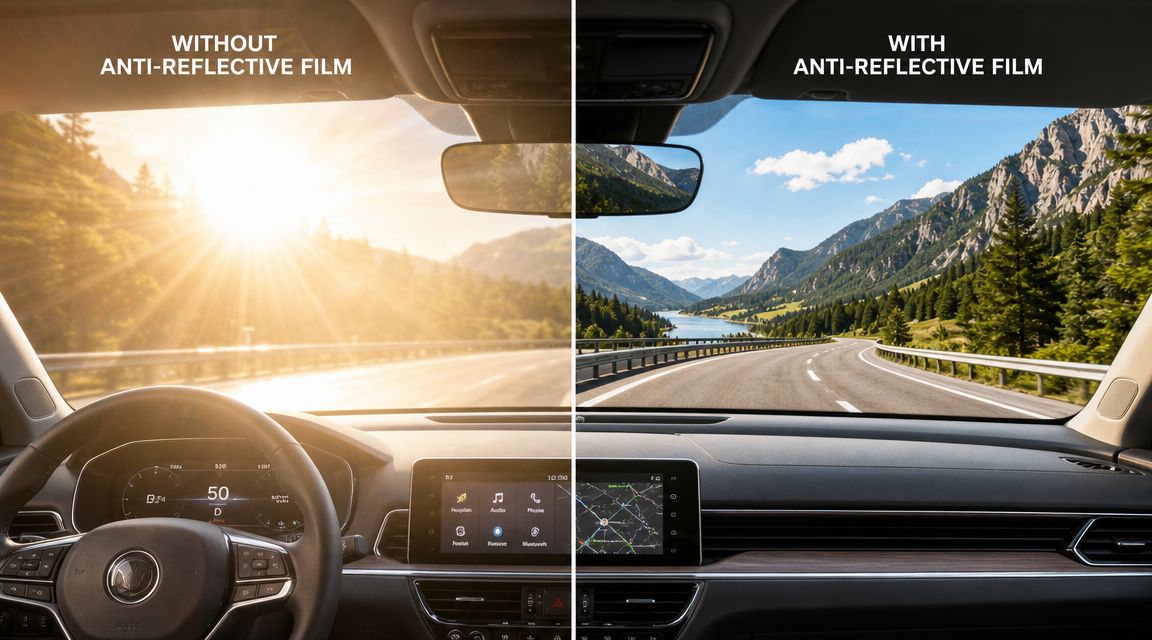
The worst glare usually hits when you're doing something routine. Morning sun on the way through Woodstock. A bright afternoon run down Barrett Parkway in Kennesaw. A late-day drive back toward Canton when the windshield starts showing more dashboard than road. Most drivers think the answer is darker tint.
Sometimes it is. Sometimes it isn't.
If your main complaint is reflected light, ghosting on glass, or that washed-out look when the sun hits at the wrong angle, anti reflective films solve a different problem than standard tint. They're built for visual clarity first. For Georgia drivers, that matters because glare isn't just annoying. It changes how quickly you pick up brake lights, lane markings, mirrors, and the display screens inside newer vehicles.
Beyond Dark Tints The Quest for Clearer Vision
A lot of drivers around North Metro Atlanta come in asking for “less glare,” but what they really mean depends on the car and the commute. One person is fighting sunset glare on Highway 92. Another is dealing with a light-colored dash reflecting across the windshield in a newer SUV. Someone else has a truck with a big upright windshield that seems to collect every headlight at night.
That's where the conversation changes. Traditional tint is mostly associated with shade, privacy, and heat control. Anti reflective films are different. They target the visual clutter that bounces off glass and back into your eyes.

What drivers usually notice first
In real cars, the problem rarely shows up as one giant blinding flash. It's usually a stack of smaller annoyances:
- Dashboard reflection that floats across the windshield during bright afternoon light
- Headlight glare that feels harsher on darker roads outside the busier retail corridors
- Screen reflections from modern infotainment systems and digital gauge clusters
- Eye fatigue after repeated squinting on a daily commute
Drivers who've already looked into clear front window tint options often realize they don't want a darker look as much as they want a cleaner view out.
Practical rule: If you keep saying “I don't need darker, I need clearer,” you're usually describing an anti-reflective problem.
Clarity matters more in newer vehicles
This is even more noticeable in vehicles with bright interiors, glossy trim, and larger screens. A lot of modern cars create their own glare. The windshield isn't the only culprit. Light can reflect off the dash, piano-black trim, gauge lenses, and display surfaces.
That's also why glare control often works best as part of a system, not a single product decision. If your rearward visibility at night is part of the problem, T1A Auto dimming mirror solutions are worth understanding because mirror glare and glass reflection often show up together in the same driving conditions.
For Woodstock, Kennesaw, and Canton drivers, the upgrade isn't just a darker cabin. It's a cabin that feels easier to look through. That's the appeal of anti reflective films. They're less about changing how your car looks from the outside and more about improving what you see from the driver's seat.
How Anti Reflective Films Work on Your Car
The easiest way to understand anti reflective films is to think of noise-canceling headphones for light. They don't just block light the way darker tint does. They manage reflection so less of it reaches your eyes in the first place.
TOPPAN explains the principle clearly. Anti-reflective films reduce glare by using thin-film interference: the reflected light from the AR layer and the interface below it is engineered to have the same amplitude but opposite phase, so the waves cancel and the film lowers visible reflection while preserving image clarity and transmittance (TOPPAN anti-reflection film reference).

The simple version
Here's what's happening on the glass:
Light hits the surface
Sunlight, headlight beams, and ambient light all strike the film.The film's layers manage the reflection
Instead of letting reflected light bounce back in a messy way, the film's structure controls how those waves behave.The unwanted reflection cancels down
The reflected waves are engineered to oppose each other, which reduces the visible reflection.More useful light passes through
That's why the view stays sharper than what people expect from a glare-control product.
This is why anti reflective films feel different from basic dark films when you sit behind the wheel. You're not just seeing “less brightness.” You're seeing less interference.
Why that matters in a car
Automotive glass is already dealing with a lot. Outside light hits it. Inside surfaces reflect into it. Then your eyes have to sort the whole scene while you're moving. Any reduction in reflected clutter helps the road scene separate faster.
That's especially useful on:
- Long commutes where eye strain builds gradually
- Night driving when oncoming lights create distracting hotspots
- Display-heavy interiors where glossy screens throw reflections
- Vehicles with light dashboards that bounce visible reflections upward
A clear windshield can still produce poor visibility if reflected light keeps competing with the road scene.
What anti reflective films don't fix
They won't hide poor installation, bad glass, or damaged surfaces. If the windshield already has mineral spotting, wiper wear, or etched contamination, the film can't make those defects disappear. In those cases, surface condition matters first. If you're trying to understand the difference between film performance and physical glass damage, this guide on solutions for etched car windows in Arizona gives useful context about what etching looks like and why it behaves differently from glare.
For a broader primer on how different automotive films are used, window film types and benefits is a helpful starting point before you choose a specific setup.
Key Benefits for Georgia Drivers
For drivers in Woodstock, Kennesaw, and Canton, glare control isn't a luxury feature. It's part of staying comfortable and alert in a climate with strong sun, reflective pavement, and long bright afternoons. Anti reflective films make the biggest difference when your complaint is visual fatigue, not just cabin temperature.

Better comfort during bright commutes
If you drive east in the morning and west in the evening, you already know how punishing low-angle sun can be. It doesn't just brighten the cabin. It creates reflections across the glass that make lane markings, traffic signals, and cars ahead harder to read cleanly.
That's where AR-focused film earns its keep. It helps cut the distracting reflected layer that sits on top of what you're trying to see. For many daily drivers, that means less squinting and fewer moments where your eyes need an extra beat to adjust.
A cleaner view in screen-heavy cabins
Newer vehicles add another challenge. Big infotainment displays, digital clusters, glossy trim, and lighter dashboard materials can all reflect into the glass. On some cars, the cabin itself becomes part of the glare problem.
That's why I usually look at the whole interior when discussing film choices. A black interior with matte surfaces behaves differently than a beige dash with a large center screen. The right film choice depends on what's bouncing light inside your specific vehicle.
Interior protection still matters
A driver usually asks about glare first, then starts thinking about what the sun is doing to the cabin over time. That's smart. Constant exposure is hard on dashboards, seats, door panels, and trim, especially in a Georgia summer.
If interior preservation is high on your list, UV protection for car windows is worth reviewing because glare reduction and cabin protection often go hand in hand when owners are building a more complete tint package.
Here's a quick walk-through that helps visualize the day-to-day payoff before deciding on film type:
The practical gains drivers actually feel
The benefits show up in ordinary moments, not showroom moments.
- Lane changes feel easier when side glass and windshield glare aren't fighting your mirrors
- Night drives feel less harsh because bright points of light create less visual noise
- The cabin feels less tiring over a long week of commuting
- Interior materials stay better protected when your overall film package also addresses UV exposure
Shop-floor advice: The right film should make driving feel calmer. If the product reduces glare but leaves the view hazy or muddy, it's the wrong fit for a windshield-adjacent application.
For North Georgia drivers, that last point matters a lot. You don't want a film that solves one problem by creating another. A little less glare isn't worth it if road detail looks softer, especially in rain, dusk, or mixed lighting.
AR Film vs Other Tints Which Is Right for You
The biggest mistake I see is treating every glare-control film like it does the same job. It doesn't. Anti-reflective, anti-glare, and nano-ceramic products can all be useful, but they solve different problems and they feel different on the vehicle.
The most important comparison is AR versus AG. A practical tradeoff exists between them. AG films scatter light with a textured surface, often introducing haze and reducing clarity, while AR films use thin-film interference to cancel reflections and preserve image sharpness (technical comparison of anti-glare and anti-reflective film). For automotive use, that distinction matters because a car owner usually needs glare reduction without sacrificing a crisp view.
The comparison that matters most
If you only remember one thing, remember this: AG reduces glare by diffusing light. AR reduces reflection while aiming to keep the image clean.
That's why AG film can make sense on certain screens or surfaces where reflected light is the main annoyance and slight haze is acceptable. In a vehicle, though, haze can become the bigger problem. You might gain comfort in one condition and lose clarity in another.
TOPPAN's product information also shows that haze levels in AG and AGLR films can range from 1% to 60% within those categories, which is a useful reminder that glare-control performance varies significantly by application and product type, not by marketing label alone. That supports the real-world approach: there isn't one universally “best” film for every surface or every driver.
Automotive Film Comparison
| Feature | Anti-Reflective (AR) Film | Anti-Glare (AG) Film | Nano-Ceramic Tint |
|---|---|---|---|
| Glare reduction method | Uses thin-film interference to reduce reflections | Uses surface texture to scatter light | Primarily manages solar energy and brightness through tint technology |
| Clarity vs haze | Prioritizes image sharpness and a cleaner view | Can reduce glare but may introduce haze | Usually offers good visual quality, but its core strength is not the same reflection-canceling behavior as AR |
| Best use case | Drivers bothered by reflected light, dashboard reflection, or screen-heavy interiors | Specialty glare reduction where some softness is acceptable | Daily drivers focused on heat rejection, UV protection, and overall comfort |
| Durability considerations | Can be more vulnerable to scratching and often costs more | Surface characteristics vary by product | Common choice for full-car tint packages because it balances comfort and durability |
| How it feels from the driver's seat | Crisp, cleaner, less visually cluttered | Softer, diffused, sometimes slightly cloudy | Cooler cabin, darker look depending on shade, strong all-around performance |
Where ceramic fits in
Nano-ceramic tint is still the default choice for a lot of Georgia vehicles because heat rejection, UV control, and legal shade selection are major priorities. If your main complaint is “my cabin gets cooked in the sun,” ceramic is often the first category to consider.
But if your complaint sounds more like this, AR should be part of the conversation:
- “I hate the reflection off my dash.”
- “My windshield looks busy in bright light.”
- “Night glare feels sharper than it should.”
- “My new screen-heavy interior reflects everywhere.”
A second shift in the market is that newer anti reflective films are being positioned as more than reflection-control products. Industry and manufacturer material now describes multi-function AR films that may add anti-static performance, anti-soiling properties, durability reinforcement, and physical protection, while display-focused applications increasingly emphasize visibility in challenging light rather than reflection reduction alone. That doesn't automatically mean every premium AR option is worth the added cost, but it does mean buyers should ask better questions about cleaning, long-term readability, and surface durability before choosing.
Don't buy an AR film just because it sounds more advanced. Buy it when the problem you want solved is reflected light and preserved clarity.
Which one fits your vehicle
The simplest way to choose is by driving pattern and vehicle type.
Choose AR film when your car has a bright interior, large windshield, glossy cabin surfaces, or you do a lot of sunrise, sunset, and night driving where reflection clutter is the main issue.
Choose AG carefully and only when you fully accept the tradeoff. It may reduce glare, but the added haze can be the wrong compromise for windshield-related visibility.
Choose nano-ceramic tint when your main goal is an all-around package for heat control, UV protection, and comfort across side and rear glass.
For many owners, the smartest setup isn't choosing one category as a religion. It's picking the right tool for the right glass and the right complaint.
Installation and Cost in the Woodstock Area
Good film on bad installation is still a bad result. That's especially true with anti reflective films, because the whole point is optical quality. Any contamination, edge lift, trapped debris, or distortion defeats the reason you bought the film in the first place.
In the Woodstock area, drivers usually ask two practical questions first. How long will it take, and what affects the price?

What professional installation actually changes
A proper install environment matters because automotive film is unforgiving. Dust, lint, and surface prep mistakes show up fast on clear or clarity-focused products. A professional shop controls the work area, cleans the glass correctly, patterns the film precisely, and shrinks or fits it so the final result sits flat and stable.
If you're comparing shops for same-day tint in Woodstock or looking up car window tint cost in Kennesaw, ask practical questions instead of shopping by price alone:
What film line is being installed
Some products are built for clarity, some for privacy, some for heat management.What glass is being covered
A sedan, a Tesla with large glass areas, and a full-size SUV don't involve the same labor or layout.What warranty comes with the install
A warranty tells you how the installer expects the product to hold up over time.
What affects cost around Woodstock, Kennesaw, and Canton
Price changes based on the vehicle and the film package. Larger vehicles take more material and more time. Complex rear windows, frameless glass, and modern windshield shapes can also increase the labor involved. Premium film categories generally cost more because they're doing more specialized work than entry-level dyed film.
One local option drivers compare when researching professional installation is The Tint Guy, which offers automotive tinting for cars, trucks, SUVs, and model-specific vehicles in the North Metro Atlanta area. Whether you choose that shop or another installer, the important thing is finding someone who can explain film selection clearly instead of pushing one product on every car.
If the installer can't explain why a film fits your commute, your vehicle, and your visibility priorities, keep looking.
How to prepare for the appointment
A smoother install starts with simple prep:
- Arrive with clean interior glass areas if possible, especially if the vehicle has heavy dust, pet hair, or smoker residue.
- Remove valuables and clutter from the doors, seats, and cargo area.
- Plan for cure time after installation. Fresh film needs time before normal cleaning and window use habits resume.
- Ask about Georgia tint compliance before choosing your final shade.
For drivers in Cherokee County and Cobb County, convenience matters. So does long-term fit and finish. A fast appointment is nice. A clean install that still looks right later is the part you live with.
Your Next Steps for a Glare-Free Drive
The right film choice comes down to one honest question: what bothers you most when you drive? If it's heat, a ceramic-focused package may be the better answer. If it's reflected light, dashboard glare, headlight harshness, or a windshield that never seems visually calm, anti reflective films deserve a closer look.
That decision is even more personal in Georgia because driving conditions change fast. One owner in Canton may be dealing with long two-lane evening drives and harsh oncoming headlights. A commuter in Kennesaw may care more about westbound sunset glare. A driver in Woodstock with a newer SUV may be more frustrated by the reflections created by the cabin itself.
Keep these points in mind before booking:
- Match the film to the problem instead of buying by label alone
- Don't trade clarity away lightly if the film will affect your driving view
- Ask about durability and cleaning on any premium glare-control product
- Confirm legal tint limits in Georgia before finalizing shade choices
Maintenance is straightforward once the film is installed and cured. Use gentle cleaning methods and non-ammonia products, and don't treat clarity-focused film like ordinary glass on day one.
The smartest move is a vehicle-specific recommendation, not a generic package. Your glass, interior color, commute, and driving hours all matter. If you want a glare-reduction setup that fits your car and your daily route through Woodstock, Kennesaw, or Canton, a direct consultation will save you from buying the wrong kind of film.
If you want a practical recommendation for your vehicle, contact The Tint Guy and ask for a film option based on your actual commute, glass layout, and visibility concerns, not just the darkest shade on the menu.