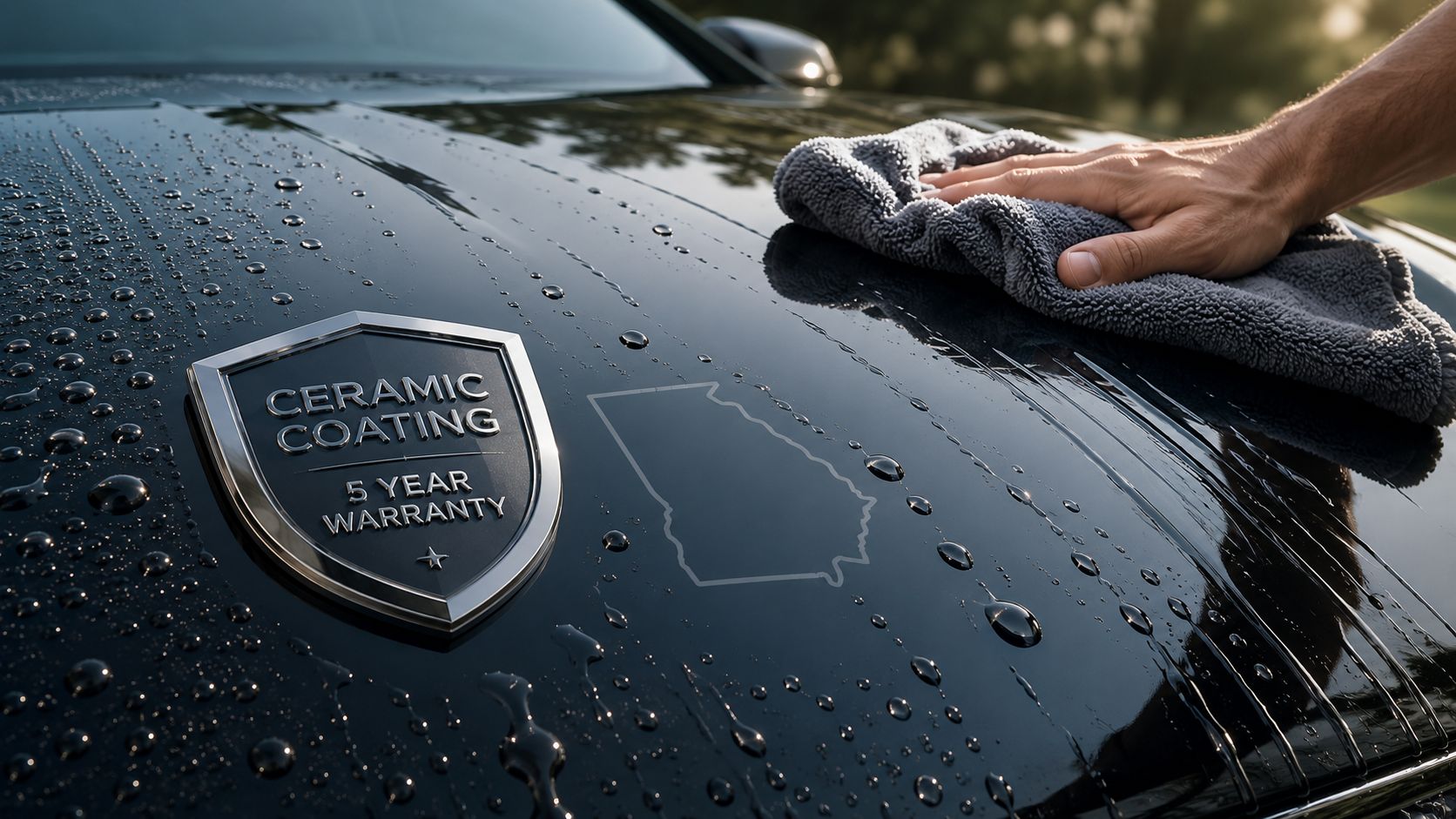
You've just picked up your car. The paint looks dripping wet, the surface feels slick, and the paperwork says your new coating is backed by a serious warranty. If you're in Woodstock, Kennesaw, or Canton, that moment feels great right up until the first road chip, wash mistake, or maintenance question shows up.
That's where most ceramic coating warranty confusion starts. The sales pitch usually sounds simple. The actual agreement rarely is. A coating warranty can be useful, but only if you understand what it covers, what it excludes, and what you have to do to keep it valid in real-world Georgia driving.
The Lifetime Promise of Your New Coating
A lot of owners hear “lifetime warranty” and translate it to “my paint is protected from whatever the road throws at it.” That's the most expensive misunderstanding in this part of the business.
The common version goes like this. A driver leaves the shop with a fresh coating, a glossy hood, and paperwork that sounds reassuring. A few weeks later, they spot a chip on the front bumper or a scratch near a door handle. They assume the warranty should handle it. Then they find out it won't.

That disconnect isn't minor. Consumers frequently ask if ceramic coating warranties cover rock chips, but 99% of warranties explicitly exclude all physical damage. Data reveals that 85% of buyers mistakenly believe ceramic coating prevents rock chips according to Dennis Auto Details on ceramic coating warranty coverage terms.
Why the promise feels bigger than the paperwork
Marketing language often leads with terms like “lifetime,” “ultimate,” and “permanent.” Customers hear durability and assume impact protection. Those are not the same thing. A ceramic coating is a surface protection product. It helps with gloss, washability, and contamination resistance. It is not a force field.
If your main worry is stone impact on highways around North Metro Atlanta, coating alone isn't the right tool.
That's why many owners eventually compare coating with a more impact-focused option like paint protection film lifespan and long-term protection. The products solve different problems. A warranty only makes sense when you match the product to the threat.
The question to ask before you buy
Don't ask, “How long is the warranty?” first.
Ask these instead:
- What failure is covered: Product failure and physical damage are usually treated very differently.
- Who has to maintain it: Many warranties place ongoing obligations on the owner, not just the installer.
- What voids it fastest: Automatic brush washes, harsh chemicals, or skipped maintenance visits often matter more than the headline term.
If you understand that gap upfront, the rest of the warranty starts to make sense.
Decoding Your Warranty What Is Typically Covered
The best way to think about a ceramic coating warranty is this. It's performance insurance for the coating itself, not invincibility coverage for the vehicle.
That distinction clears up almost everything. The warranty is generally there to address cases where the coating doesn't perform the way it should because of a product problem, an application failure, or a breakdown in expected behavior. It is not there to cover every bad thing that can happen to painted panels in daily use around Woodstock, Kennesaw, or Canton.

What real coverage usually looks like
The clearest verified description is straightforward. Ceramic coating warranties primarily cover specific failure modes like delamination (separation from paint), loss of hydrophobic properties (failure to bead water), and material defects. They do not cover rock chips, scratches, or accident damage, as coatings are not designed for physical impact protection as explained by Kleen Whips in its ceramic coating warranty breakdown.
In practical shop terms, a valid claim usually looks like the coating itself failing in an abnormal way.
Common examples include:
- Delamination: The coating separates from the paint instead of bonding correctly.
- Hydrophobic failure: Water behavior changes far earlier than the warranty terms allow, assuming proper care.
- Material defect: The coating product itself has a formulation issue.
- Application-related failure: Surface prep or curing problems lead to abnormal performance.
What to look for on the car
A customer doesn't need to speak installer jargon to spot a legitimate concern. You're looking for signs that the product itself isn't behaving normally, not signs that the vehicle met road debris or poor wash methods.
A quick comparison helps:
| Situation | More likely a warranty issue | More likely owner or road damage |
|---|---|---|
| Coating separating from paint | Yes | No |
| Water beading disappears despite proper maintenance | Yes | Possibly |
| Scratch from contact or impact | No | Yes |
| Rock chip on bumper or hood | No | Yes |
| Paint damage after an accident | No | Yes |
Coating and film are not interchangeable
Buyers often cross wires between ceramic products and impact protection products. If your priority is easier cleaning and surface performance, coating fits. If your priority is resisting physical strikes, the better comparison is paint protection film vs ceramic coating for different types of vehicle protection.
Practical rule: Read the warranty as a promise about coating behavior, not as a blanket promise about paint survival.
That mindset will keep you from filing claims that were never intended to be approved.
The Fine Print Common Warranty Exclusions
Most disappointment with a ceramic coating warranty comes from exclusions, not from the stated warranty term. The paper may look generous. The exclusions define the boundaries.
Owners in Woodstock, Kennesaw, and Canton usually run into the same four categories of non-coverage. None of them are unusual. They're standard because they follow the basic design limits of ceramic coatings.
Physical damage is almost always excluded
The biggest exclusion is the one customers care about most. Warranties generally do not cover impact or abrasion damage. If a rock hits the bumper on I-575, a shopping cart brushes a door, or a branch drags across the hood, that's outside the normal scope of coating coverage.
A ceramic coating is a sacrificial surface layer. It helps the paint deal with contamination and wash more easily. It doesn't stop impact energy.
A coating can reduce how stubborn grime is. It cannot stop a stone from breaking paint.
That's why claims for chips, scratches, key marks, and collision damage almost always fail. The product didn't malfunction. The car got physically damaged.
Owner-caused maintenance issues usually void coverage
The second major exclusion is improper care. This catches more people than actual product failure.
If the owner runs the vehicle through automated brush washes, uses harsh degreasers, scrubs with abrasive mitts, or lets contamination sit too long, the warranty may no longer apply. The reason is simple. The manufacturer can argue the coating didn't fail on its own. The care routine damaged or degraded it.
Typical red flags include:
- Brush tunnel washes: These often introduce marring and contamination.
- Harsh chemicals: Strong cleaners can strip behavior from the surface.
- Abrasive tools: Rough pads, brushes, and low-quality towels can damage the finish.
- Neglected contaminants: Bird droppings, bug remains, and tree fallout can etch if left too long.
Pre-existing paint defects are not the coating's fault
A coating doesn't reset bad paint. If the vehicle already has swirls, oxidation, repaint issues, etching, or hidden defects under the surface, a warranty generally won't absorb that problem later.
That matters on used vehicles and dealer-prepped cars. If correction work wasn't done, or if prior paintwork wasn't stable, the coating may sit on top of flaws that eventually become visible. The warranty usually follows the coating, not the history of the paint underneath it.
Unauthorized products and outside work can create problems
Some warranties also get shaky when another detailer performs correction, uses incompatible toppers, or applies products the warranty provider doesn't approve. Once someone else modifies the surface, proving the original coating failed becomes much harder.
Here's the logic most manufacturers follow:
| Exclusion | Why it's excluded |
|---|---|
| Rock chips and scratches | Physical impact is outside coating design |
| Brush wash damage | Improper care changes the surface |
| Existing paint flaws | The coating didn't create the defect |
| Third-party chemical damage | Outside products interfere with performance |
The short version is blunt. A long warranty doesn't mean broad coverage. It often means narrow coverage with strict conditions.
How to Keep Your Ceramic Coating Warranty Valid
A ceramic coating warranty isn't passive. You don't file the paperwork once and forget about it. You keep it alive through maintenance.
That's the part many owners miss after the excitement of delivery day. They remember the term length and forget the obligations tied to it. In practice, maintenance rules matter more than marketing language.
The non-negotiables most premium warranties expect
Verified manufacturer guidance is clear here. Most premium warranties require professional installation and strict maintenance, such as regular washing with pH-neutral soap and avoiding abrasive materials. Many warranties from brands like Ceramic Pro also mandate annual inspections to remain valid; if an inspection is missed, a lifetime warranty may be reduced to a 5-year term from the last inspection date according to Ceramic Pro warranty and after-care documentation.
That means the owner has a job to do after install.
A simple maintenance checklist that protects your coverage
Use this as your baseline routine:
Wash on schedule
Don't wait until the car is heavily soiled. Regular hand washing reduces contamination buildup and lowers the chance of etching or bonded grime becoming a warranty argument.Use pH-neutral soap
Strong household cleaners and aggressive degreasers can create problems fast. Use products intended for coated vehicles.Skip abrasive wash tools
Cheap brushes, rough sponges, and dirty towels can scratch or dull the surface. If the warranty says avoid abrasives, take that seriously.Keep maintenance records
Save invoices, emails, and inspection notes. If there's ever a claim, documentation matters.Show up for inspections
Annual checkups aren't upsells when they're listed in the warranty terms. They're compliance.
What owners get wrong most often
A lot of people treat coating care like ordinary car care. That's the mistake. Standard habits can clash with warranty language.
For example:
- A “quick wash” at a brush tunnel may be convenient, but it can conflict with care terms.
- A strong wheel or bug cleaner used everywhere on the car may be harsher than the coating maker allows.
- Skipping an inspection because the car still looks glossy can still cost you coverage.
The coating can still appear fine while the warranty has already been voided on paper.
If you've just had a vehicle coated, it also helps to review practical guidance on how to protect new car paint so your day-to-day habits support the warranty instead of undermining it.
Think of maintenance as contract compliance
The best owners don't treat aftercare as optional detailing advice. They treat it like a service schedule. That mindset prevents most warranty headaches.
If the paperwork tells you to wash a certain way, inspect it on schedule, and avoid specific chemicals, that isn't a suggestion. It's the condition for keeping the agreement enforceable.
Navigating Warranties in North Metro Atlanta
A ceramic coating warranty doesn't live in a vacuum. It lives on a car parked outside in Georgia.
That changes how you should think about upkeep in Woodstock, Kennesaw, and Canton. North Metro Atlanta drivers deal with heavy pollen, long hot stretches, bug residue, tree sap, and sudden weather swings. None of that automatically creates a warranty claim, but all of it affects how carefully an owner needs to maintain the vehicle.
Local conditions change the maintenance burden
Pollen season leaves a fine layer that encourages frequent washing. Bug residue and bird droppings don't wait for a convenient weekend. Summer heat bakes contamination onto panels faster, especially on dark paint. If the owner delays cleanup, the coating may still help, but the warranty won't usually excuse neglect.
A good local installer accounts for that reality. They don't hand you generic care language and send you home. They explain what “prompt removal” means when Georgia bugs and sap are part of the routine.
Here's what practical local advice usually sounds like:
- Wash sooner during high pollen periods so contaminants don't sit on the surface.
- Remove bug splatter and droppings quickly instead of letting heat bond them to the finish.
- Park smart when possible under cleaner cover, not under sap-heavy trees.
- Ask for a written maintenance plan that fits your driving pattern, not just the product brochure.
Coating warranties and tint warranties are different products
Many owners buy both at the same shop, yet a ceramic coating warranty and a ceramic window tint warranty are not the same agreement.
A coating warranty concerns paint-surface performance and maintenance. A tint warranty deals with film-related issues on glass, such as product behavior and installation quality. The care requirements, failure signs, and claim process may overlap in spirit, but they protect different parts of the vehicle.
That distinction matters more when shoppers compare “lifetime” language across services. One lifetime claim may refer to a paint product with inspection obligations. Another may refer to window film performance on side and rear glass. Read each on its own terms.
Local expertise matters most when the installer explains how Georgia conditions affect both the product and the paperwork.
That's what separates a smooth ownership experience from a surprise denial later.
Filing a Claim and The Role of Your Installer
If you think the coating itself may be failing, don't start by chasing the manufacturer. Start with the original installer.
That's usually the most efficient path because the installer has your application details, product records, and service history. They can tell the difference between true coating failure and damage caused by impact, contamination, or maintenance mistakes.
The clean way to handle a claim
Use a straightforward process:
- Take clear photos of the affected area in good lighting.
- Check your paperwork for registration deadlines, cure timing, and inspection requirements.
- Contact the original installer quickly before attempting correction or applying other products.
- Gather maintenance records including wash history, inspections, and any prior service notes.
- Let the installer inspect the vehicle and submit or guide the claim if the issue fits the warranty terms.
Verified warranty terms can include timing details owners overlook. Many warranties require the vehicle to be registered within 30 days of application and become effective 72 hours after to allow full curing. The warranty is often transferable if the vehicle is sold, provided maintenance is documented. To remain valid, some warranties for periods over 2 years require annual inspections by an authorized agent as outlined by Sage Auto Studios in its explanation of ceramic coating warranty coverage.
Why installer communication matters so much
A good shop doesn't just install. It documents, registers, and helps manage the relationship between owner and manufacturer. That support becomes even more important when customer communication slips. Shops that miss incoming service calls often create avoidable frustration, and resources like stop losing money from missed calls are useful because they show how easily detail businesses can lose trust when response times break down.
If you bought from a reputable installer, use them. They're usually the warranty liaison that keeps the process organized.
A Warranty Is a Partnership Not Just a Document
The strongest way to understand a ceramic coating warranty is as a shared responsibility. The installer has to prep and apply the product correctly. The manufacturer has to stand behind legitimate coating failure. The owner has to maintain the vehicle the way the agreement requires.
When any one of those pieces falls out, the word “lifetime” stops meaning much. That's why transparent shops matter. The right installer doesn't sell the dream version of a warranty. They explain the limits, the exclusions, the maintenance schedule, and what daily ownership looks like in Woodstock, Kennesaw, and Canton.

A smart buyer should want that honesty. Clear expectations prevent bad claims, wasted money, and a lot of resentment later. They also help you choose the right protection mix for your car, whether that's coating, window tint, paint protection film, or a combination that fits how and where you drive.
The best warranty experience usually starts before the install, when someone takes the time to explain what the warranty won't do.
That's the standard to look for. Not just glossy paperwork. Real guidance, proper documentation, and support after the sale.
If you want straight answers about ceramic coating, paint protection, and premium vehicle care in North Metro Atlanta, talk with The Tint Guy. Drivers in Woodstock, Kennesaw, and Canton who want honest guidance on protection options, warranty expectations, and professional installation can reach out for a no-pressure conversation based on how the vehicle is used.