You're probably reading this after one of those North Georgia drives where the sun feels like it's coming through the side glass sideways, the steering wheel is hot, and the cabin never really cools down until you've been on the road a while. That's a normal summer afternoon in Woodstock, Georgia, a daily commute through Kennesaw, Georgia, or a weekend run across Canton, Georgia.
For most drivers, tint starts as a comfort upgrade. Then the first long stretch of Georgia sun changes the math. You notice the glare, the hot spots across your arm and face, and the way interiors age faster when untreated glass keeps letting sunlight pour in. Good automotive tint doesn't just darken glass. It controls heat, filters UV, and protects the parts of your car you paid for.
Beat the Georgia Heat with UV Window Film
A lot of Georgia drivers come in thinking they need darker tint. What they usually need is better film and a cleaner install.
On a bright afternoon in Woodstock or Canton, the problem isn't just visible light. It's the constant exposure through the side windows and rear glass that turns the cabin harsh and fatiguing. High-quality film changes that driving experience immediately. It softens glare, helps the interior feel more stable, and adds real protection instead of cosmetic darkness.

What UV film actually does
The biggest reason drivers ask about UV window film installation is usually heat. That makes sense. But the long-term value often comes from what the film blocks before it reaches your skin and interior surfaces.
High-quality window film installation can reject up to 99% of harmful ultraviolet rays, specifically blocking between 99% and 99.9% of both UVA and UVB radiation that pass through untreated glass, according to American Window Film's overview of UV rejection. That matters for fading, cracking, and the steady wear that shows up first on dashboards, leather, trim, and door panels.
If your main concern is cabin comfort, this guide on how window tint reduces heat gives a useful look at why the right automotive film does more than cut brightness.
Practical rule: If you spend a lot of time driving in Georgia, UV protection isn't a cosmetic add-on. It's part of preserving the vehicle and making the cabin easier to live with.
Why Georgia drivers feel the difference fast
In Kennesaw and the rest of North Metro Atlanta, plenty of daily driving happens at the worst possible sun angles. Morning commutes hit one side of the car. Late afternoon drives hit the other. That repeated exposure is why people often notice one arm, one seat bolster, or one section of trim aging faster than the rest.
A well-chosen film helps in a few ways:
- Cabin comfort: It reduces the harshness you feel through the glass during long drives.
- Glare control: It makes bright roads, reflective traffic, and low sun easier to manage.
- Interior preservation: It helps slow the fading and breakdown that untreated glass allows.
- Cleaner appearance: Good film looks integrated with the vehicle, not pasted onto it.
Darkness is not the same thing as protection
Many buyers misunderstand this point. Dark tint and strong UV rejection are not the same spec. Some high-performance clear films can block very high levels of UV without making the glass look dramatically darker, while lower-grade dark films can underperform where it matters most.
That's why the film itself and the installer's standards both matter. In automotive work, Georgia heat exposes shortcuts quickly. A film can look acceptable on day one and still fail later if the install was rushed, contaminated, or trimmed poorly.
Why Professional Installation Beats a DIY Weekend Project
DIY tint kits are appealing because the box makes the job sound simple. Clean the glass, spray a little slip solution, lay the film down, and squeegee it flat. Real-world automotive glass is less forgiving than that.
Side windows, rear glass curvature, edge sealing, and contamination control separate a clean install from one that starts lifting or hazing. In Georgia, where the car sits in heat and sunlight for long stretches, those details don't stay hidden for long.

The technical part DIY videos usually skip
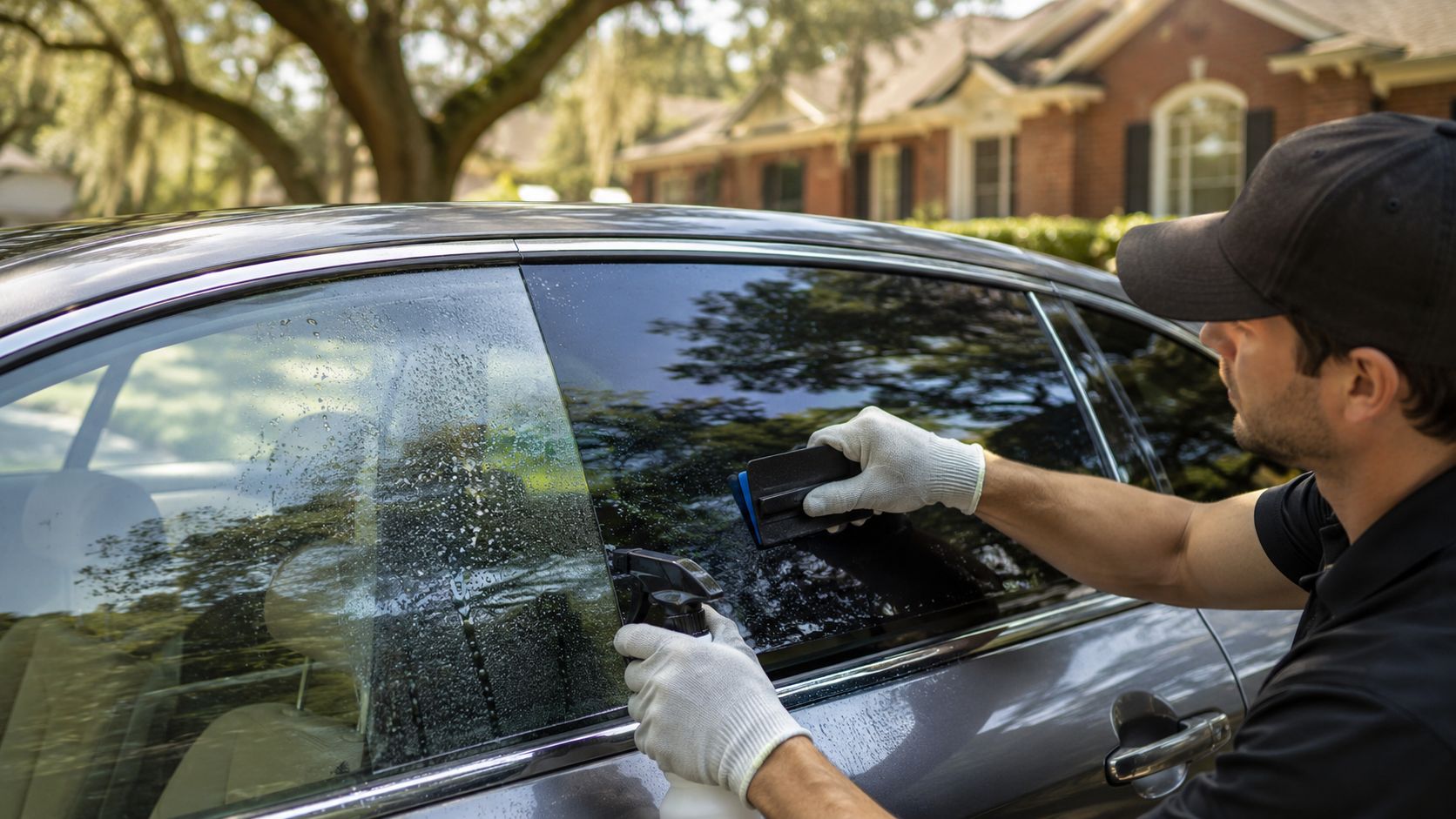
Proper automotive UV window film installation uses a wet application method, not a dry stick-and-hope approach. The glass has to be thoroughly cleaned, the slip solution has to be right, and the film has to be positioned with precision before final squeegee passes lock it down.
There's also edge management. Proper trimming leaves a 1 to 2 mm gap at the edges, which is roughly fingernail thickness, so the film can seat correctly and the window can still move without dragging the edge. On curved glass, ceramic film may also need heat-shrinking so it conforms cleanly before the final finish. WindowFilm.com's installation guidance notes that failure to leave this gap or improper heat-shrinking leads to edge lifting in over 30% of DIY attempts, while professional installations achieve over 95% success rates.
That gap is one of the best examples of why experienced installers matter. Too tight, and the edge can catch. Too loose, and the install looks sloppy.
What usually goes wrong with weekend installs
The most common DIY failures aren't dramatic. They're the small defects that become obvious after a few hot days.
- Trapped contamination: Dust, lint, pet hair, and tiny debris get locked under the film.
- Bad edge cuts: The film sits too close to the gasket or too far from the edge.
- Poor shrinking on curved glass: Rear windows end up with fingers, tension lines, or lifted corners.
- Inconsistent squeegee pressure: Moisture stays trapped where it shouldn't.
- Rushed prep: Old adhesive, oils, or residue interfere with bonding.
Clean glass isn't the same thing as film-ready glass. On automotive work, the difference shows up at the edges first.
A professional shop controls the environment better, uses the right blades and hard cards, and knows where each vehicle platform tends to fight back. Frameless glass, deep seals, defroster lines, and tight rear decks all change the approach.
Long-term protection depends on install quality
This is the part many buyers miss. UV protection isn't only about the film's lab spec. It's about whether the film stays flat, sealed, and stable over time.
If the edge lifts, if contamination creates a weak bond, or if the rear glass was shrunk poorly, the job stops being durable. That's why drivers looking for a lasting result usually end up choosing professionally installed window film instead of treating tint like a disposable accessory.
Professional work doesn't just look better on pickup day. It holds up better after heat cycles, window movement, cleaning, and daily use.
Choosing Your Shield Ceramic vs Other Film Technologies
Not all tint films solve the same problem. Some are built to hit a lower price point. Others are built for clarity, thermal control, and stability over time. If you're comparing options for a vehicle in Woodstock, Kennesaw, or Canton, the key is to look past shade alone and understand what the film is doing.
Why ceramic sits at the top of the stack
Nano-ceramic window films use microscopic ceramic particles within a multi-layer construction. According to Euroluxe Detailing's technical breakdown of nano-ceramic film construction, high-quality nano-ceramic films absorb and reflect more than 80% of infrared radiation, block more than 99% of UV rays, and reject 54% to 64% of total solar energy, depending on visible light transmission. The same source notes that standard dyed films may reject only 30% to 45% of total solar energy and degrade faster.
For a Georgia driver, that translates into a film that does more actual work without relying on heavy darkness or metallic reflectivity.
Where dyed and carbon films fit
Dyed film usually appeals to price-conscious buyers. It can improve appearance and cut some brightness, but it's often the first category to show age. Color shift and performance drop-off are the trade-off.
Carbon film is a middle-ground option in many shops. It typically aims for a darker, richer look than entry-level dyed film and often avoids the signal issues associated with older metallic products. For some owners, that makes it a valid option when ceramic isn't the target. But if the priority is top-tier heat management and long-term consistency, ceramic remains the benchmark.
Here's the practical comparison:
| Feature | Dyed Film | Carbon Film | Ceramic Film |
|---|---|---|---|
| UV protection | Varies by product | Stronger than entry-level film in many applications | Excellent, with premium films blocking over 99% of UV |
| Heat rejection feel | Basic improvement | Better balanced performance | Best choice for high heat loads and daily Georgia driving |
| Color stability | More likely to fade over time | Generally more stable than dyed film | Built for long-term color stability |
| Signal interference | Depends on construction | Usually chosen to avoid metallic drawbacks | Does not interfere with GPS or mobile signals in high-quality ceramic designs |
| Best fit | Budget appearance upgrade | Mid-range daily-driver option | Drivers who want top performance and durability |
The common mistake buyers make
Many people still assume darker means better protection. That's not reliable. A lighter, higher-grade ceramic film can outperform a darker low-end film where comfort and UV blocking matter.
The best automotive tint isn't the one that looks darkest in the parking lot. It's the one that still performs cleanly after years of heat, window movement, and regular driving.
For modern vehicles with integrated tech, ceramic also avoids one of the old headaches of metallic films. You don't want signal problems just because you wanted cooler glass.
The Tint Guy Installation Process Step by Step
A clean tint job looks simple when it's finished. The work that makes it look simple happens before the customer ever sees the final glass.
For vehicles coming from Woodstock, Kennesaw, and Canton, the process has to be repeatable. Different makes, frameless doors, steep rear windows, and tight weatherstripping all require small adjustments, but the standard can't move.

Step 1 consultation and vehicle check
Before any film touches glass, the installer needs to know how you use the vehicle. Some drivers want maximum cabin comfort for long commutes. Some care most about preserving a newer interior. Others want a legal setup with strong daytime comfort and a factory-clean look.
The vehicle itself also gets checked. Existing film, old adhesive, damaged seals, and glass condition affect what happens next.
Step 2 film selection and pattern setup
Much of the final quality is determined at this point. A good shop doesn't treat all cars the same. A sedan, truck, SUV, and Tesla all present different cutting and handling needs.
For precision, modern shops often use computer-aided pattern cutting so the film shape is consistent and matched to the glass. That reduces hand-cut risk on the vehicle and helps keep the edges clean.
Step 3 contamination control and glass prep
Prep is the most underappreciated part of UV window film installation. The visible glass can look clean and still hide debris near the seals, on defroster lines, or along the top edge where the film will finish.
That's why proper prep usually includes:
- Detail cleaning at the edges so hidden debris doesn't wash back under the film.
- Inspection under good lighting to catch residue, lint, and fine contamination.
- Controlled slip-solution application so the installer can position the film without dragging contamination across the adhesive.
A tint job usually doesn't fail in the middle of the glass. It fails where prep got lazy.
Step 4 shrinking, placement, and final squeegee work
Curved automotive glass needs controlled shaping before final installation. Rear windows are the classic example. If the film isn't shrunk correctly, it can fight the curve and create tension that shows up later as fingers or lift.
On installation, the film is aligned, seated, and worked down with deliberate squeegee passes. The goal is simple to describe and hard to execute well. Remove moisture, control tension, and leave a clean edge without overworking the material.
Step 5 inspection and curing guidance
A professional finish includes the last check. Edge alignment, contamination, rear glass consistency, and overall appearance all need inspection before the vehicle goes back out.
Customers also need realistic curing guidance. Freshly installed film needs time to settle. During that period, a driver may notice some temporary moisture haze depending on the film and conditions. What matters is that the job was installed correctly from the start and the owner knows how to treat it while it cures.
For local drivers in Canton, Woodstock, and Kennesaw, that combination of process discipline and vehicle-specific handling is what separates a premium result from an average one.
Staying Legal Georgia Car Window Tint Laws for 2026
A good-looking tint job that isn't legal is a problem waiting to happen. Georgia law is one area where guessing causes expensive mistakes, especially when drivers ask for a shade by number without understanding how that number applies to the finished glass.

The baseline Georgia rule for passenger cars
For sedans in Georgia, passenger cars must maintain a minimum of 32% Visible Light Transmission across the front side windows, rear side windows, and rear window, which makes 35% tint legally compliant while 20% or 30% tint is illegal according to this Georgia tint law summary.
That's the number drivers in Woodstock, Kennesaw, and Canton need to keep front of mind when they're shopping by shade.
The tolerance detail most drivers don't hear
Georgia law also includes an enforcement tolerance. Under Georgia Code § 40-8-73.1, law enforcement meters may allow a ±3% tolerance, meaning a reading as dark as 29% VLT may be accepted during enforcement even though the legal compliance standard remains 32% VLT.
That tolerance is not permission to choose a darker target. It's one reason a professional installer aims for a compliant finished result instead of chasing the edge.
To get familiar with the state rules before choosing a film, review Georgia auto window tinting laws.
A quick visual helps if you want to see the legal framework in plain language:
What a legal-minded installer should help you avoid
A solid shop should help you avoid three common mistakes:
- Picking shade by appearance alone: Factory glass and film combine to create the final VLT.
- Confusing privacy with legality: Darker isn't automatically smarter if it creates enforcement issues.
- Ignoring the vehicle type: Passenger-car rules matter when you're tinting a sedan.
If a driver asks for “30% because my friend has it,” the right answer isn't yes. The right answer is to measure the glass, explain the law, and build a compliant setup.
That matters because legal tint should still deliver comfort, UV protection, and a clean finish without creating future headaches.
Your UV Film Questions Answered
Most drivers reach the final decision on tint after they've answered three practical questions. How much will the right film cost, how long will it last, and what do I need to do after installation?
Is professional tint still worth it if cheaper film exists
Usually, yes. The market keeps growing because drivers continue to see value in comfort, energy control, and interior protection. Wifitalents' industry statistics roundup projects the global window film market will reach USD 7.2 billion by 2032, and notes that professional installers average 15 cars tinted per week. That doesn't prove every shop is equal, but it does show this isn't a niche add-on. It's a standard upgrade that many vehicle owners keep choosing.
What changes price most is the combination of film technology, vehicle size, glass complexity, and the install standard. Ceramic costs more than entry-level film because it performs better and tends to hold its appearance longer. A large rear window with aggressive curvature also takes more labor than a simple flat side glass panel.
How long does automotive UV film last
Longevity depends on two things more than anything else. Film quality and installation quality.
A premium ceramic product has a strong chance of aging well if it was installed on properly prepared glass with clean edge work and good shrinking technique. A lower-grade product, or a premium product installed poorly, won't age as gracefully. When drivers ask how long tint lasts, the better question is whether the film was set up to stay bonded and stable through heat, window movement, and regular cleaning.
What should I do right after installation
Follow the shop's curing instructions. That sounds simple, but it matters.
A few basics usually make the biggest difference:
- Leave the windows up: Let the edges settle without unnecessary movement during the early curing period.
- Don't scrub fresh film: Wait until the film has had time to cure before cleaning aggressively.
- Use soft materials later: A microfiber towel and gentle cleaner are the safe standard.
- Expect temporary haze: Fresh film can show minor moisture patterns before it fully settles.
What should I ask before booking
Ask questions that reveal how the shop works, not just what shade they have.
- Which film technology do you recommend for my vehicle and why
- How do you handle curved rear glass
- Are your patterns hand cut or computer cut
- How do you make sure the job stays legal in Georgia
- What workmanship support comes with the install
Those answers usually tell you more than a price quote by itself.
If you drive in Woodstock, Kennesaw, or Canton and want a result that looks right, feels better on the road, and stays legal, the best move is to get your vehicle evaluated by a shop that treats installation quality as part of the product, not an afterthought.
If you want expert guidance on automotive tint that fits your vehicle, your goals, and Georgia law, contact The Tint Guy. Drivers across Woodstock, Kennesaw, Canton, and the North Metro Atlanta area trust the shop for professional window tint installation that prioritizes clean workmanship, premium film options, and long-term performance.