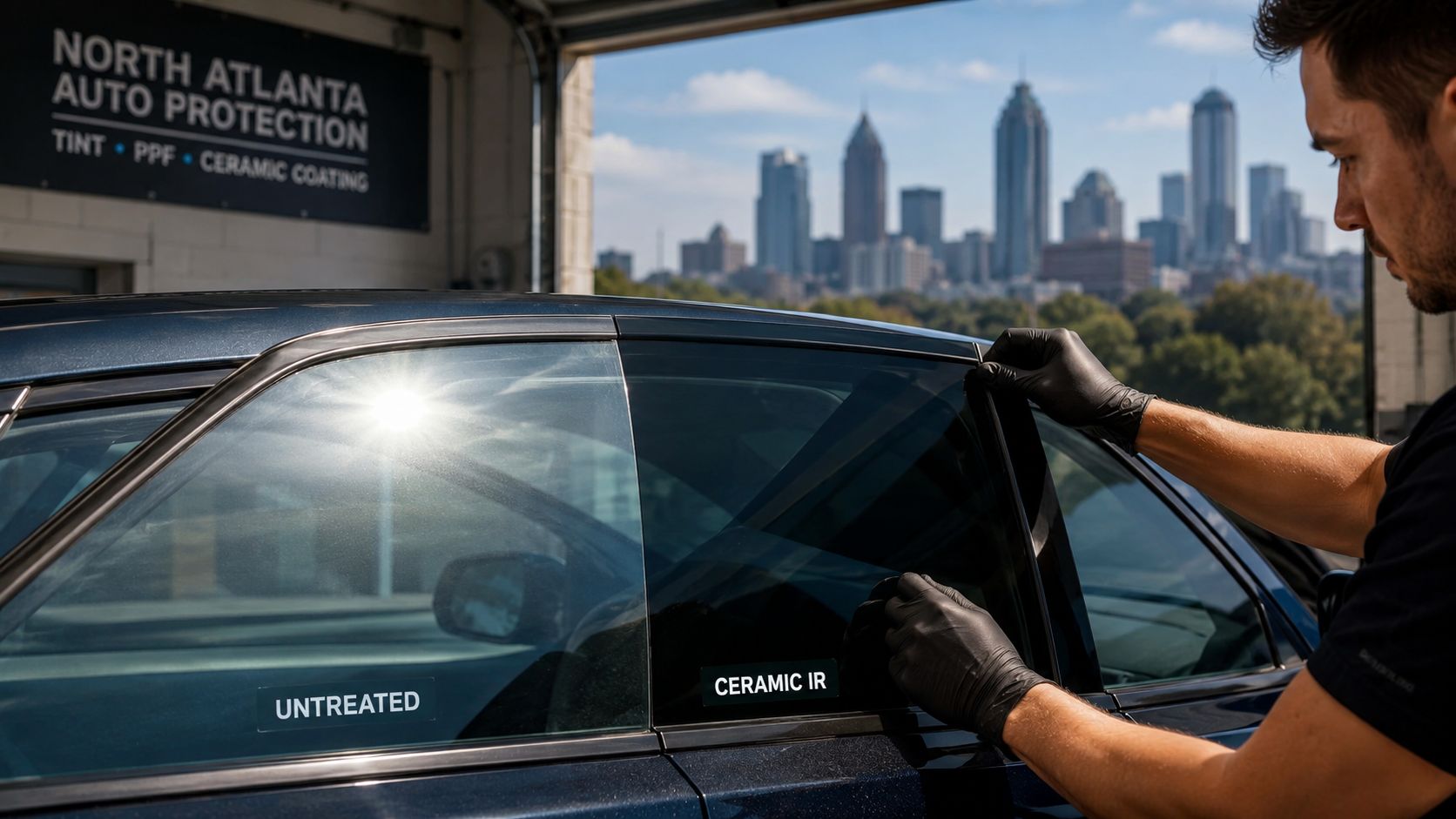
A lot of drivers around Woodstock, Georgia, Kennesaw, Georgia, and Canton, Georgia start looking into tint after the same kind of day. You leave work, your car has been sitting in a parking lot, the steering wheel is hot, the seats feel worse, the sun is blasting through the side glass on the drive home, and your AC has to fight the cabin the whole way.
That's usually when car owners stop thinking of tint as a styling add-on and start treating it like what it really is. A comfort and protection upgrade that changes how the vehicle feels every day.
In North Metro Atlanta, that matters. Summer heat, bright afternoon glare, and constant sun exposure wear on both the driver and the interior. A professionally installed window film helps control all three when it's matched to the vehicle, installed cleanly, and kept legal for Georgia roads.
Why Your Car Needs More Than Just Glass
Glass lets you see. It also lets in heat, glare, and UV exposure that make a daily commute harder than it needs to be.
If you drive from Canton down through Woodstock, or cut across Kennesaw in late afternoon traffic, you already know the worst moments. The sun sits low enough to hit your eyes, the cabin keeps building heat at every red light, and anything left inside the vehicle feels like it's baking. Factory glass doesn't do enough to manage that on its own.
What drivers notice first
A common initial observation after quality tint is simple. The car feels calmer.
Not darker in a sketchy way. Not closed off. Just more controlled. The cabin takes less abuse from direct sun, bright reflections don't hit as hard, and the interior doesn't feel exposed every time the vehicle is parked outside a store or office.
Practical rule: If your car is uncomfortable before the AC catches up, your glass is part of the problem.
That's why professionally installed film makes sense for commuters, parents hauling kids around Cherokee and Cobb County, truck owners, Tesla drivers, and anyone who parks outside for long stretches. The right film helps the car hold comfort better and protects the surfaces you paid for.
More than appearance
Tint still changes the look of a vehicle, and that matters to plenty of owners. But its main value is functional.
- Heat control: The cabin gets less overwhelmed by direct solar load.
- Glare reduction: Sunrise and sunset driving become less fatiguing.
- UV protection: Seats, trim, screens, and skin all get a layer of defense.
- Privacy: Bags, tools, and personal items aren't on full display.
For drivers in Woodstock, Kennesaw, and Canton, that combination is why tint stays popular year after year. Good film doesn't just make a car look finished. It makes the car easier to live with.
The Real Benefits of Professional Car Tint
A cheap film can make a window darker. A well-chosen, professionally installed film changes how the whole vehicle performs in daily use.
That difference shows up on the first hot day, the first sunrise commute, and the first time you realize the car isn't punishing you after sitting in a lot for a few hours.
Heat reduction that actually matters
Heat control is the main reason most North Atlanta drivers ask about tint. They're not chasing a cosmetic change. They want the cabin to stop turning into an oven.
Professionally installed nano-ceramic window film such as the C70-2mil variant reaches 44% Total Solar Energy Rejection and 70% Visible Light Transmission, while also delivering 99% or greater UV rejection, according to TeckWrap's C70 ceramic film specifications. That matters because you can keep a lighter, cleaner look on the glass and still cut down the heat load pushing into the cabin.
Less solar energy entering the vehicle means your AC doesn't have to fight as hard to make the car livable. In real driving, that shows up as faster comfort and less punishment during stop-and-go traffic.
UV protection for people and interiors
I tell drivers to think of tint as sunscreen for the cabin.
UV exposure doesn't just hit your skin. It works on dashboards, leather, vinyl, trim, and electronics every day. Over time, interiors fade, dry out, and lose that fresh look that owners spend money trying to preserve.
Premium automotive films are built to block UV while keeping visibility usable. That's one of the strongest reasons to tint a newer car early instead of waiting until the interior already shows wear.
The best time to protect an interior is before the first long summer does its damage.
Safer visibility in harsh light
Glare is easy to underestimate until you drive into it every day. Bright late-afternoon sun through the side glass, intense reflections off nearby cars, and washed-out conditions on open roads all make driving more tiring.
Quality tint helps by softening that harsh light so your eyes don't stay strained. That's a comfort benefit, but it's also a practical safety benefit. Drivers can stay more relaxed and focused when the glass isn't amplifying brightness.
Privacy without the cheap look
Privacy matters for normal reasons. You leave a backpack in the back seat. You've got tools in the truck. You don't want every person in a parking lot seeing exactly what's in the vehicle.
Professional installation helps here because the film sits clean and even. No purple cast, no obvious contamination, no peeling corners that make the whole car look neglected.
A good tint job gives you:
- Day-to-day discretion: Valuables are less visible from outside.
- A more comfortable cabin feel: Passengers don't feel exposed at every stoplight.
- A finished appearance: The vehicle looks intentional, not patched together.
That's the difference between buying film and investing in the right solution for your car in Woodstock, Kennesaw, or Canton.
Choosing Your Armor The Different Types of Window Film
Not all tint is built the same. Two cars can look similar from ten feet away and perform very differently in Georgia heat.
When people compare quotes, they often focus on shade first. That's understandable, but shade alone doesn't tell you how the film handles heat, glare, clarity, fading, or long-term durability. The core of the decision is film construction.
The main film categories

Here's the practical breakdown most drivers need:
| Film type | What it does well | Common trade-off |
|---|---|---|
| Dyed film | Improves appearance and cuts some glare | Lower heat performance and shorter useful life |
| Carbon film | Better color stability, cleaner finish | Stronger than dyed, but still not top-tier heat rejection |
| Ceramic film | Excellent heat control, strong clarity, no signal interference | Higher upfront cost |
| Metallic film | Good solar control | Can interfere with electronics and connectivity |
If you want a broader primer on materials and use cases, this window film guide on types and benefits is a useful starting point.
Why ceramic sits at the top
Ceramic is the premium choice because the technology works differently from basic dyed film. According to Ceramic Pro's explanation of ceramic tint vs regular tint, ceramic window film uses ceramic particles that refract infrared rays in different directions so that heat is kept from entering the cabin. That's why premium products such as KAVACA Ceramic IR can block up to 96% of infrared heat and 99% of UVA/UVB radiation.
For drivers in Woodstock, Kennesaw, and Canton, that difference is noticeable in real traffic. The car doesn't load up with heat as aggressively, and the film keeps doing its job without the dyed-film look that can age poorly.
Ceramic also avoids a big problem found with some metal-based films. Signal interference. On modern vehicles with GPS, phones, Bluetooth, and connected systems, that matters.
Nano-ceramic for modern vehicles
Nano-ceramic film pushes the same idea further. The goal is strong heat rejection without making the glass overly dark or reflective.
That makes it a strong fit for daily commuters, newer SUVs, work trucks, and vehicles with a lot of onboard tech. If you drive a Tesla or another electronics-heavy vehicle around North Metro Atlanta, this category usually makes the most sense because it protects comfort without creating connectivity headaches.
Ceramic tint costs more because it performs more. That's the trade-off, and for many drivers in North Atlanta, it's the right one.
Where dyed and carbon still fit
Not every car needs the most expensive film on the menu.
Dyed film can still make sense when the goal is a cleaner appearance and basic glare reduction on an older vehicle or a tighter budget. Carbon is a good middle ground for drivers who want something better-looking and more stable than entry-level film without stepping all the way into premium ceramic pricing.
The mistake is expecting dyed film to behave like ceramic in a Georgia summer. It won't.
A quick note on PPF
Some car owners also ask about Paint Protection Film, or PPF, during the same visit. That's a different product entirely. PPF protects painted surfaces from physical damage like road rash and rock chips. Window film protects the glass area from solar load, glare, UV exposure, and visibility issues.
Both have a place. They just solve different problems.
DIY Kits vs Professional Installation
Saturday afternoon in Woodstock, a DIY kit looks like a money-saver. By Monday morning, the rear glass has dust under the film, the top edge is already lifting, and the glare is still there every time the sun hits I-575.
I see that pattern a lot with cars that come into the shop from Canton, Kennesaw, and Woodstock after a first attempt at home. The problem usually is not effort. It is the setup, the tools, and the learning curve on vehicle glass that is less forgiving than it looks.
Where DIY usually goes wrong
Flat house glass is one thing. Automotive glass is different.
Rear windows on many sedans and SUVs need heat shrinking to match the curve without leaving fingers or distortion. Side glass sits tight against seals and trim. A small trimming mistake can leave a light gap, catch the seal, or start peeling early. On newer vehicles, there is also less room for sloppy knife work around defrosters, antennas, sensors, and interior panels.

Common DIY problems show up fast in direct sun:
- Contamination under the film: Dust, lint, and hair get trapped in the adhesive.
- Poor edge alignment: The cut sits unevenly or starts lifting near the border.
- Optical distortion: Bad shrinking leaves waviness or fingers in the film.
- Shade mistakes: The film chosen does not line up with Georgia tint limits.
North Metro Atlanta makes those flaws easier to spot. Bright sun, long commutes, and hot parking lots put weak installs under stress quickly.
What a professional install changes
A professional install changes the conditions and the outcome. The bay is controlled. The glass is cleaned for film, not just wiped down. The installer knows how a specific film behaves on a curved back window, how much heat it will take, and how to seat the edges without overworking the material.
That matters with premium film. Ceramic and nano-ceramic products cost more, and they are not forgiving if they are mishandled during shrinking or trimming. A bad install can waste a good product.
It also matters over time. As noted earlier, professionally installed film generally lasts much longer than bargain material put on in poor conditions. Longevity comes from prep, pattern accuracy, edge finishing, and curing discipline more than from the box the film came in.
Clean work holds up. Most failures start at the edges, in contamination, or in glass that was never prepped well enough.
Making the Choice
Here is the practical way to look at it.
- DIY fits a low-stakes car or a trial run. If you are working on an older vehicle and can live with redoing it, a kit may be acceptable.
- Professional installation fits a vehicle you plan to keep. The car looks better, the film performs the way it was designed to, and you are less likely to pay twice.
- Professional shops help you avoid legal and product mistakes. That matters in Georgia, where shade selection and windshield rules are specific.
One factual example is The Tint Guy's vehicle-specific window tint installation process, which centers on fit, prep, and controlled application instead of off-the-shelf kit handling.
Film quality matters. Installation quality decides whether you receive the comfort, appearance, and service life you paid for.
What to Expect From Your Tint Appointment
Most customers haven't watched a tint job from start to finish, so they fill in the blanks themselves. That's where bad assumptions come from. If you know what happens during a proper appointment, it's easier to judge the work and easier to care for the film afterward.
Early in the process, the job is less about applying film and more about preparing the glass. Any contamination left behind gets trapped forever.

Step one and two
The appointment starts with vehicle check-in and film confirmation. The installer verifies the shade, confirms what windows are being tinted, and checks the condition of the glass, seals, and any old adhesive or existing film.
Then comes cleaning. Not casual cleaning. Detailed prep with glass-safe tools, slip solution, and close attention to the edges where contamination likes to hide. On many vehicles, that prep work is what separates a sharp result from one that looks dirty from day one.
For a visual overview of how shops handle scheduling and installation flow, this automobile window tinting process explanation gives a useful look at the service sequence.
Film cutting and application
On many vehicles, the film is plotter-cut or otherwise patterned for precision before final install. That helps the installer match the glass shape cleanly and reduce the risk of rough hand cuts near trim and seals.
Application itself is a controlled process. The liner comes off, the adhesive side is managed carefully, the film is positioned on wet glass, and then the technician works out moisture and air with a squeegee sequence that sets the film flat without contamination or distortion.
This walk-through helps show what that looks like in practice:
The edge gap people worry about
One thing that throws customers off is the small edge gap on some installs. They see a thin line near the perimeter and assume the film was cut short.
That's not always a mistake. As noted in this WindowTint community discussion about questions to ask an installer, precut film often leaves a 1mm gap from the window edges, and that gap is typically a cost-saving and time-saving method, not a defect. It's one of those details installers should explain more often because customers frequently misread it as poor workmanship.
If the edge is clean, even, and intentional, a slight gap can be normal. Random jagged trimming is the real problem.
Aftercare and curing
When the film is on, the job still isn't finished. The adhesive needs time to settle.
That's why shops give you the no-roll-down rule for the first part of the curing period. You may also see a little haziness or small water pockets at first. That can be normal while the film dries out, as long as the install itself is clean and the defects aren't contamination or creasing.
At pickup, a proper shop should walk you through:
- When you can roll the windows down
- What the film may look like during curing
- How to clean it later
- What's covered under warranty
That final conversation matters as much as the installation itself.
Staying Legal Your Guide to Georgia Tint Laws
You leave a shop with a darker front window setup, drive through Woodstock for a week, and then get pulled over because the meter says your front doors are too dark. At that point, the installer is gone from the conversation. The ticket, the rework, and the wasted money are yours.
That is why legal tint is part of the job, not a side note.
For drivers in Woodstock, Kennesaw, and Canton, the number that matters most is the front side window limit. Georgia requires front side windows to measure 32% VLT, with a 3% tolerance. A reading of 29% can still pass. If you want the full breakdown, see this guide to the legal tint limit in Georgia.

The rules that matter most
Three areas cause the most problems in the shop.
- Front side windows: They must stay within Georgia's legal VLT range. This is the one customers ask about most because it affects daily driving and traffic stops.
- Windshield strip: Non-reflective film is generally limited to the top portion above the AS-1 line or the top six inches, depending on the glass marking.
- Reflectivity and color: Georgia restricts highly reflective film and banned looks such as mirrored finishes and certain colors. Georgia window tint law details from Glasstiger Tinting outline those restrictions.
What trips car owners up
The first mistake is choosing tint by appearance alone. A shade that looks clean on a friend's truck in Canton may meter differently on your car once factory glass is part of the equation. Film does not go on clear air. It goes on glass that already has its own light transmission.
The second mistake is assuming every shop will stop a bad decision. Good shops will. Others will install what you ask for and leave you to deal with the result.
A meter matters more than a guess.
That is especially true around North Metro Atlanta, where drivers spend plenty of time on busy roads between Kennesaw, Woodstock, and Canton. If you want privacy, heat reduction, and a clean look without legal headaches, the smart move is to choose a setup that performs well and still stays inside Georgia law.
Cost Warranty and Long-Term Care
Price matters, but with automotive tint, the better question is what you're paying for. Film type, vehicle shape, number of windows, and installation quality all affect cost. Ceramic and nano-ceramic packages typically cost more because they deliver stronger heat rejection, better clarity, and better long-term stability than entry-level options.
Warranty matters just as much. A real warranty should cover defects such as bubbling, peeling, adhesive failure, or abnormal color change. If a shop can't explain the warranty in plain language, that's a warning sign. You should know what's covered, what isn't, and what kind of follow-up support exists if there's a problem later.
How to protect the investment
Once the film is cured, maintenance is simple if you don't get aggressive with it.
- Use ammonia-free cleaner: Harsh chemicals can shorten the life of the film.
- Choose a soft microfiber towel: Rough paper products can mark the surface.
- Don't scrape the film: If something gets on the glass, clean it gently.
- Watch the edges: If you ever see lifting, address it early before dirt gets under the film.
One more practical point that doesn't get discussed enough. Warranty can mean two different things. There's the film warranty, and there can also be your vehicle glass or manufacturer warranty considerations. For home windows, some manufacturers may object to film application, and Film Systems notes that warranty compatibility should be checked before tinting. The automotive context is different, but the lesson still applies. Ask warranty questions before the install, not after.
A professionally installed window film gives you comfort, interior protection, privacy, and a cleaner driving experience. For drivers in Woodstock, Kennesaw, and Canton, it's one of the few upgrades you notice every single day.
If you're comparing options for your vehicle in North Metro Atlanta, The Tint Guy is a practical place to start. They focus on automotive tinting for cars, trucks, SUVs, vans, Teslas, and other vehicles, with local relevance for drivers in Woodstock, Kennesaw, and Canton who want legal, professionally installed film that improves comfort, reduces glare, and helps protect the interior over the long term.