
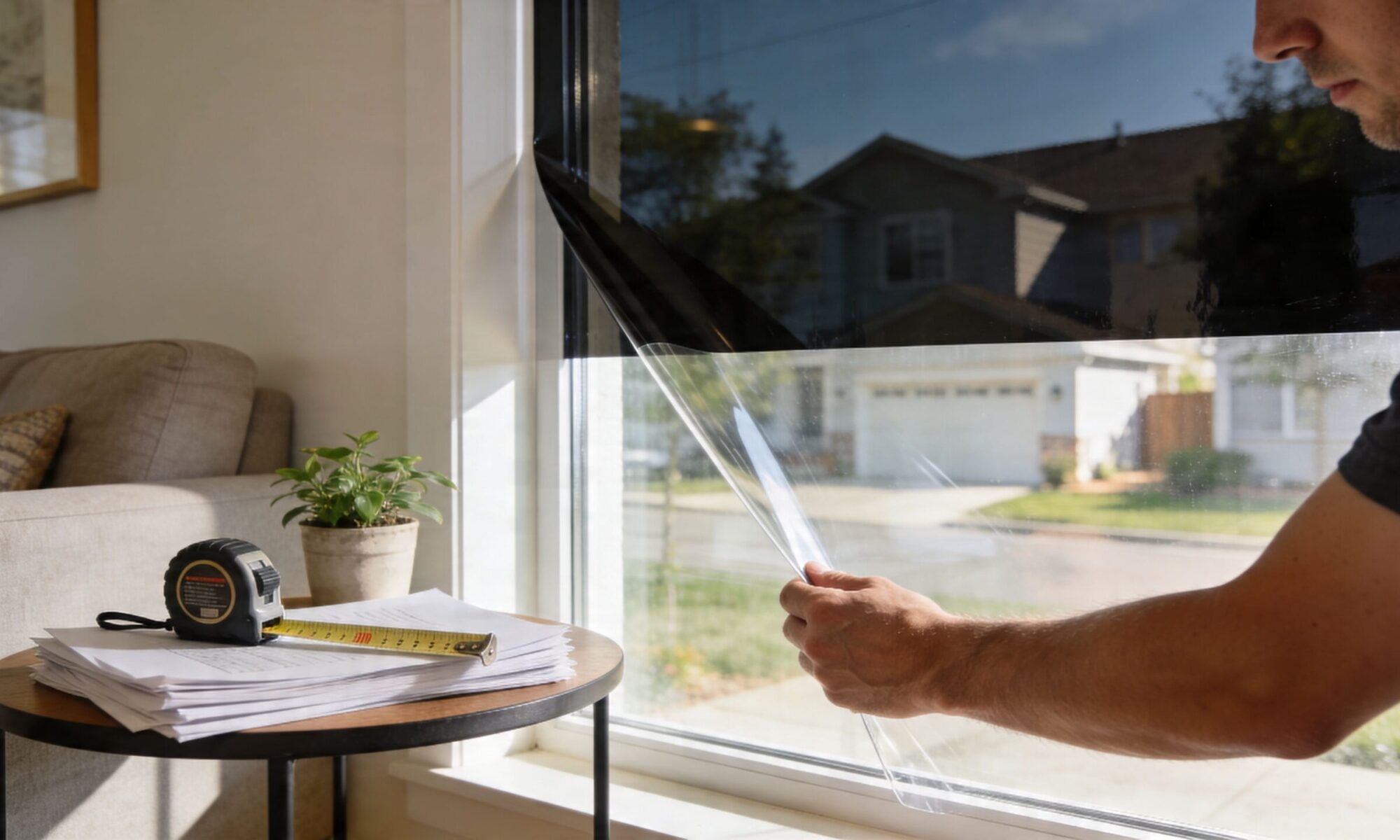
If you're in Kennesaw, Woodstock, Acworth, or Marietta, you probably already know which rooms get hit hardest. The west-facing living room turns bright and hot by late afternoon. The upstairs bedroom holds heat long after sunset. The TV catches glare. The hardwood near the big windows starts looking tired before the rest of the room does.
That’s usually when homeowners start searching residential window tinting cost. They want a number, but the better question is what you’re paying for. Some films are built mainly for appearance and privacy. Others are made to cut heat, reduce glare, block UV, and hold up for years in Georgia sun.
In North Metro Atlanta, that difference matters. A home in Woodstock with large rear windows and strong afternoon exposure has very different needs than a shaded ranch in Canton. The price should reflect that. So should the film choice.
Tired of Georgia Heat in Your Home? Window Tinting Can Help
A lot of homeowners call after trying everything else first. They’ve closed blinds, moved furniture, added blackout curtains, and adjusted the thermostat. The room is still hot. The glare is still there. The AC still runs longer than it should.

Window film helps because it addresses the glass itself. Instead of reacting to the heat after it enters the room, the film is designed to reduce how much solar energy comes through the window in the first place. That changes comfort, glare, and privacy all at once.
What homeowners usually notice first
In homes around Kennesaw and Woodstock, the first complaints are usually practical:
- Hot spots by windows that make a sofa, breakfast nook, or upstairs office uncomfortable
- Screen glare on TVs, tablets, and computer monitors during the brightest part of the day
- Fading concerns for flooring, rugs, furniture, and artwork near direct sun
- Lack of daytime privacy on front-facing windows or large street-side glass
Some people also start with broader comfort fixes. If you're trying multiple approaches at once, this guide on how to cool a room without AC is a useful companion resource. It covers practical room-cooling strategies that pair well with window film.
Why this matters in North Atlanta homes
Georgia homes often have beautiful natural light, but big glass areas come with trade-offs. Two-story foyers, oversized rear windows, sunrooms, and upstairs bedrooms all look great when the house is being built. Later, those same windows can become the source of heat gain and glare that never really goes away.
Practical rule: If one room in your home feels consistently hotter than the rest, the glass is usually part of the problem.
Residential tinting isn't just about darkening windows. The right film can keep the room brighter than heavy curtains would, while still making it more usable during the hottest part of the day. That’s why homeowners who come in asking about house film often end up asking about ceramic window tint for their vehicles too. The goal is the same in both cases. Less heat, less glare, more comfort.
How Residential Window Tinting Cost Is Calculated
Most professional quotes are built the same basic way. The installer measures the glass, factors in the film type, and then adjusts for labor based on access and complexity. It works a lot like flooring or paint. The final number depends less on the house size itself and more on the amount and type of glass being covered.
According to HomeAdvisor’s residential window tinting cost guide, the average cost for residential window tinting in the United States ranges from $316 to $941 per typical home, with a national average of $612 including materials and professional installation. The same source notes that per-window costs average $30 to $114 for a 6 square foot pane.
Per square foot is the main pricing model
Most installers price home window film by square footage of glass. That’s the cleanest way to quote because it accounts for window size, not just the window count. Ten small panes and ten oversized picture windows are completely different jobs.
The basic measurement is simple:
- Measure width
- Measure height
- Multiply them
- Convert to square feet
That’s why a professional quote starts with glass measurements, not a quick guess from the street.
Per window pricing still shows up
Some homeowners hear a per-window number instead, especially when the windows are standard sizes and easy to count. That can be helpful for rough budgeting, but it has limits. A single “window” might mean a small bathroom pane, a tall foyer window, or a large rear-facing panel in a living room.
Per-window pricing works best when:
- The windows are uniform and mostly standard sized
- The home has straightforward access with no ladders or specialty fabrication
- The film choice is already narrowed down to a specific product level
If the house has mixed glass sizes, half-moons, transoms, or large decorative sections, square-foot pricing is usually more accurate.
Why two homes with similar square footage can price differently
A 2,000 square foot house doesn’t automatically cost more to tint than a 1,600 square foot house. A smaller home with more glass, taller glass, or harder access can come in higher.
Key quote variables usually include:
- Total glass area rather than total living area
- Film selection and whether you're choosing a standard, carbon, or ceramic product
- Installation difficulty on upper-story windows, skylights, or custom shapes
- Condition of the glass if old adhesive, residue, or previous film has to be dealt with
For homeowners who want a rough local budgeting reference before booking an estimate, a window tinting price guide can help you understand how installers usually structure quotes. It won’t replace measuring the glass in person, but it gives you a clearer frame of reference.
A good quote should tell you what film is being installed, how the glass was measured, and what labor challenges are included. If it doesn’t, it’s hard to compare one proposal to another.
Key Factors That Drive Your Final Price
Once the glass is measured, the primary pricing differences come from the details. Homeowners can then see why one quote is modest and another is much higher, even when both are for the same house. The labor and film choice usually explain most of that gap.
According to Angi’s house window tinting cost article, professional installation ranges from $5 to $20 per square foot, and custom arched or specialty glass like skylights can escalate to $500 to $1,500 per window because of material waste and on-site fabrication.
Film type changes both cost and outcome
The biggest pricing driver is the film itself. Some products are built for a basic privacy or appearance upgrade. Others are built for strong solar control, higher clarity, and longer-term performance.
That difference matters because homeowners sometimes compare two quotes that aren't for the same result. A lower quote may use an entry-level film that looks tinted but doesn’t deliver the same heat reduction as a premium product.
Window access can change labor fast
A ground-floor den with easy access is one thing. A second-story stairwell window, skylight, or tall foyer glass is another.
Installers look at access because it affects setup time, safety, and the precision needed to get clean edges and a clean final finish. In homes around Marietta and Canton, this is common on:
- Two-story foyers
- Large rear-facing living room windows
- Skylights
- Windows above staircases
- High transoms and half-rounds
If ladders, scaffolding, or difficult body positioning are involved, labor goes up for good reason.
Shape matters more than most homeowners expect
Rectangular windows are the simplest. Specialty shapes are where the job slows down.
Arched windows, circles, half-moons, and narrow decorative panes often require careful hand-cutting on site. That increases waste and raises the chance of visible mistakes if the installer rushes. Clean edges on odd-shaped glass are one of the places where professional skill really shows.
The harder a window is to reach or pattern cleanly, the less useful a “cheap per-window” quote becomes.
Existing glass condition can add work
If the glass is dirty from paint overspray, construction debris, hard water spotting, or old adhesive, prep takes longer. Old film is another big variable. Homeowners replacing bubbling, peeling, or purple tint often assume the new install is the only part being priced, but removal can be labor-heavy.
A few common hidden cost drivers:
- Old film removal that leaves adhesive behind
- Windows with divided lites that require more trimming and alignment
- Very large panes where handling and positioning the film takes two people
- Glass near trim or frames in poor condition that requires extra care during install
Why neighborhood style affects the quote
An Acworth ranch with simple double-hung windows is usually a more straightforward install than an older Marietta home with decorative shapes and mixed glass sizes. A newer Woodstock build might have large modern panes that raise material use but still install efficiently. A custom home in East Cobb may have both large format glass and hard-to-reach upper sections.
That’s why the same residential window tinting cost question can have different answers from one street to the next. The smartest way to read a quote is to look beyond the total and ask what made that number. If the installer can explain the glass, film, and labor clearly, the quote usually makes sense.
Comparing Film Types Ceramic vs Carbon and Standard Tints
Most of the confusion around residential window tinting cost comes down to one issue. Homeowners get quoted different films and assume they’re being quoted the same product. They’re not.
Choices typically include standard dyed film, carbon film, and ceramic film. Each has a place. Each solves a different problem. In North Atlanta, where heat reduction matters more than just appearance, the differences are worth understanding before you sign off on a quote.

What standard dyed film does well
Dyed film is usually the entry point. It changes the look of the glass, adds privacy, and helps with basic glare control. For some rooms, that’s enough.
According to Green Film USA’s home window tinting cost guide, basic dyed films cost $2 to $5 per square foot and offer 35 to 45 percent Total Solar Energy Rejected, while premium ceramic films cost $8 to $12 per square foot and use nano-ceramics to block over 90 percent of infrared heat, reducing cooling costs by 25 to 40 percent in hot climates.
The trade-off with dyed film is simple. It’s usually the lower-cost option, but it isn’t the strongest performer for Georgia heat.
Where carbon fits
Carbon film sits in the middle. It’s a step up from dyed film for homeowners who want better heat rejection and a more refined appearance without jumping straight to ceramic. It also avoids the basic look that some lower-end films can have over time.
Carbon tends to make sense when the homeowner wants:
- Better heat control than entry-level film
- A non-reflective finish that looks clean from both inside and outside
- A stronger long-term value than basic dyed products
For many homes, carbon is the practical middle ground.
Why ceramic gets recommended so often in Georgia
Ceramic film is the premium choice because it’s built for performance, not just appearance. It’s what I’d point most homeowners toward when the main complaint is heat, glare, or a room that gets blasted all afternoon.
Ceramic window tint usually makes the most sense for:
- Large sun-facing living room windows
- Upstairs bedrooms that stay warmer than the rest of the house
- Home offices with screen glare
- Homes where the owners want high clarity, not a dark look
- People planning to stay in the house and want the stronger long-term payoff
Field advice: If your goal is serious heat reduction, skipping ceramic to save money upfront often means paying for a second solution later.
Side-by-side comparison
| Film Type | Cost per Sq. Ft. (Installed) | Heat Rejection | UV Protection | Lifespan |
|---|---|---|---|---|
| Dyed | $2 to $5 | 35 to 45% TSER | Basic UV protection | Standard |
| Carbon | Qualitatively mid-range | Better than dyed | Stronger than dyed | Longer-lasting than basic |
| Ceramic | $8 to $12 | Blocks over 90% of infrared heat | Premium UV protection | Premium |
The chart makes the core point. A lower film price doesn't always mean better value. If the room still feels hot, the project didn’t solve the actual problem.
What works and what doesn’t
What works is matching the film to the room and to the homeowner’s goals.
A shaded bedroom that mainly needs privacy may do fine with a more basic film. A west-facing family room in Woodstock with wide glass and constant afternoon sun usually won’t. That room needs a product chosen for solar control, not just tint shade.
What doesn’t work is buying based on darkness alone. A darker film isn't automatically the better heat reduction tint. In both homes and vehicles, that’s one of the most common misconceptions. The same principle shows up in car window tinting, windshield tint discussions, and ceramic tint upgrades. Performance depends on the film technology, not just how dark it looks.
If you want a more technical breakdown of the material differences, this guide to window film types and benefits is a good next step. It helps homeowners compare what each film is designed to do.
Calculating Your ROI Energy Savings and Home Protection in Georgia
Home window film makes the most sense when you stop treating it like a cosmetic upgrade and start looking at it as an efficiency upgrade. In Georgia, that’s the right lens. Most homeowners aren't calling because they want darker glass. They're calling because one side of the house runs hot and the cooling bill keeps climbing.

For local budgeting, the most useful data point is from HomeGuide’s cost analysis for home window tinting. It states that for North Metro Atlanta homes, ceramic tints blocking 65%+ of infrared heat can cut AC costs by 20 to 30% annually, yielding a payback in 2 to 4 years. The same source gives a practical scenario: a $4,000 project on a 2,000 sq ft home could save $500 to $750 per year on energy bills at 2026 Georgia utility rates.
Why premium film often pays back faster than expected
The sticker shock usually comes from ceramic film. The performance payoff is what changes the conversation.
In North Metro Atlanta, the math often favors the better film because the cooling demand is real for a long stretch of the year. A cheaper product may reduce glare and help appearance, but if your main pain point is heat, the stronger film has a better chance of changing how the room feels every day.
A practical way to think about ROI:
- Comfort savings show up immediately in rooms that become usable again in late afternoon
- Energy savings build over time as the AC doesn’t have to fight as much solar load
- Interior protection matters if you have hardwood, rugs, leather, artwork, or furniture near direct sun
- Long-term ownership makes premium film easier to justify than short-term ownership does
If the room is still hot after the install, the lower upfront cost wasn’t really savings.
Interior protection is part of the return
Homeowners often focus on HVAC savings and forget the second half of the value. Sun damage is expensive, and it’s slow enough that people often don’t notice it until the floor, furniture, or fabrics no longer match the rest of the room.
That’s one reason window film is often paired with broader efficiency planning. If you’re looking at several ways to reduce electricity bills, glass performance deserves a spot on the list, especially in rooms with strong solar exposure.
A real-world decision framework for Georgia homes
If you’re trying to decide whether the upgrade is worth it, ask these questions:
Which rooms are uncomfortable now
If the same spaces stay too bright or too warm, the glass is affecting daily use of the home.How long do you plan to stay
The longer you’ll be in the house, the easier it is to justify a higher-performing film.What are you protecting
Expensive flooring and furniture near large windows raise the value of UV protection.
A quick visual example helps if you're comparing comfort improvements with energy strategy over time:
The main point is straightforward. In Georgia, premium residential film often performs less like an accessory and more like a targeted fix for heat-heavy glass.
Getting Local Quotes What to Expect in North Metro Atlanta
Local quotes make more sense when you know what the installer is really evaluating. In Kennesaw, Woodstock, Canton, and nearby areas, the number changes based on the glass, the exposure, and the film selected. Two neighboring homes can land in different ranges for completely valid reasons.
The most useful quote isn’t the cheapest one. It’s the one that tells you exactly what’s being installed and why that film fits the house.
What a solid quote should include
A professional estimate should be specific enough that you can compare it line by line. If the proposal is vague, you’re left guessing whether the lower price comes from lower-grade film, less prep, or excluded labor.
Look for these items:
- Film identification so you know whether you're comparing ceramic, carbon, or standard film
- Glass count and measurements instead of a rough lump-sum number
- Access notes for skylights, upper-story windows, or specialty shapes
- Warranty details that explain what is covered if the film fails
- Scope clarity on whether old tint removal or replacement is part of the job
How local housing styles affect your quote
North Metro Atlanta gives installers a wide mix of homes. That’s why broad online estimates only get you so far.
A few common local patterns:
- Acworth ranch homes often have simpler access and more standard window sizes
- Marietta homes can include older custom shapes, divided panes, and trim details that slow the install
- Woodstock and Canton newer builds may have larger modern windows that increase total glass area even if the layout is straightforward
Those differences matter because labor isn't just about time. It’s also about precision, setup, and the likelihood of waste on custom cuts.
Don’t ignore replacement work
A surprising number of local residential jobs start with old film. It may be peeling, hazy, bubbling, or outdated. That changes the quote because tint replacement includes both removal and reinstallation.
This is also where homeowners often ask about their vehicles. The same people replacing failed house film are frequently dealing with old car window tinting, windshield tint strip issues, or needing tint removal before a ceramic upgrade on a truck or SUV. The buying questions are similar in both settings. What lasts, what cuts heat, and what’s worth doing once instead of twice.
A quote that clearly separates installation from tint removal gives you a much better picture of true project cost.
If you want a starting point before scheduling an onsite visit, home window film installation details can help you see how residential projects are typically evaluated in this market.
Your Top Window Tinting Questions Answered
Most homeowners narrow down the film choice before they feel ready to book. Then the practical questions come up. How long will it last, how do you clean it, what happens if you already have old tint on the glass, and what about legal tint limits in Georgia?

According to Total Protection Films’ window tinting statistics page, window tinting can provide up to a 30% reduction in energy costs, and premium films offer longevity of 15 to 20 years compared with 5 to 10 years for basic films. That’s one reason long-term homeowners often lean toward better film instead of choosing the lowest upfront option.
How long does residential window tint last
It depends on the film quality, sun exposure, and installation quality. In practical terms, premium films are built for a much longer service life than basic films. That matters in Georgia because hard sun exposure puts cheap products under stress faster.
If longevity is one of your main concerns, ask what specific film line is being installed and how the warranty is written. “Tint” by itself doesn’t tell you enough.
How should you clean tinted home windows
Keep it simple. Use a soft microfiber cloth and a cleaner that won’t scratch or damage the film. Avoid abrasive pads, razor blades, and harsh scrubbing around the edges.
Good maintenance is straightforward:
- Use soft materials so you don’t create fine scratches
- Clean gently near edges where aggressive scrubbing can cause problems over time
- Skip harsh tools that are fine for bare glass but not for filmed glass
What are the legal tint limits in Georgia
For homes, there isn’t a vehicle-style VLT rule that homeowners are usually dealing with in the same way. The phrase legal tint limits Georgia almost always applies to auto glass, not residential windows.
That’s where shop experience matters. If you’re also researching car window tinting, auto tint installation, windshield tint, or the best window tint for cars, make sure the installer understands Georgia vehicle compliance as well as heat reduction and visibility. Home and auto tint aren’t the same application, but the product knowledge overlaps. Ceramic film, glare reduction tint, UV protection tint, tint replacement, and tint removal all depend on choosing the right material for the right glass.
What happens during tint removal and replacement
Old film has to come off cleanly before new film goes on. If the existing tint is bubbling, turning purple, peeling, or leaving adhesive behind, the installer will usually remove the old layer, clean the glass thoroughly, and then install the replacement film on a clean surface.
That process matters. Installing over failed film or leftover adhesive is asking for visible defects and early failure.
Old bubbling tint is rarely just an appearance problem. It usually means the film has reached the end of its useful life and needs proper removal before replacement.
A lot of homeowners in North Atlanta want one place that can handle both home and vehicle film questions. The Tint Guy provides residential window film installation along with auto tinting, which is useful if you're comparing ceramic options for the house and a daily driver at the same time.
If you're pricing out residential window tinting cost in Kennesaw, Woodstock, Acworth, Marietta, or Canton, get a quote that matches the actual glass, sun exposure, and performance you want. A well-built estimate saves a lot of confusion. For homeowners who want help choosing the right film for heat reduction, glare control, UV protection, or replacing old bubbling tint, contact The Tint Guy for a local consultation.