
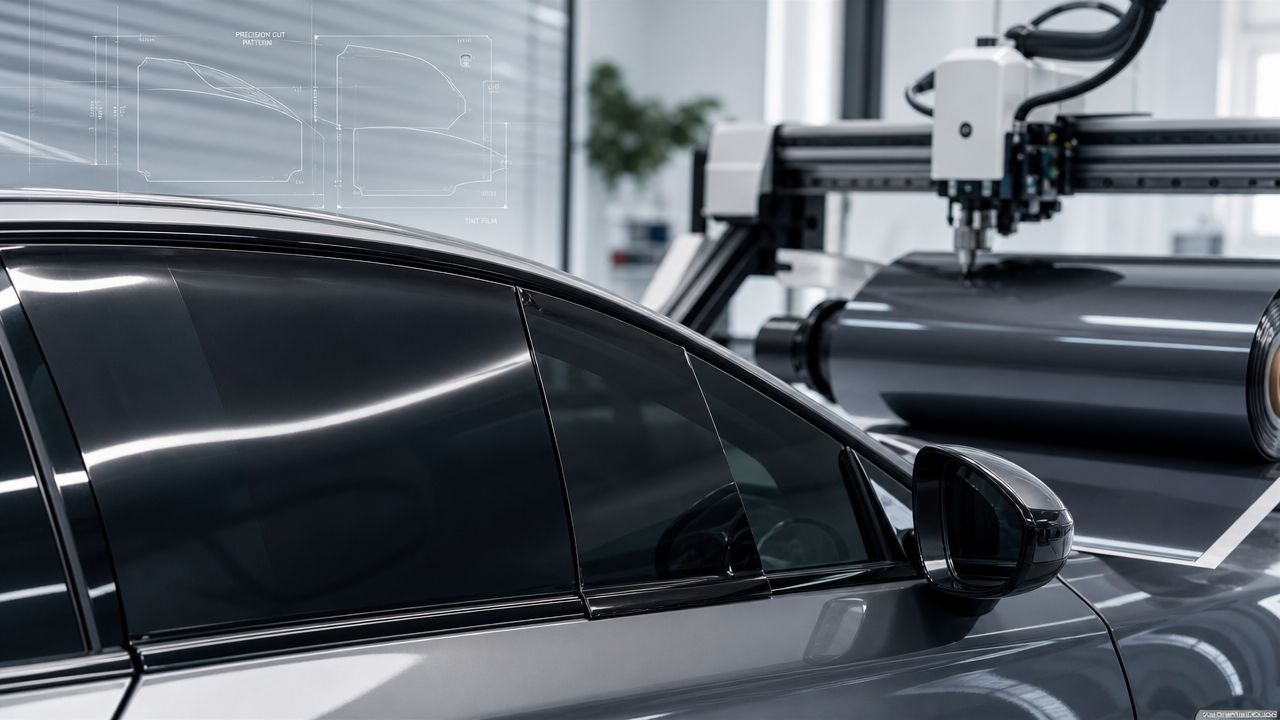
You're probably in the same spot most drivers are when they start looking into tint. You want the car to look cleaner, stay cooler, and feel finished, but you don't want crooked edges, peeling corners, or that hacked-together look that shows up a month later. Around Woodstock, Kennesaw, and Canton, that concern is real because heat exposes every weakness in an install.
A lot of people focus on film brand first. That matters. But the part many owners miss is this: premium film only performs like premium film when the cut is right. If the edge fit is off, the window tint computer cut process becomes the difference between a job that lasts and one that starts lifting, bubbling, or needing warranty attention long before it should.
The Secret to a Flawless Factory-Finish Tint Job
A driver brings in a newer SUV, a Tesla, or a daily commuter they've finally decided to upgrade. They've seen good tint before. They've also seen the bad version. Light gaps at the top edge. Rough corners. Film trimmed a little too aggressively on one side and a little too tight on the other. What they usually ask is simple: how do some tint jobs look like they came on the vehicle from the factory?
The answer usually starts before the film ever touches the glass. Shops that chase a factory-finish result don't rely on eyeballing patterns window by window. They use computer-cut window tint so every piece starts with the correct shape for that exact vehicle.
In practical terms, that means the install begins with a digital pattern instead of a knife on your glass. The film is cut to the vehicle's window shape before installation, which makes the finished result cleaner and more repeatable. That matters even more on modern vehicles with tighter seals, frameless glass, and complex rear windows.
What drivers notice first
Most car owners don't talk in installer language. They notice three things:
- Edge quality: The top line looks even when the glass is up.
- Consistency: Left and right sides match.
- No obvious trimming mistakes: Nothing looks hand-corrected after the fact.
Those details are what separate a decent tint job from one that still looks right years later.
Practical rule: If the cut is inconsistent, the install can only be corrected so much during application. Good installation starts with a good pattern.
For drivers in Woodstock, Kennesaw, and Canton, that's why computer-cutting has become the standard expectation on premium automotive tint work. It doesn't just help with appearance. It supports cleaner installs across Teslas, trucks, vans, and daily drivers where each window shape has its own quirks.
That connection between precision and long-term durability is where this topic gets more interesting, especially for ceramic and nano-ceramic films in Georgia heat.
What Is Computer-Cut Window Tint
Imagine a Cricut for cars, or more accurately, a plotter system using automotive tint templates. Instead of laying raw film on the outside of the window and hand-trimming every edge, the installer pulls up a vehicle-specific pattern from a digital library, sends it to the cutter, and the machine cuts the film to shape.
That doesn't remove installer skill. It shifts the skill to pattern selection, machine setup, calibration, and clean application.
How the process works
The workflow is straightforward:
- The installer selects the exact year, make, model, and window set.
- The software sends the pattern to a plotter cutter.
- The cutter trims the film using set blade, speed, and force parameters.
- The installer applies the pre-cut piece to the glass and finishes the edges cleanly.

For drivers comparing film types, it helps to understand the basics of window film types and benefits before you choose shade and material.
Why the machine part matters
Repeatability is an advantage. Computer-cut platforms maintain cut tolerances on complex auto glass ranging from ±0.3 mm to ±0.8 mm, and the mean deviation between the pattern and the cut is less than 1% of the window's longest dimension according to automotive computer-cut pattern system data. On modern cars with narrow edge seals, that level of control helps reduce installation-related defects.
A hand-cut pattern can still come out well in skilled hands. The issue is consistency across every door glass, quarter glass, and rear window. A digital template gives the installer a cleaner starting point every time.
What this means on real vehicles
On a straightforward sedan, the benefit is a neater edge and a faster, more predictable fit. On something more demanding, like a Tesla with tight seals and large fixed glass, the difference is bigger.
- Frameless windows: Pre-cut accuracy helps keep top edges uniform.
- Large rear glass: The pattern needs to track the curve correctly from the start.
- Mixed vehicle types: SUVs, vans, trucks, and coupes all need different pattern logic.
A good computer-cut file doesn't replace technique. It removes guesswork so technique can show up where it matters most, during shaping and installation.
That's the core of window tint computer cut technology. It isn't hype. It's a cleaner production method that gives the installer a more exact film shape before the install starts.
Computer Cut vs Hand Cut Tinting A Precision Showdown
Hand-cut tinting is the older method. The installer places film on the glass, shapes it, then trims to fit. In experienced hands, it can work. Some veteran tinters can do impressive hand work. But for most owners deciding what they want on their own vehicle, the comparison comes down to risk, repeatability, and waste.

Side-by-side differences
| Method | What happens | Main trade-off |
|---|---|---|
| Computer cut | Film is cut from a digital pattern before installation | Requires calibrated software and plotter workflow |
| Hand cut | Film is trimmed manually to the vehicle window | Depends heavily on individual cutting skill every time |
The biggest reason shops moved toward computer-cut systems is efficiency with control. Compared with traditional hand-cutting, computer-cut systems have been shown to reduce installation time by roughly 25 to 40 percent and lower film waste by about 12 to 18 percent per vehicle according to window tint industry statistics on computer-cut workflows.
What owners care about most
If you're evaluating one shop against another, these are the practical differences that matter:
- Glass safety: With computer-cut workflow, the cutting phase happens off the vehicle. That reduces the need to trim directly against the glass during pattern creation.
- Symmetry: Matching side windows is easier when both pieces come from the same digital library.
- Cleaner edges: The installer starts with a shape that already follows the window contour closely.
- Less wasted film: Better patterning usually means fewer recuts.
A lot of people also underestimate the training side. A hand-cut shop depends more heavily on the cutter's personal consistency. A computer-cut workflow gives a shop a more controlled standard from one technician to the next.
Here's a quick visual example of the process in action:
Where hand cutting still shows up
Hand trimming hasn't disappeared. Installers still make minor adjustments when needed, especially around difficult seals or specialty glass. But there's a difference between fine-tuning a precise pattern and building the whole fit from scratch with a blade.
Hand cutting rewards talent. Computer cutting rewards process. For most car owners, process gives the more predictable result.
For drivers in Woodstock, Kennesaw, and Canton, that predictability matters. You don't just want dark glass. You want the finish to look intentional from every angle.
Why Precision Matters for Modern Tints and Vehicles
Ceramic and nano-ceramic films are premium products. They're chosen by drivers who want better heat control, cleaner optics, and a longer-lasting result. But premium film can also be less forgiving when the pattern fit is sloppy, especially at the perimeter where failure usually begins.
That's why precision isn't just about appearance. It's tied directly to durability.

Where failures usually start
Most long-term tint problems don't begin in the center of the glass. They start at the edge.
If a film is cut too tight, too loose, or slightly uneven, the perimeter becomes the weak point. Heat, repeated window movement, seal contact, and cleaning all work against that edge every day. The precision of computer-cut patterns directly impacts long-term durability and warranty outcomes, and independent tests note that perfect edge alignment is a top factor in preventing edge lifting, bubbling, or delamination, especially in high-heat regions according to Rightlook's discussion of computer-cut tinting and longevity.
That matters in North Georgia more than many owners realize. A car parked through long hot days in Woodstock or Kennesaw puts constant thermal stress on film edges.
Why modern vehicles raise the standard
Today's vehicles make precision more important, not less.
- Tesla glass packages: Large curved rear sections and tight edge finishes leave little room for sloppy patterning.
- Frameless door glass: The top edge is easy to inspect every time the door opens.
- SUV and truck rear glass: Bigger surfaces expose any wave or mismatch fast.
- Premium ceramic films: Better film deserves better pattern control.
A clean cut also supports a better-looking warranty outcome. Owners usually think about a warranty as paperwork. In practice, a strong tint warranty is only as useful as the installation quality behind it. If the original fit minimizes stress at the edges, there's less chance of call-backs and fewer reasons to redo work later.
Why Georgia heat changes the conversation
Heat doesn't create every tint problem, but it exposes weak installation faster. In cooler conditions, a mediocre edge can hide for a while. In Georgia, that same edge gets tested quickly.
The closer the film fits the glass without overhanging or crowding the seal, the better chance it has to stay stable over time.
That's the part most articles skip. They talk about computer-cutting as a convenience feature. The core value for many ceramic and nano-ceramic jobs is reliability. If you're paying for premium film, the cut quality should protect that investment, not undermine it.
Understanding Georgia Tint Laws and Computer-Cut Compliance
A clean install isn't enough if the film choice or placement leaves you outside Georgia law. For automotive tinting in Woodstock, Kennesaw, and Canton, one of the most important numbers is Georgia's 32% VLT rear-window legal limit.
The legal side is where precise workflow helps in a less obvious way. It's not just about how dark the film is. It's also about clean edge definition, consistent application, and avoiding a sloppy result that draws the wrong kind of attention.
Why precision helps with compliance
For North Metro Atlanta operators, consistent parameter mapping per film line improves throughput and pattern accuracy while preserving the edge definition needed to meet Georgia's 32% VLT rear-window legal limit where optical precision matters for compliance and aesthetics. In plain language, the better the cut and setup, the more controlled the finished result.
If you want a fuller breakdown of what's allowed on different windows, review this guide to Georgia legal tint limits.
What that looks like in the shop
Compliance is easier when the shop follows a repeatable process:
- Correct vehicle pattern: The tint piece matches the right glass section from the start.
- Consistent film handling: Cleaner installation reduces visual irregularities near the edge.
- Less improvisation: The installer isn't making on-the-fly cutting decisions that can affect finish quality.
- Better uniformity: The overall look is closer from window to window.
This doesn't mean software decides what's legal by itself. The installer still has to choose the right film and apply it correctly. But a computer-cut system helps remove some of the variability that causes avoidable mistakes.
Why owners should care
A legal tint job should still look sharp. Too many people think they have to choose between compliance and appearance. You don't. The right film, paired with precise cutting and proper installation, gives you both.
If the edge looks rough, the whole job looks questionable, even when the film itself is within the law.
For drivers around Canton and Kennesaw, that's one more reason a disciplined window tint computer cut workflow makes sense. It supports a result that looks deliberate, not improvised.
Pricing and Professional Installation in North Georgia
A tint job can look clean on day one and still fail early if the pattern is off by a fraction. In Georgia heat, that small miss shows up fast. The edge starts collecting dust, the film can lift near the top of a roll-down window, and the customer is left wondering why a premium ceramic or nano-ceramic film is already showing problems.
That is why price gaps between shops are not just about the film itself. You are paying for pattern software that matches the exact glass, plotter accuracy, installation discipline, and the experience to set up premium film so it stays stable through heat, window movement, and regular cleaning. For drivers in Woodstock, Kennesaw, and Canton, that matters more than the lowest quote on paper.
What you're really paying for
A professional automotive tint install in North Georgia usually includes several things that affect long-term results:
- Pattern accuracy: The film is cut to the vehicle's glass shape, which helps the edge sit cleaner from the start.
- Less risk during prep: There is less need for trimming directly on the vehicle.
- Better warranty support: Premium films perform better when the install starts with a precise fit and clean edge.
- Consistent results across vehicle types: The same process can be repeated on sedans, trucks, SUVs, vans, and Teslas without guessing.
Drivers comparing quotes can get a clearer sense of the variables in this breakdown of car tint cost factors and pricing.
Where cheap installs usually come apart
Low-price jobs usually follow the same pattern. The film may be fine, but the cut quality and install process are not.
| Low-cost shortcut | What usually goes wrong |
|---|---|
| Universal DIY kit | Edges fall short or overlap in the wrong places |
| Cheap film | Fade, haze, and adhesive issues show up sooner |
| Rushed hand trim | Top edges and corners look uneven |
| Weak process control | More dust, more rework, and more visible flaws |
With ceramic and nano-ceramic film, those mistakes cost more. These films carry a higher material cost, and they are often chosen for heat rejection and long service life. If the edge is cut poorly or the fit is inconsistent, the film is more likely to fail at the margins first. That can affect appearance, durability, and whether the job holds up the way the manufacturer intended under warranty.
Value over sticker price
The practical question is simple. What will the tint look like after two Georgia summers, daily window use, and routine cleaning?
A precise computer-cut pattern gives the installer a better starting point. A careful install turns that into clean edges and fewer stress points. For vehicle owners in North Georgia, that usually means better durability, fewer callbacks, and less chance of paying to strip bad film and install it again.
Get a Perfect Computer-Cut Tint Job in Woodstock and Kennesaw
Drivers shopping for car window tint in Woodstock, ceramic tint in Kennesaw, or a tint shop near Canton usually start with appearance. That's normal. The vehicle should look better when it leaves than when it arrived. But the smarter way to judge the job is to ask what the edge quality will look like after months of heat, window movement, and daily use.
That's where computer-cut tinting earns its place. It gives the installer a precise starting shape. That cleaner fit supports the finish you notice immediately, and the durability you notice later.
What local drivers should look for
If you're comparing shops in Woodstock, Kennesaw, or Canton, focus on these questions:
- Do they use vehicle-specific digital patterns?
- Do they regularly install ceramic and nano-ceramic film on modern vehicles?
- Can they produce consistent edges on frameless glass, SUVs, and large rear windows?
- Do they understand Georgia compliance as part of the install, not as an afterthought?
Those questions matter whether you drive a commuter sedan, a truck, a van, or a Tesla.

The takeaway for Woodstock, Kennesaw, and Canton
Window tint computer cut technology isn't just a shop convenience. It's one of the strongest indicators that the installer is trying to control the result from the first step. For Georgia drivers dealing with heat, glare, and long-term film performance, that matters more than a flashy sales pitch.
If you want car window tint in Woodstock, ceramic tint in Kennesaw, or you're searching for a trusted tint installer near Canton, focus on fit quality, film quality, and whether the process protects the long-term warranty outcome. That combination is what gives you the clean, factory-style look most owners want in the first place.
If you want a quote or want to compare film options for your vehicle, contact The Tint Guy for automotive tinting in Woodstock, Kennesaw, and Canton.