You pull a new car out of the driveway, merge onto I-575 or I-75, and within the first week you hear it. That sharp tick of road debris hitting the front end. Then the bug splatter starts. Then the wash-induced swirls. For drivers in Woodstock, Kennesaw, and Canton, that pattern is familiar fast.
That's why paint protection film matters. On Georgia roads, PPF isn't a vanity upgrade. It's the closest thing you can get to a sacrificial layer for the painted surfaces that take the abuse first. The hood edge, bumper, fenders, mirrors, rocker panels, and headlights all live in the impact zone.
The tricky part is that shoppers often ask for the best PPF film as if it's only a brand decision. It isn't. The film matters, but the final result comes from the combination of film quality, correct coverage, and a clean install done by someone who knows how to wrap edges, manage stretch, and keep the finish visually invisible.
Protecting Your Investment on Georgia Roads
A lot of North Atlanta drivers reach the same point at about the same time. They buy a new truck, SUV, Tesla, or performance car, then realize their normal route includes gravel kicked up by traffic, construction zones, and long highway stretches where the front end gets hammered.
That's where PPF earns its place. A professionally installed system is commonly expected to last 5 to 10 years, and some industry comparisons put leading films at 7 to 10 years under normal use, tied to multilayer construction that often includes about a 6.0 mil polyurethane layer and a 0.5 mil self-healing clearcoat according to Ceramic Pro's breakdown of PPF construction and lifespan.
For a driver in Canton heading down 575 every day, or someone in Kennesaw running I-75 often, that matters because the damage usually doesn't come from one major hit. It comes from repeated small impacts that slowly rough up the front of the vehicle.
Here's the practical truth. PPF won't make a car invincible, but it does put a durable, replaceable barrier between the paint and the road. For insights into real-world chip defense, this guide on whether PPF prevents rock chips is worth reading before you choose coverage.
Shop-floor reality: Most regret comes from waiting too long. Once the bumper and hood already have chips, the job becomes paint correction and damage control before protection.
Why local driving conditions matter
North Georgia driving isn't one thing. A Woodstock commuter, a Kennesaw weekend traveler, and a Canton SUV owner all put stress on paint in different ways. Highway miles bring higher-speed debris. Short suburban trips bring less impact but still expose the car to bugs, bird droppings, and routine wash marring.
That's why a smart PPF decision starts with use, not hype. The best setup for your vehicle is the one that matches where you drive and how long you plan to keep it.
What Exactly Is Paint Protection Film
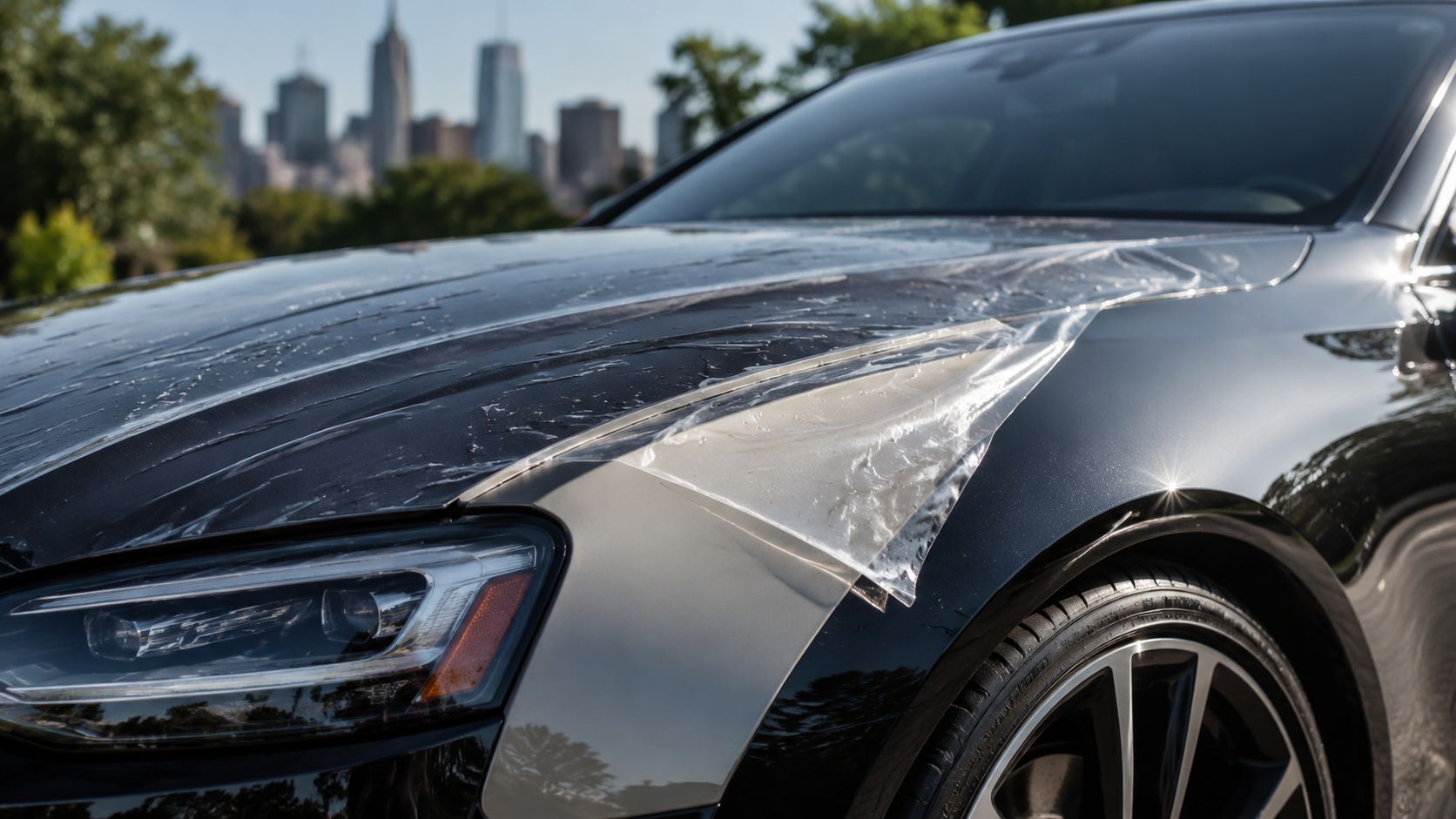
Paint protection film is a transparent, multi-layered urethane film installed over painted surfaces to absorb abuse before the paint does. If you've heard it called clear bra, that's the older term many drivers still use.
The easiest way to think about it is this. PPF is a physical barrier. It's not like a wax, and it's not the same thing as a ceramic coating. Its job is to take the hit first.

How the layers work together
A strong film isn't just judged by one feature. Technical data sheets show that top-tier PPF should be evaluated on more than self-healing alone. Criteria include a resistant top-coat formulation for longevity and installability, plus appearance standards such as film-fitting bubble control and visual invisibility, as outlined in INFLEX's PPF technical data sheet.
In plain language, that means four things matter:
- Top coat performance helps the film resist light marring and maintain a cleaner finish.
- Impact absorption is what gives PPF its value against chips and road rash.
- Adhesive quality affects how securely the film bonds and how well edges stay down.
- Final appearance determines whether the install disappears on the panel or looks like an obvious add-on.
If you want a straightforward explanation of the mechanics, this article on how paint protection film works breaks down the process clearly.
What PPF does better than other paint protection options
PPF and ceramic coating are often mentioned together, but they don't do the same job. A coating helps with wash behavior and surface slickness. PPF adds an actual impact barrier.
Vinyl wrap is different too. Wrap changes the look of the vehicle. PPF is usually chosen to preserve the look that's already there, whether that's gloss paint, satin paint, or factory-fresh clearcoat.
Good PPF should disappear once installed. If you notice silvering, trapped contamination, or obvious edges from across the parking lot, the issue is usually the install, not the concept.
What customers usually get wrong
Many buyers focus only on self-healing because it sounds impressive. In the shop, that's rarely the deciding factor. Clarity, edge finish, adhesive behavior, and how the film settles on complex curves matter more over time.
That's especially true on dark paint. Black, blue, and deep gray vehicles show every flaw. A film can have strong protection on paper and still disappoint if it installs with distortion, visible lines, or poor conformity around tight body lines.
Comparing the Best PPF Film Brands and Types
Shoppers usually want a clean ranking. In practice, the best PPF film depends on the vehicle, finish preference, and who's installing it. Some films are known for clarity. Others are chosen for how they handle complex panels. Some owners care most about gloss. Others want a stealth look on matte paint or a satin conversion.
The comparison below keeps the decision practical.
| Film factor | What to look for | Why it matters on the car |
|---|---|---|
| Thickness range | Most automotive PPF falls between 6 and 12 mil, with 8 to 8.5 mil often viewed as the best all-around balance according to this PPF thickness guide | Too thin can reduce impact confidence. Too thick can become less forgiving during install on tight curves |
| Optical finish | High clarity, low distortion, clean gloss or satin options | This determines whether the film disappears or changes the look |
| Self-healing behavior | Light surface marring should relax with heat exposure | Helps the film keep a fresher appearance between washes |
| Installer compatibility | Stable adhesive, predictable stretch, clean edge work | A film that fights the installer often shows it later at seams and edges |

LLumar and XPEL in real buying decisions
LLumar and XPEL are two names buyers in North Atlanta ask about constantly. Both can produce excellent results when the installer knows the film well. That's the important part. A clean install in a film the shop thoroughly understands is usually better than a poor install in a brand with stronger marketing.
A helpful side-by-side on LLumar vs XPEL can narrow down the starting point, but don't stop at the label on the box.
Here's how I'd frame the decision from a practical standpoint:
When clarity is the priority
If the vehicle is a garage-kept weekend car, a luxury sedan, or a dark-colored daily where appearance is everything, clarity and finish quality matter most. You want a film that stays visually quiet on the paint and doesn't add haze or texture.
That's where premium films separate themselves. The goal is simple. From a few feet away, no one should be able to tell the panel is wrapped.
When impact resistance matters more
If the car lives on 575, 75, or GA-400, or if it's a truck, SUV, or performance car that sees regular highway use, I care more about a balanced thickness and a stable install than about marketing terms.
Practical rule: Mid-thickness films are often the smartest choice. They give strong protection without making installation on mirrors, bumpers, and compound curves harder than it needs to be.
That's one reason the 8 to 8.5 mil range gets so much respect. It sits in the middle where impact protection, flexibility, and optical clarity work well together.
A premium benchmark worth knowing is 3M Paint Protection Film Pro Series, specified as 0.203 mm (203 μm) ultra-transparent self-healing polyurethane in 3M's product brochure. I don't cite that as a universal winner. I cite it because it gives shoppers a real construction reference point for what a high-end film can look like on paper.
Brand matters less than use case
Don't buy by logo alone. Buy by fit.
- Daily commuter: Prioritize balanced thickness, clean gloss, and a film your installer uses regularly.
- Show car or dark paint vehicle: Put more weight on optical finish and invisible edges.
- Matte or satin finish owner: Choose a film designed to preserve or create that look cleanly.
- Highway-heavy truck or SUV: Focus on impact zones and coverage before chasing niche features.
A quick visual overview can help if you're narrowing brand choices first.
What doesn't work
Blindly choosing the thickest film usually isn't the answer. Neither is buying the cheapest option online and expecting a premium result from a difficult install. If the film doesn't conform well, if the edges don't stay tucked, or if the finish has visible contamination, the ownership experience goes downhill fast.
That's why I don't treat “best PPF film” as a one-line answer. The right film is the one that protects well, looks right on your paint, and can be installed cleanly by the shop doing the work.
Choosing Your PPF Coverage for North Atlanta Driving
Coverage is where most owners either spend wisely or miss the mark. They compare brands for weeks, then pick the wrong package for how they use the car.
For Woodstock, Kennesaw, and Canton drivers, this choice should start with road exposure. Neutral guidance points out that highway drivers benefit most from full-front protection due to high-speed debris, while partial kits protect only the most impact-prone areas, and the right package depends on how and where the vehicle is driven, as noted in this coverage-focused discussion.

Partial front works for limited exposure
A partial front package usually makes sense for drivers who stay close to home, avoid long interstate commutes, and want basic protection on the most exposed leading edges.
This can work on a second car, a local errand vehicle, or a garage-kept fun car that doesn't spend much time behind trucks and fast traffic. It's a budget-conscious entry point, but it also leaves visible transition lines and unprotected paint beyond the covered sections.
That last part matters. On some vehicles, partial coverage solves enough. On others, it can feel like stopping halfway.
Full front is the sweet spot for many North Atlanta drivers
For drivers regularly commuting between Canton, Woodstock, Kennesaw, and the wider North Metro area, full front is the package I'd call the practical standard.
It protects the surfaces that take the worst abuse:
- Front bumper: The first place road debris shows up
- Full hood: Better than a partial strip because there's no visible cut line across the panel
- Full fenders: Important for tire-thrown debris and shoulder spray
- Mirror caps: Small area, high impact exposure
- Headlights: Worth protecting because they take direct hits and are expensive to replace
If your commute includes highway speed most days, full front usually gives the best balance between protection and cost discipline.
If you drive enough to worry about chips, you probably drive enough to justify full-front coverage.
Full vehicle is for owners protecting every painted panel
Full-body PPF isn't only for exotics. It also makes sense for black vehicles, luxury daily drivers, EVs with broad flat panels, and owners who are serious about long-term appearance.
This choice is strongest when one of these is true:
- You plan to keep the vehicle for years and want every panel protected from regular use.
- The paint is difficult or expensive to match, which makes preserving the original finish more important.
- You're particular about wash marring and overall presentation, especially on dark paint.
What doesn't make sense is paying for full-body coverage on a vehicle you won't keep, don't care to maintain, or mainly want to protect only from frontal impact. Matching the package to your driving pattern is smarter than copying what someone else did on a different vehicle.
Finding a PPF Expert in Woodstock Kennesaw and Canton
Your car gets picked up on Friday, looks great under shop lights, and by the second wash you notice a corner lifting on the bumper or dirt trapped along an edge near the hood. That usually is not a film problem. It is an installation problem.
Around North Atlanta, the best PPF film is only half the decision. The shop matters just as much because film has to be stretched correctly, aligned cleanly, and finished with restraint. A careless install can make a premium film look average fast. A disciplined installer can make a good film package hold up and look right for years.

What good installation actually looks like
Shoppers in Woodstock, Kennesaw, and Canton do not need installer buzzwords. They need to know what separates clean work from the kind of job that starts bothering you a month later.
Look for these signs:
- Wrapped edges where the panel allows it: Less exposed edge usually means a cleaner look and fewer places for dirt to collect.
- Pattern work used with judgment: Plotter-cut patterns help, but the installer still has to know where to adjust, where to tuck, and where tension will cause trouble later.
- A clean, well-lit bay: Dust in the air and poor lighting often show up in the finished film.
- Even alignment across body lines and corners: The film should follow the shape of the panel without odd gaps, crooked relief cuts, or stressed corners.
- A real conversation about how the vehicle is used: Good shops ask where you drive, how long you keep cars, and what level of finish bothers you. That tells you more than a menu board ever will.
Problems that show up after pickup
A weak PPF install can look fine on day one. Then the edges start collecting debris. Fingers form near compound curves. A corner on the bumper dries back. Silvering or trapped contamination becomes easier to see once the car is outside and fully cured.
I tell customers to judge a shop by the details it is willing to discuss before the job starts. Ask how they handle edges on your specific vehicle. Ask what gets removed and what stays in place. Ask what happens if a panel does not lay down correctly the first time. Shops that do high-level work answer those questions directly.
The best PPF film installed poorly will bother you every time you wash the car.
Why local matters in Woodstock Kennesaw and Canton
Local reputation is not just marketing. It is accountability.
A shop serving Woodstock, Kennesaw, and Canton has to live with its work in the same community where the car is driven, parked, and noticed. That matters if you need an edge checked after cure, want to add rocker coverage later, or want to see real examples on vehicles that deal with the same Georgia roads and pollen. Photos online hide a lot. Clean edge work, proper finish quality, and honest package recommendations are easier to judge in person.
The best choice in North Atlanta usually is not the shop with the loudest brand claims. It is the installer with consistent finished work, repeat customers, and enough discipline to avoid rushing a car through the bay.
Your PPF Questions Answered Cost Maintenance and More
A customer picks up a new SUV in Woodstock, drives 575 for a week, and starts looking at PPF after the first sand marks and bug hits show up on the front bumper. The next questions are always the same. What should I buy, how much should I cover, and how much of the result depends on the film versus the shop putting it on?
In North Atlanta, that last question matters more than the brand debate. Good film gives you the material. A good local installer gives you the result.
Is the best PPF film always the most expensive one
No.
The better choice is the film and installer combination that fits the vehicle, the paint condition, the owner's expectations, and how the car is used. Higher-end films usually bring better clarity, cleaner topcoat behavior, and more forgiving finish quality on dark paint. That matters on black hoods, piano-black trim, and curved bumper sections where flaws show fast.
But I would still take a film an installer knows inside and out over a premium brand they only install occasionally. Familiarity affects edge work, stretch control, relief cuts, and how clean the finished car looks a month later.
Should you get PPF, ceramic coating, or both
They solve different problems.
PPF is the layer that takes the abuse from rock chips, road rash, and light physical impact. Ceramic coating helps with washability, water behavior, and keeping the surface from looking dirty as quickly. If the main concern is highway damage between Kennesaw and Canton, start with PPF. Add coating if you want easier upkeep and a slicker finish.
A lot of owners do both, especially on new vehicles they plan to keep.
How do you maintain PPF properly
PPF is not difficult to live with, but it does need basic care. Neglect usually shows up first at the edges and on the horizontal panels.
A simple routine works:
- Wash with clean tools: Use a proper wash mitt, quality soap, and rinse grit off before touching the film.
- Dry with clean towels or air: Dragging a dirty towel across film can dull the finish and grind in contamination.
- Remove bug residue and bird droppings early: Letting acidic contamination bake on the surface makes cleanup harder.
- Watch the edges: If an edge starts lifting or collecting debris, have the shop inspect it before it gets worse.
- Use film-safe toppers if you want extra slickness: Helpful, but not required for the film to do its job.
Most maintenance problems I see are not product failures. They come from bad wash habits, automatic brushes, or waiting too long to address a dirty edge.
Is thicker always better
No, and that point gets oversimplified.
Thicker film can add impact resistance, but thickness by itself does not guarantee a better-looking install or a better ownership experience. The film still needs to conform around complex shapes, stay optically clear, and finish without heavy texture. On some cars, a balanced film with good clarity and predictable install behavior gives a better result than chasing the thickest spec sheet.
That trade-off is real on modern bumpers with deep recesses and tight curves.
What package should most daily drivers choose
For a North Atlanta daily, full front is usually the smart middle ground. Hood, fenders, bumper, mirrors, and headlights cover the areas that take the abuse on 75, 575, and local construction-heavy roads. It also avoids the line across a partial hood, which bothers a lot of owners once they see it in person.
Partial front still works for some vehicles, especially lower-mileage cars that rarely see highway speeds.
Full-body coverage makes sense for higher-end vehicles, dark paint, soft paint systems, or owners who are serious about keeping every painted panel in top condition. It costs more up front, but it changes how freely you can drive and wash the car.
Can PPF still look good years later
Yes, if the film is good, the install is clean, and the owner keeps up with basic care.
Long-term results usually come down to three things:
- The film matches the job
- The installer pays attention to edges, alignment, and contamination control
- The owner washes it properly and addresses small issues early
That is why the best ppf film is not just a box with a brand name on it. Around Woodstock, Kennesaw, and Canton, it is a service decision. The local shop you choose affects the pattern fit, the finish quality, the follow-up support, and whether the car still looks right after the film has fully cured.
If you want help choosing the right PPF package for your vehicle in Woodstock, Kennesaw, or Canton, The Tint Guy is a strong local place to start. Whether you're comparing full-front coverage, weighing LLumar against XPEL, or trying to protect a new daily driver before the first chips show up, a conversation with an experienced local installer can save you from choosing the wrong film, the wrong package, or the wrong shop.