You're probably doing the same familiar thing when a room starts baking in the afternoon sun. You open Walmart, search for home window tint, see a roll that looks affordable, and wonder if this is a quick fix for heat, glare, and privacy without paying for a full installation.
That search makes sense. Walmart carries a huge assortment, and the prices are low enough that trying a roll feels low-risk. But low-risk at checkout isn't the same as low-risk on the glass. The main question isn't just what the film costs today. It's whether the product you buy matches what you expect it to do after a hot Georgia summer, after repeated cleaning, and after you notice every trapped speck, crease, or edge lift.
The DIY Dilemma Walmart Tint vs Professional Installation
A lot of homeowners land on Walmart because they want a fast answer to a real problem. One room gets hammered by afternoon sun. A bathroom window needs privacy. A front door sidelight feels too exposed. The listing says privacy, UV protection, glare reduction, maybe even energy savings, and the price looks easy to justify.

That appeal is easy to understand when Walmart lists more than 1,000 home window tint products, with some priced as low as $8.98, while industry summaries tied to the same source frame quality tint as something evaluated over an ROI window of 6 months to 3 years in the professional market, as noted in these window tinting market and product statistics. Those are two completely different buying mindsets. One is bargain retail. The other is long-term performance.
Before you put anything on glass, it helps to start with clean windows and realistic expectations. If you're still deciding whether to tint or focus on reducing buildup and haze first, this homeowner's guide to window cleaning is worth a look because dirt, residue, and hard-water spotting can make any film job look worse than it is.
For shoppers comparing retail options to more permanent solutions, it also helps to see how store-bought film stacks up against pro-installed material. This breakdown of privacy window tint alternatives is useful because the trade-off usually isn't privacy alone. It's privacy, finish quality, heat control, and how long you want the result to last.
Practical rule: If your goal is “cheap and temporary,” Walmart film can fit. If your goal is “clean-looking and long-lasting,” you're shopping in a different category.
Decoding the Film What You Get from Walmart vs a Pro
A roll bought off a retail shelf and a film installed by a tint shop may both say "window tint," but they are not built for the same job. Homeowners usually see that difference after installation, when a film that looked fine in the box starts showing dust, fingers, silvering, or weak edges on the glass.
What Walmart film usually is
Retail home film is commonly made for accessibility first. That usually means static-cling or other removable formats aimed at renters, short-term privacy needs, or small DIY projects. There is nothing wrong with that if the goal is simple and temporary. The problem starts when shoppers expect a removable film to perform like a bonded, professionally selected product.
In practice, the usual traits are:
- Easy removal: Better for temporary use, but less committed to the glass over the long haul
- Privacy-first design: Often centered on frosting, mirror finish, or basic light filtering
- Higher sensitivity during install: Dust, poor prep, and uneven pressure show up quickly
- Less forgiveness on large panes: Bigger windows make flaws easier to see
I see this often with budget-conscious buyers. They are not making a bad decision. They are buying for a lower upfront cost and accepting more risk on finish quality, edge hold, and lifespan. If you're comparing that trade-off against a longer-term project budget, this breakdown of residential window film cost factors gives a more realistic picture of what changes the price.
What professional film is built to do
Professional film is chosen and installed as a system. The film, the adhesive, the glass condition, and the install method all have to work together. That matters more than many product listings let on.
A pro-grade film is usually designed for stable adhesion, cleaner optics, and more predictable performance over time. It is also matched to the actual goal of the room or vehicle. Some clients need daytime privacy. Others need glare reduction, heat control, fade protection, or a cleaner exterior look without the harsh mirrored appearance that many retail products lean on.
The automotive side makes the quality gap easier to spot. A shop that regularly tints vehicles in places like Roswell, Alpharetta, Johns Creek, and Cumming works with curved glass, tight edges, dot matrix borders, and strict visual standards every day. If a film or installer cannot hold up there, it usually will not impress on a large living room window either. That crossover matters. Strong automotive tinting habits often reflect the same discipline needed for clean residential film work.
Why the material difference shows up on the glass
Film performance is not just about shade or privacy. It shows up in the details you notice every afternoon when the sun hits the window.
Pro-grade material generally gives better results in a few specific areas:
- Edge stability
- Optical clarity
- Resistance to bubbling and distortion
- More uniform appearance across wider panes
- Better alignment between the film type and the job
Those are real trade-offs, not sales language.
A Walmart film can be the right call for a bathroom sidelight, a garage window, or a quick privacy fix where perfection is not the priority. A professionally installed film makes more sense for high-visibility glass, sun-facing rooms, and any project where you want the result to stay clean-looking instead of becoming another weekend redo.
That is the main distinction. Retail film usually solves a short-term problem. Professional film is selected to hold up, look cleaner, and perform closer to what the customer expected in the first place.
Performance Cost and Longevity A Head-to-Head Comparison
Price is what gets homeowners to try Walmart film. Longevity is usually what makes them reconsider after a summer or two.
A low-cost roll can solve a common problem fast. If the goal is short-term privacy on a small window, that may be enough. But on larger glass, sun-heavy rooms, and windows you look through every day, the key comparison is not shelf price. It is how the film looks after installation, how it performs in afternoon heat, and whether you are replacing it sooner than expected.
| Feature | DIY Home Tint (from Walmart) | Professional Tint (The Tint Guy) |
|---|---|---|
| Upfront purchase | Lower initial cost, broad retail selection | Higher initial investment |
| Primary use case | Temporary privacy, basic glare reduction, small DIY projects | Long-term performance, cleaner finish, better consistency |
| Film type | Often static-cling or removable film | Professionally installed bonded film |
| Longevity | Often shorter service life | Built for multi-year service |
| Finish quality | Depends heavily on prep and installer skill | More controlled application and edge finishing |
| Large windows | Harder to install cleanly | Better suited to bigger or more visible panes |
| Heat-control expectations | Varies widely by listing | More predictable when matched to the application |
For budgeting, this breakdown of residential window film cost factors gives a clearer picture of why the cheapest roll and the best long-term value are usually two different things.
Durability and service life
Service life is where bargain film often loses its price advantage. Earlier Walmart guidance on home window tint points out that film lifespan varies widely by product grade and care. In practice, that matches what installers see all the time. Budget film can look acceptable at first, then start showing edge lift, haze, or adhesive issues once it has been through enough heat cycles.
That matters more in Georgia than people expect. A pane that bakes all afternoon in Alpharetta or Roswell will expose weak film faster than a shaded bathroom window ever will. The same standard applies in automotive work. If a film cannot stay stable on a vehicle parked in North Atlanta heat, I would not trust that product on a sun-facing room either.
Installation quality changes the math
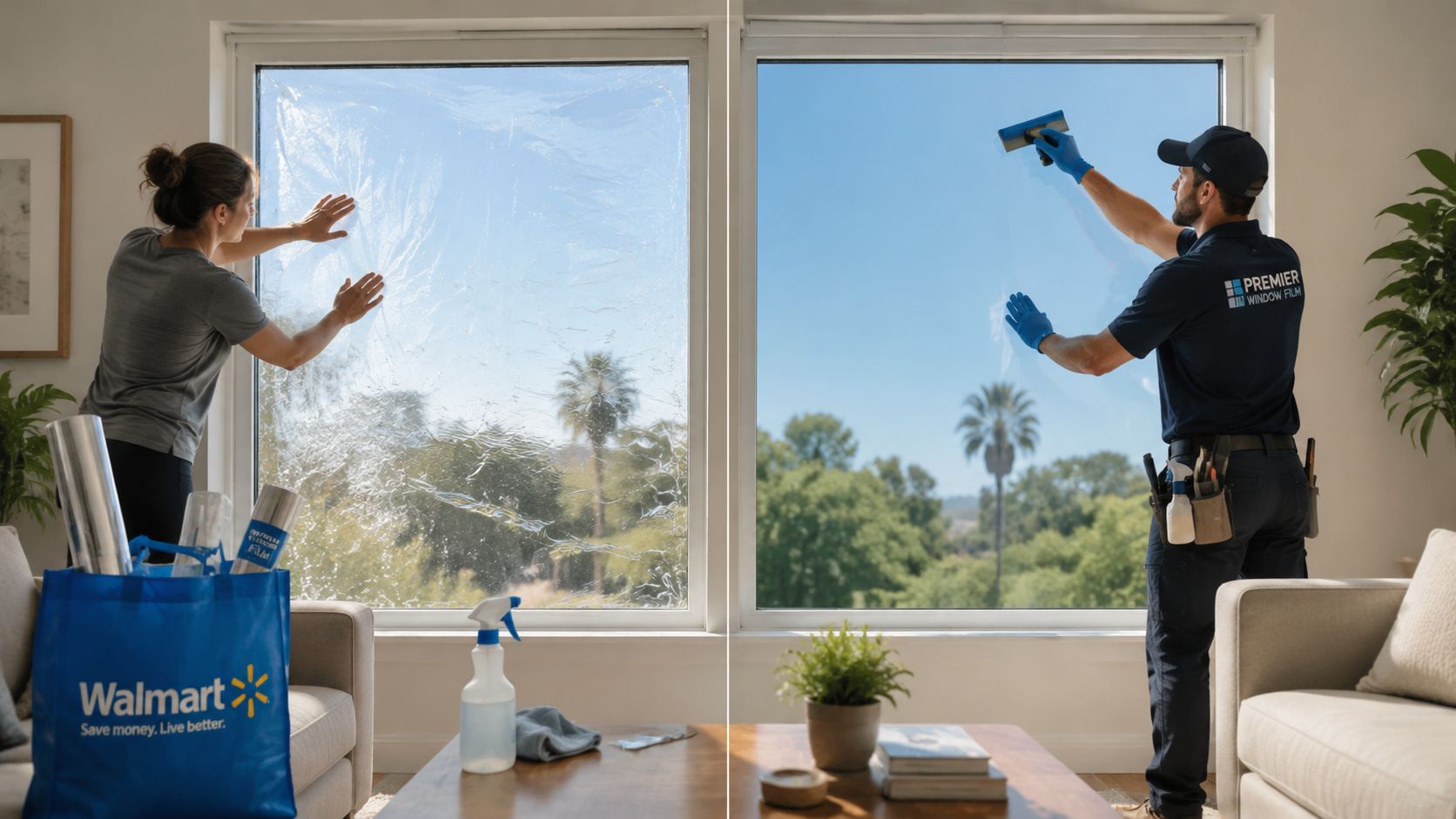
Homeowners usually count the roll, the tool kit, and maybe a spray bottle. They do not always count the wasted film from bad cuts, the second attempt after contamination gets trapped underneath, or the time spent peeling off a piece that never laid down right.
Large residential glass is unforgiving.
Three problems show up repeatedly on DIY jobs:
- Contamination: Dust, lint, and pet hair get sealed under the film.
- Distortion: Creases, fingers, and pressure marks become obvious in direct sunlight.
- Edge failure: Corners and borders start lifting first, especially on poorly trimmed pieces.
A professional install reduces those risks because the material, surface prep, and application method are chosen together. That discipline is not limited to homes. Shops that tint vehicles cleanly in Johns Creek, Cumming, and the rest of North Atlanta are already working to a tighter visual standard on curved glass, narrow edges, and highly visible surfaces. That same precision carries over to residential film.
Better film on poor prep still looks poor. Lower-grade film on perfect prep still has limits.
Heat and glare performance
Homeowners frequently become disappointed. A film may add privacy and darken the glass, but that does not guarantee strong solar control. Many retail products blur those uses together, so a buyer ends up choosing based on appearance and then judging the result based on room comfort.
Those are two separate jobs.
Professional film selection is usually more accurate because the installer matches the product to the problem. If the room is overheating, the film should be chosen for solar performance. If the issue is visibility from the street, privacy may be the priority. Automotive tinting works the same way. Good shops do not put one film on every car. They match the film to heat rejection, shade preference, legal limits, and glass type. That same product discipline matters on residential windows.
Total cost over time
DIY film makes financial sense in a narrow set of cases. It works best when the window is small, the goal is temporary, and the finish does not need to be perfect.
Professional installation makes more sense when the glass is prominent, the room gets hard sun, or you want the result to last without turning into a redo project.
The cheapest option up front can still cost more once removal, replacement, and frustration are added in. That is the genuine head-to-head result.
When to DIY and When to Call The Tint Guy
Some jobs are perfectly reasonable to do yourself. Others turn into the kind of project that costs more in time, frustration, and replacement film than people expect.

The DIY route makes sense if
A removable film is a practical choice in a few situations.
- You need short-term privacy: Bathroom glass, a garage door window, or a temporary office setup.
- You're working with small, flat panes: These are more forgiving than big feature windows.
- You already know the result is temporary: You're testing appearance, not expecting a long-term upgrade.
That lines up with one of the most important homeowner concerns in the verified data. People want to know whether the film will peel, bubble, or leave residue after a season of heat, and the broad takeaway is that static-cling products are removable but less durable, while professional films are intended for long-term adhesion without damage, as noted in Walmart's home window tint guidance page.
Call a pro when the glass matters
The threshold for bringing in a professional is lower than many people think.
- Your main living area gets cooked by the sun.
- The window is large enough that a bad install will be obvious.
- You care about clean sightlines and tidy edges.
- You don't want to redo it after one rough season.
A lot of homeowners also start with home film and then realize their bigger priority is vehicle comfort. That's where professional automotive tinting makes much more sense than experimenting with retail film.
Here's a quick visual example tied to that decision process:
If the window is important enough that you'll notice flaws every day, it's important enough to avoid a bargain-film gamble.
The Professional Automotive Tinting Advantage in North Atlanta
A lot of homeowners start with a Walmart film search for the house, then look at the car in the driveway and wonder if the same budget-minded approach can work there too. On a vehicle, the margin for error is much smaller, and the mistakes stay in your line of sight every day.

Automotive glass has curves, tighter tolerances, defroster lines, and trim that punishes sloppy cuts. House glass is usually more forgiving. Car glass is not. A film that looks acceptable on a small flat window at home can fail fast on a rear windshield once heat, vibration, and daily use get involved.
Why automotive film isn't a DIY retail job
Drivers in Woodstock, Georgia, Kennesaw, Georgia, and Canton, Georgia usually choose professional tint for reasons that have nothing to do with vanity.
- Curved glass has to be heat-formed correctly
- Edge gaps and contamination show immediately
- Day and night visibility both matter
- Georgia tint law has to be handled correctly
Some retail listings claim the film works for both automotive and home use. That label does not make it a true automotive product. On a car, film has to shrink cleanly, hold up against cabin heat, sit properly around seals, and maintain clear sightlines. Those are the areas where bargain film and inexperienced installation show their limits.
Why local professional work matters
In North Metro Atlanta, a good automotive tint job is a workmanship test as much as a product choice. The installer has to match the film to the vehicle, the driver's priorities, and the legal limits, then finish it with clean edges and clear glass. If you also care about heat control, it helps to understand how solar heat gain coefficient affects window film performance before choosing by shade alone.
That crossover matters for this article's main question. Someone searching for Walmart home tint is usually trying to solve glare, privacy, or heat on a budget. Those are valid goals. But once the project shifts from a spare room window to a daily driver, the better comparison is not Walmart film versus another roll off the shelf. It is DIY experimentation versus a professional install that has to perform every day in Georgia heat.
For drivers searching for car window tint in Woodstock, Kennesaw, or Canton, The Tint Guy is one local option focused on professional vehicle tinting instead of retail home-film shortcuts.
Automotive tint shows installer skill immediately. Poor shrinking, uneven cuts, and bad edge work are hard to miss and expensive to redo.
Beyond Aesthetics The Legal and Energy Benefits of Pro Film
A lot of Walmart film listings lean hard on bold benefit claims. That's part of why shoppers get confused. The listing may promise privacy, UV blocking, glare control, and lower bills all at once, even when the product is mainly a simple static-cling film.
One verified issue is that seller-provided Walmart listings often advertise up to 99% UV blocking and energy bill reductions up to 30%, but those figures often aren't backed by standardized third-party testing in the listing itself, which is exactly the concern raised by this Walmart one-way static film listing example.
What that means for homeowners
That doesn't mean every retail claim is false. It means you should separate seller marketing from verifiable product performance.
A few practical realities matter more than listing language:
- Night privacy changes: Mirror-style films often lose the one-way effect after dark.
- Visible light matters: Too much darkening can make a room feel closed in.
- Heat control and privacy are not the same thing: Some films do one better than the other.
For homeowners comparing options, this explanation of solar heat gain coefficient and how film affects heat transfer is useful because it gets closer to the comfort question than broad marketplace claims do.
Why professional film earns its keep
Professional film gives you a better chance of matching the product to the problem. If the issue is furniture fade, the solution may be different than if the issue is afternoon heat on a west-facing room. If the issue is vehicle comfort, legal visibility and proper installation become part of the decision too.
That's the value beyond looks. You're not just paying for darker glass. You're paying to avoid guessing.
Your Window Tinting Questions Answered
Can I use Walmart home window tint on my car
You can physically stick almost anything to glass. That doesn't make it a good automotive product. Home films and automotive films are built for different conditions, and car glass demands better fit, better heat handling, and cleaner edge work.
Will DIY film turn yellow or cloudy
It can. Comparative tests cited in the verified data indicate that static-cling DIY films can degrade, lose clarity, or yellow within 2 to 3 years in high-UV environments, while professional ceramic tints with scratch-resistant coatings can maintain optical clarity for over 10 years, according to this comparative tint performance example.
Will DIY home film damage my windows
Removable film is generally chosen because it's easier to take off, but the main risk is less about catastrophic damage and more about residue, uneven removal, edge lifting, and a finish that never looked right in the first place. The larger and more visible the glass, the less forgiving the result.
What should drivers in Woodstock, Kennesaw, and Canton do instead
For vehicles, skip the home-film experiment. Automotive tint should be selected and installed as automotive tint, especially if you care about visibility, finish quality, and staying within Georgia law. If your search started with Home Window Tint Walmart and ended with “I mostly need my car cooler,” that's a useful answer by itself.
If your main concern is vehicle heat, glare, UV exposure, or privacy, a retail home-film roll probably isn't the right tool. The Tint Guy focuses on professional automotive tinting for drivers in Woodstock, Kennesaw, Canton, and nearby North Metro Atlanta areas, with service built around proper film selection and clean installation rather than DIY compromise.