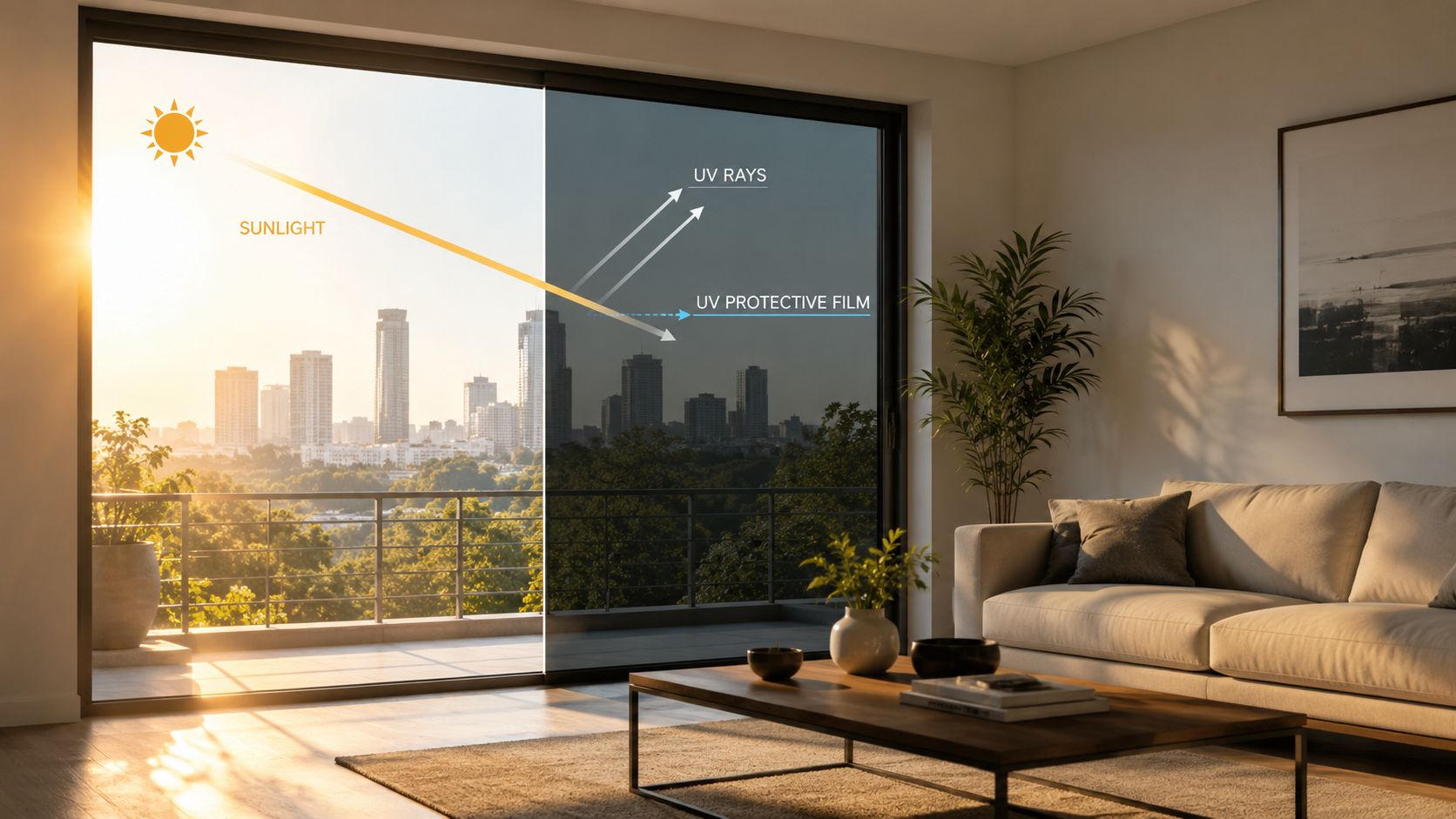
Sun coming through the living room can feel great at 8 a.m. By midafternoon, it's a different story. The hardwood near the patio door looks a little lighter than the rest of the floor. The sofa arm on the window side is aging faster. One seat in the house is always hotter than the others, and glare on the TV forces everyone to close the blinds.
That's usually when homeowners start looking at home window UV film. Not because they want darker glass, but because they want control. They want to keep the daylight, cut the punishment, and protect what's already inside the home.
The good news is that modern window film is no longer something you judge by color alone. Good products are specified by measurable performance, and the right film can turn problem windows into usable space again. The trick is knowing what matters, where the tradeoffs are, and when a lighter, clearer film is smarter than the darkest option on the sample board.
Protect Your Home from Sun Damage and Heat
Most homeowners don't start with the phrase home window UV film. They start with a problem. A room gets too bright in the afternoon. A west-facing window turns into a heat source. Furniture near the glass starts showing uneven wear. Those are practical warning signs that the window is doing very little to manage solar load and UV exposure.
A quality film gives you a retrofit solution. You don't have to replace the glass to improve comfort, reduce glare, and add protection. That matters if your windows are structurally fine and you merely need better performance from them.
If you're also weighing broader efficiency upgrades, this guide to energy-saving windows gives useful context on how glazing, insulation, and solar control work together. Window film fits into that larger picture when replacement isn't the first move.
What homeowners usually notice first
The first benefit people feel is comfort. The second is visual. Rooms become easier to use during the brightest hours of the day, and the constant need to close blinds often drops.
A lot of homeowners also look at film from a health angle. If that's part of your concern, this overview on reducing skin cancer risks with window films is worth reading alongside the comfort and furnishing-protection side of the decision.
Practical rule: If you love the room but avoid sitting near the window, the glass is part of the problem.
What works and what doesn't
What works is matching the film to the room. Sun-heavy rooms need heat control. Media rooms need glare reduction. Street-facing rooms may need a privacy-minded solution. Plant rooms often need a lighter hand.
What doesn't work is buying based on darkness alone. A darker look doesn't automatically mean better performance. In real homes, the right answer is usually the film that solves the specific complaint without creating a new one, like making the room too dim or changing the exterior look more than you wanted.
What Exactly Is Home Window UV Film
Home window UV film is a thin laminate applied directly to existing glass. The easiest way to think about it is high-tech sunglasses for your windows, except modern film can be nearly clear, lightly tinted, or more aggressively solar-control oriented depending on the job.
It isn't just there to darken the pane. The film is built to manage parts of the solar spectrum and improve how the glass performs in everyday use. Some films focus on UV protection with minimal appearance change. Others combine UV control with glare reduction, heat rejection, or daytime privacy.

How it functions on real windows
Professional-grade residential film is usually selected as part of a glass-specific recommendation. The installer considers the orientation of the window, how much sun it gets, what the room is used for, and what outcome matters most to you.
Some homeowners need the least visible option possible. Others want stronger visual shading and don't mind a darker look. Both approaches can be valid. The mistake is assuming all films behave the same because they come in rolls and stick to glass.
According to Madico's residential terminology guide, most residential window films reject 95% to 99% of UV rays, with some blocking up to 99.9%, and professionally installed solar-control films often last 15 to 20 years. That's why film should be viewed as a long-term building upgrade, not a temporary patch.
Why homeowners underestimate it
People often compare film to blinds or curtains. That's understandable, but they solve different problems. Blinds block light after it enters the window area and usually take away the view. Film works on the glass itself. It helps the window behave better before the room absorbs the full impact of the sun.
Good home window UV film doesn't make a room feel shut down. It makes the room easier to live in.
That distinction matters in spaces where you still want daylight, outdoor visibility, and a cleaner look than heavy coverings provide.
Key Benefits Beyond Just UV Protection
The biggest buying mistake I see is treating window film like a one-benefit product. UV protection is important, but homeowners usually end up happiest when the film solves several problems at once. Better comfort, less glare, more usable daylight, and improved daytime privacy often matter just as much as protecting floors and furniture.

Heat control changes how rooms feel
A room with harsh sun exposure doesn't just look bright. It stores heat unevenly. That's why one corner feels comfortable and the seat near the glass doesn't.
Modern film is commonly evaluated with metrics like TSER, SHGC, and VLT rather than tint shade alone. The same industry guidance says a proper specification should include UV rejection, Total Solar Energy Rejected, Solar Heat Gain Coefficient, and Visible Light Transmission, with VLT ranging from 0% to 100%. For residential solar-control films, typical VLT values are 5% to 50%. A film with 35% VLT passes 35% of visible light and blocks 65%. An SHGC below 0.40 is considered good heat control, below 0.30 is excellent, and below 0.25 is high-performance for hot climates. A TSER of 50% or higher is a reasonable baseline, above 65% is high performance, and above 75% is exceptional, as outlined in this window film specification guide.
That matters because “looks dark” is not a performance metric. Numbers let you compare products that may appear similar but behave very differently.
The benefits homeowners notice every day
- Less screen glare: TVs, laptops, and phones are easier to use in bright rooms.
- More stable comfort: The room feels less punishing during peak sun hours.
- Interior preservation: Floors, fabrics, and finishes get a stronger layer of protection.
- Daytime privacy: Many films make it harder for passersby to see in during daylight.
- A cleaner look: You may use blinds and drapes less often during the day.
If utility costs are part of the conversation, these practical steps to cut utility costs are useful alongside film selection, because solar control works best when it's part of a bigger efficiency mindset.
Here's a quick visual overview of why homeowners consider film for comfort and energy control:
Privacy has a catch
Privacy film can help a lot in daylight, but homeowners need a realistic expectation. If interior lights are on at night, privacy changes. In many homes, blinds or shades still matter after dark.
That's not a flaw. It's just how glass and lighting behave. The right installer should explain that upfront instead of selling privacy as universal in every condition.
Comparing the Main Types of Window Film
Not all film technology is built the same. Homeowners usually hear broad labels like dyed, metalized, carbon, and ceramic. Those labels matter because they affect appearance, glare control, durability, and how the glass behaves over time.
Dyed and metalized films
Dyed film is usually the entry-level option. It can soften glare and add a shaded look, but it's typically chosen more for appearance and basic comfort than top-tier performance. In lower-end products, long-term color stability can be a concern.
Metalized film uses metallic layers to reflect solar energy. It often provides a stronger reflective appearance from the outside, and some homeowners like that look for very sunny exposures. Others don't. Reflectivity can be a benefit on harsh windows and a drawback if you want a more neutral finish.
One issue with metalized products is practical rather than visual. In some applications, homeowners prefer to avoid metallic construction because they don't want the look to feel too mirrored or technical.
Carbon and ceramic films
Carbon film is often chosen by people who want a richer appearance without a shiny exterior. It usually gives a more subdued, non-reflective finish than traditional metalized products.
Nano-ceramic or ceramic film sits in the premium conversation for a reason. It's typically favored when homeowners want strong solar performance with a cleaner, less mirrored look. In both residential and automotive work, ceramic-based film is often the product family people ask for when they care about heat control and appearance equally.
If you want a more technical look at premium film behavior on the automotive side, this comparison of 3M Crystalline vs 3M Ceramic IR helps show how advanced film categories differ when performance matters more than just darkness.
Window Film Type Comparison
| Film Type | Primary Benefit | Heat Rejection | Appearance | Price |
|---|---|---|---|---|
| Dyed | Basic glare control and shaded look | Modest in many applications | Darker, traditional tint look | Lower |
| Metalized | Reflective solar control | Strong in many sun-heavy settings | Reflective or mirrored appearance | Moderate |
| Carbon | Non-reflective comfort upgrade | Better balanced than entry-level films | Neutral, deeper finish | Moderate to upper-mid |
| Nano-ceramic | Premium solar performance with cleaner aesthetics | Commonly chosen for top-tier heat control | Clearer or more neutral, less mirrored | Premium |
Which type fits which homeowner
- Choose dyed if budget leads and the problem is mostly brightness.
- Choose metalized if exterior reflectivity doesn't bother you and sun intensity is severe.
- Choose carbon if you want a cleaner finish without a shiny look.
- Choose ceramic if you want the most advanced feel and you care about both comfort and appearance.
The right film type is the one that solves your window problem without creating a visual problem you'll stare at every day.
How to Choose the Right UV Film for Your Home
Choosing film gets easier when you stop asking, “How dark is it?” and start asking, “What do I need this window to do?” That's the difference between a satisfying install and one that looks fine on day one but annoys you for years.
Start with performance, not color
A proper specification should include UVR, TSER, SHGC, and VLT. Those numbers tell you how the film handles ultraviolet exposure, total solar energy, heat gain, and visible light. They're more useful than showroom impressions because they describe actual performance.
For homeowners, VLT is often the easiest metric to understand. A lower VLT means a darker result. A higher VLT keeps the room brighter. A film can still be effective without looking very dark, which is why nearly clear and spectrally selective products appeal to people who don't want their house to feel tinted.
Match the film to the room's job
Different rooms want different things:
- Living rooms and family rooms: Balance matters. You want glare control and comfort without making the room feel cave-like.
- Home offices: Screen glare often matters more than privacy.
- Sunrooms: Heat control usually becomes the top priority.
- Plant-heavy spaces: Light preservation matters more than aggressive darkening.
- Street-facing windows: Daytime privacy may move up the list.
The houseplant issue gets overlooked. Some homeowners want maximum UV protection for furnishings while still keeping enough natural light for indoor plants and a bright interior feel. Existing guidance points out that options range from nearly clear films to darker solar-control products, and that the comparison between clear UV-focused film, spectrally selective film, and darker film is where better decision-making happens, as discussed in this home window film tradeoff article.
If you love your natural light, don't automatically buy the darkest sample. Ask what the room gains and what it gives up.
Don't underestimate installation quality
DIY film usually looks easier online than it is on glass. Homeowners run into trapped debris, fingers, edge lift, haze, and miscuts. Even when the film itself is decent, the final result can feel amateur every time sunlight hits the pane.
Professional installation gives you cleaner edges, better glass prep, and a recommendation based on the actual window instead of guesswork. If you're shopping locally, indoor window tinting near me is the kind of service query that should lead you to installers who handle residential film as a measured product selection, not a one-size-fits-all roll off the shelf.
Finding Professional Installation in North Metro Atlanta
Professional installation matters more than most homeowners expect. Film has to be cut cleanly, shrink correctly where needed, bonded to properly prepared glass, and installed with enough care that the final result disappears into the window instead of advertising itself with dust, fingers, or rough edges.
For residential work, that level of finish is what separates “this helped” from “I wish we'd done this sooner.”
The natural pivot from home film to vehicle film
The same technology principles that matter in a house matter in a vehicle. UV management, glare reduction, solar control, optical clarity, and film construction all carry over. The difference is that a vehicle adds curved glass, legal considerations, interior heat buildup, and a much smaller cabin where bad film is even easier to feel.
That's why many homeowners who research film for the house end up asking about their cars next. If you've learned what makes a residential film worth paying for, you already understand why cheap automotive tint usually disappoints.
For drivers seeking the best car window tinting in Woodstock, Georgia, or premium automotive ceramic film in Kennesaw, Georgia, our team provides flawless, same-day installations. We are also the trusted tint shop for vehicle owners in Canton, Georgia, who need superior heat rejection and UV protection for their cars and trucks.
What local shoppers usually search for
People rarely search in technical language first. They type:
- window tint near me
- professional tint installer
- car window tint Woodstock
- ceramic tint Kennesaw
- tint shop Canton
Those searches usually come from the same underlying problems. The cabin gets too hot. The glare is tiring. The interior is baking in the lot. The daily commute feels brighter and harsher than it should.
One local option homeowners and drivers may come across is The Tint Guy, which offers automotive tinting for North Metro Atlanta vehicles. In practice, the value is in getting film that's specified and installed correctly for the car, not just sold by shade percentage alone.
Frequently Asked Questions About Window Film
Are there legal or HOA restrictions on home window film
Residential rules are different from automotive tint laws. Some neighborhoods and HOAs care about exterior reflectivity or visible appearance from the street, especially on front-facing windows. Before installing film on a home, check your HOA documents and ask the installer how the chosen product looks from outside in daylight.
How do I clean tinted home windows
Use a soft cloth or soft synthetic applicator with an ammonia-free cleaner. Avoid abrasive pads, harsh scraping, and aggressive chemicals. Good film is durable, but the surface still deserves normal care instead of heavy-handed cleaning.
How long does installation take
The timing depends on the number of windows, access, and how much prep the glass needs. A full-home project takes longer than a small targeted install on problem windows. Vehicle tinting is usually faster, which is one reason drivers looking for same-day comfort upgrades often move quickly once they decide on a film.
Is maximum UV protection always the best choice
Not always. If your main issue is preserving a bright interior, maintaining a natural look, or keeping a plant-friendly room from feeling muted, a lighter or more selective film may be the better answer. The best result is the one that fits the room, not the one with the most aggressive appearance.
Will window film make my home look dark
It can, but it doesn't have to. Some films are nearly clear, while others create a stronger tinted or reflective effect. That's why samples and performance specs matter together. Homeowners should judge both the numbers and the look.
If you've reached the point where sun, glare, or heat is affecting how you use your home or your vehicle, talk to The Tint Guy. A good film recommendation should match the glass, the goal, and the way you live or drive in Woodstock, Kennesaw, and Canton.